
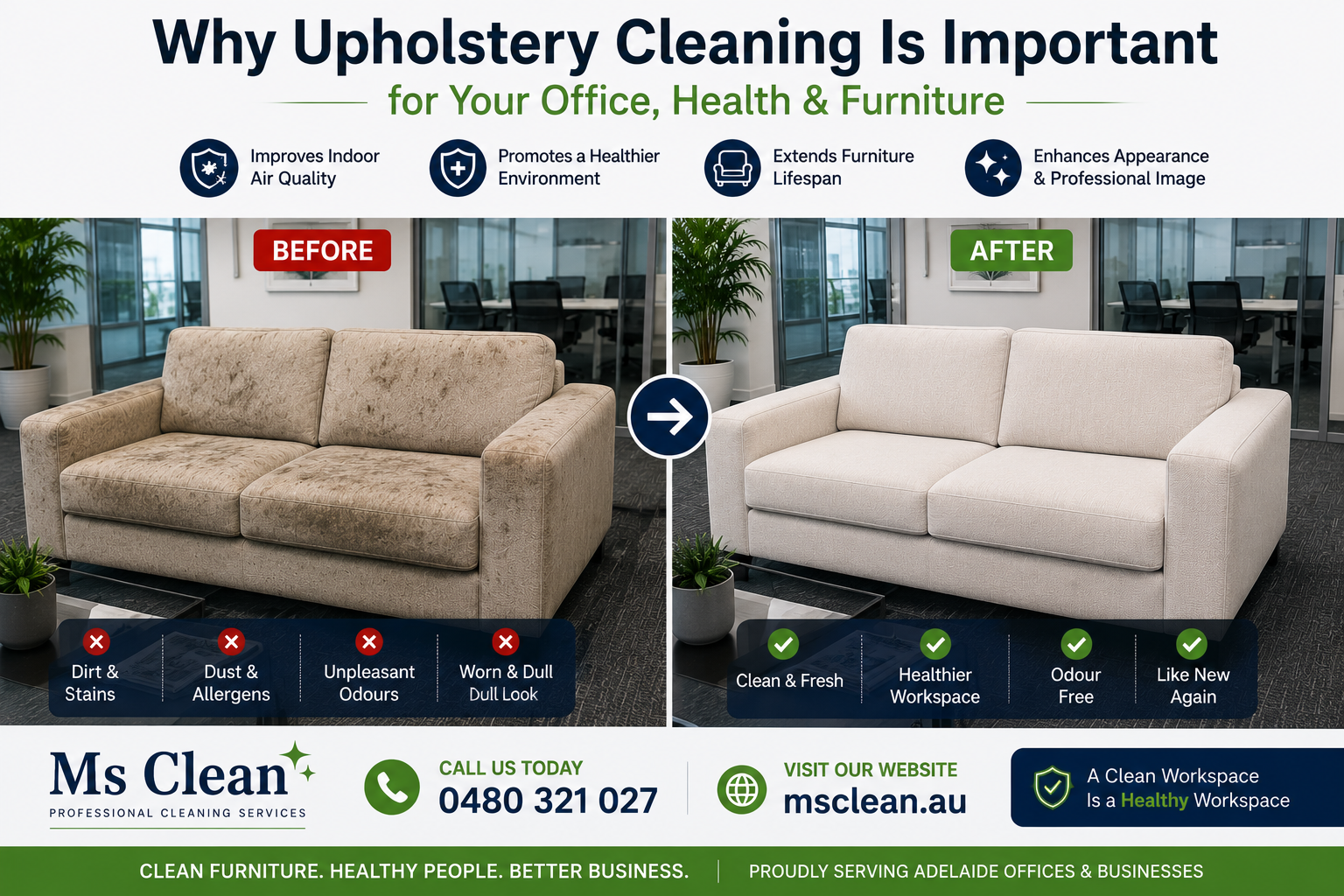
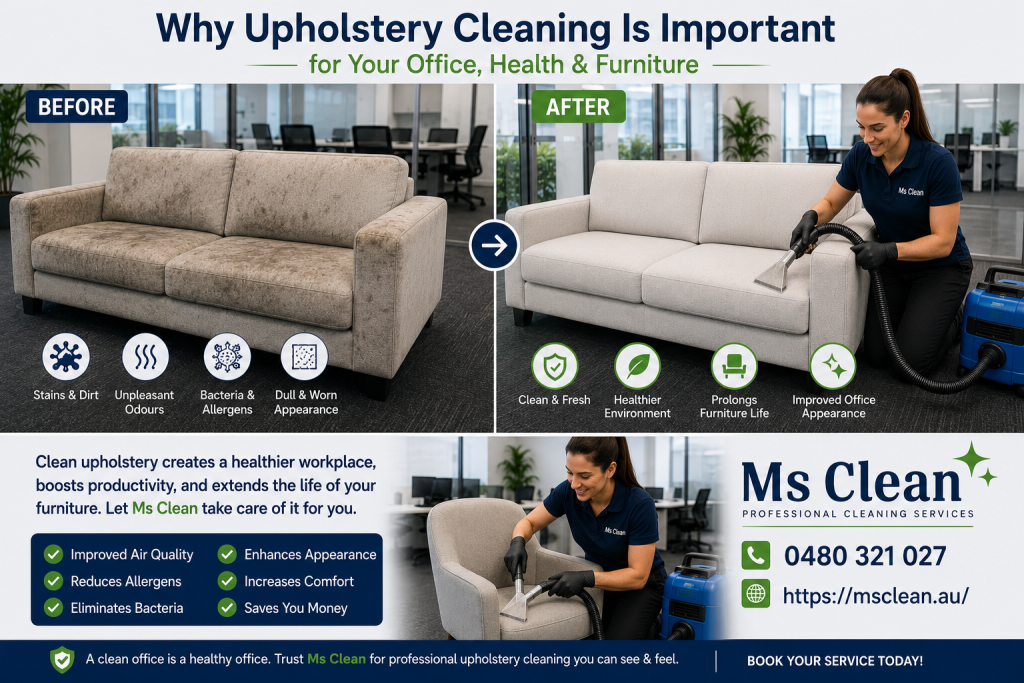
Upholstery cleaning is important because sofas, chairs, and fabric furniture accumulate dust mites, pet dander, bacteria, mould spores, and allergens at up to 100 times the concentration of hard floors. Regular professional cleaning removes these hidden health hazards, extends furniture life by 5 to 10 years, eliminates odours, and improves indoor air quality critical for Adelaide offices with children, pets, or allergy sufferers.
Your sofa gets vacuumed occasionally. Maybe spot-cleaned when something spills. But when was it last properly cleaned deep down, through the fibres, into the foam?
For most Adelaide households, the honest answer is: never. And that’s a problem, because upholstered furniture is one of the most contaminated surfaces in any office or commercial space yet one of the most overlooked.
In this guide, Ms Cleaning Services, Adelaide’s upholstery cleaning specialists, explain exactly why regular upholstery cleaning matters, what’s living in your fabric right now, and how professional treatment makes a measurable difference to your health, air quality, and the lifespan of your furniture.
The Numbers Most Adelaide Office Owners Don’t Know
| Statistic | What It Means for Your office |
|---|---|
| 100x | Sofas can harbour up to 100 times more bacteria per square centimetre than a toilet seat, a commonly cited figure in indoor microbiology research. |
| 10M+ | A typical used sofa can contain over 10 million dust mites. These microscopic arachnids thrive in fabric fibres and are a leading trigger of asthma and allergic rhinitis. |
| 1.5kg | The average human sheds approximately 1.5 kg of skin cells per year. A significant portion settles into upholstery, the primary food source for dust mites. |
| 40% | Indoor allergen exposure triggers asthma attacks in up to 40% of Adelaide’s asthma sufferers, with upholstered furniture identified as a primary reservoir (Asthma Australia). |
| 5–10 yrs | Professional upholstery cleaning every 12–24 months can extend furniture life by 5 to 10 years by preventing fibre breakdown caused by embedded grit and body oils. |
01 Why Upholstery Cleaning Is a Health Issue, Not Just a Hygiene One
Most people clean their upholstery when it looks dirty. But the most serious contaminants in your sofa are invisible, and some of them can affect your health even before you notice anything wrong with the fabric.
Dust Mites: The Hidden Trigger
Dust mites are microscopic arachnids that thrive in warm, humid environments with an abundant food source: human skin cells. Your sofa is their ideal habitat. They are the single most common indoor allergen trigger in Australian offices, responsible for allergic rhinitis, eczema flare-ups, and asthma attacks.
In Adelaide, where offices are sealed during winter months to retain warmth, dust mite populations peak between June and September precisely when residents spend the most time on their sofas.
- Dust mite faeces (not the mites themselves) trigger IgE-mediated allergic responses
- Symptoms include persistent sneezing, itchy eyes, nasal congestion, and asthma attacks
- Standard vacuuming removes surface debris but cannot extract mites embedded in fabric padding
- Professional hot water extraction at 60°C+ kills dust mites and removes allergen-laden debris
Pet Dander, Bacteria, and Mould
For Adelaide households with pets, the contamination profile of upholstered furniture is significantly higher. Pet dander, microscopic flakes of skin shed by cats and dogs, becomes embedded in fabric within days of a pet entering an office. It is virtually impossible to remove with domestic vacuuming.
- Pet dander particles are 2.5 microns or smaller, small enough to remain airborne for hours
- Bacterial colonies from skin contact, food spills, and body oils can establish within 24 hours of moisture exposure
- In Adelaide’s humid winter months, spilt liquids that are not fully dried create conditions for mould growth in sofa padding with health implications identical to carpet mould
⚠️ Critical for Aged Care, Childcare & NDIS Properties
In regulated South Australian facilities, upholstered furniture in lounges, waiting rooms, and resident areas must be maintained to SA Health and ACECQA standards. Visible and invisible contamination of fabric furniture can constitute a compliance breach. Ms Clean provides post-treatment compliance documentation for all regulated facility work in Adelaide.
02 Upholstery Cleaning and Indoor Air Quality
Your upholstery doesn’t just trap what sits on it — it releases contaminants back into the air. Every time someone sits down on an unclean sofa, it disturbs and launches allergens, dust mite faeces, mould spores, and volatile organic compounds (VOCs) from cleaning products and body care products into the breathing zone.
This matters particularly in Adelaide’s winter months when offices are tightly sealed. Poor indoor air quality in sealed environments concentrates airborne particles, making upholstery a significant contributor to what the Australian Indoor Air Quality Association identifies as one of the top environmental health risks for domestic occupants.
What Gets Released When You Sit on Dirty Upholstery
- Dust mite allergen (Der p1 and Der f1 proteins) primary asthma trigger
- Pet dander airborne for up to 6 hours after disturbance
- Mould spores released from deep within foam padding when compressed
- VOCs accumulated from body care products, food spills, and off-gassing synthetic fabrics
- Bacteria including Staphylococcus and E. coli strains in heavily used commercial furniture
✅ The Clean Air Difference
Professional upholstery cleaning using HEPA-filtered extraction equipment does not simply surface-clean — it creates negative pressure through the fabric, drawing contaminants out from the padding and into a sealed collection system. Post-treatment air quality in client offices consistently shows measurable reductions in airborne allergen particle counts within 24 hours of cleaning.
Worried About What’s in Your Furniture?
Adelaide’s ISO-certified team offers professional upholstery cleaning for offices, offices, aged care & childcare. Free quote. Safe products. Same-day available.
Book Free Assessment → MsClean.au or Call (0480 321 027 )
03 How Upholstery Cleaning Extends the Life of Your Furniture
Upholstered furniture is a significant household investment. A quality fabric sofa in Adelaide retails for $800 to $4,000+. Professional cleaning every 12–24 months is one of the most cost-effective ways to protect that investment.
How Dirt Destroys Fabric From the Inside
The damage that shortens furniture life is not visible on the surface. It happens at the fibre level:
- Grit and abrasive particles embedded in fabric act as tiny blades; every movement of the fabric cuts individual fibres, causing progressive weakening and pilling
- Body oils and sweat break down fabric dyes and natural fibres over time, causing permanent discolouration and structural weakening
- Moisture from spills that is not fully extracted promotes mould growth in foam padding, which destroys padding structure and causes permanent odour
- Accumulated debris compresses padding, reducing the support and comfort the furniture was designed to provide
The Financial Case for Regular Cleaning
| Scenario | Typical Outcome | Estimated Cost |
|---|---|---|
| No cleaning — replace sofa every 5 years | Permanent staining, odour, fibre breakdown by year 4 | $1,500–$4,000 replacement every 5 yrs |
| Professional clean every 18 months | Fabric maintained, odour-free, padding intact | $150–$280 per clean — furniture lasts 12–15 yrs |
| Commercial furniture — no maintenance | Hygiene complaints, regulatory risk, early replacement | $500–$2,000+ replacement per item |
| Commercial — scheduled professional cleaning | Compliance maintained, lifespan extended 8–10 yrs | $200–$500/clean — ROI positive within 2nd year |
04 Odour Elimination — Why Sprays Don’t Work
One of the most common reasons Adelaide office owners contact Ms Clean is persistent fabric odour that won’t respond to surface treatments, deodorisers, or fabric sprays. The reason these products fail is simple: they mask odour at the surface while leaving the source — which is always deeper in the fabric — completely untouched.
Where Odour Really Lives in Upholstery
- Pet urine that has been absorbed into foam padding, where ammonia compounds continue producing odour indefinitely
- Sweat and body oil residue embedded in fabric fibres, which oxidise over time and produce increasingly strong odour
- Mould colonies in padding producing musty, damp odour that intensifies in winter
- Food and beverage residues that have migrated below the surface layer into padding and spring systems
- Smoke and VOC absorption in fabric common in older Adelaide rentals and heritage properties
The Professional Odour Elimination Process
- Enzyme pre-treatment applied directly to odour source areas breaks down organic compounds at molecular level
- HEPA extraction removes dissolved waste matter and enzyme solution from padding
- Hot water rinse at 70–80°C flushes residual odour compounds from deep within the padding
- Industrial air movers reduce drying time to 2 to 4 hours, preventing new odour from incomplete drying
- Post-treatment neutralisation spray applied to fabric surface odour-free result within 4–6 hours
🏠 Adelaide office owner Case Study Prospect, May 2026
A family in Prospect contacted Ms Clean after a fabric sofa retained a persistent pet odour despite three months of surface spray treatments. Our technician identified cat urine saturation in the base foam across two seat sections. Full enzyme treatment and extraction restored the sofa to odour-free in a single 3 hour visit to saving a $2,200 sofa replacement. [Source: Ms Clean Service Record #PROS-2026-05]
05 What Types of Upholstery Does Ms Clean Clean in Adelaide?
Different fabric types require different cleaning approaches. Ms Clean’s certified technicians are trained across all major upholstery types found in Adelaide residential and commercial settings:
| Upholstery Type | Common Location | Key Challenge | Ms Clean Method |
|---|---|---|---|
| Fabric / Polyester | Residential lounges | Allergen & stain absorption | Hot water extraction + enzyme |
| Microfibre | Modern sofas, dining chairs | Water-marking if over-wet | Low-moisture extraction |
| Velvet | Heritage offices, feature chairs | Pile crushing, watermarks | Dry-clean method + pile lift |
| Leather & PU Leather | Offices, dining furniture | Cracking, product damage | pH-neutral conditioner clean |
| Wool / Natural Fibre | Older Adelaide offices | Shrinkage, colour bleed | Controlled low-heat extraction |
| Commercial Vinyl | Aged care, childcare, medical | Biofilm, compliance requirements | Hospital-grade sanitisation |
Not sure what fabric your furniture is? Ms Clean provides a free fabric identification assessment with every booking. We never treat a fabric without confirming the correct method — protecting your warranty and your furniture.
06 How Often Should You Have Upholstery Professionally Cleaned?
The right cleaning frequency depends on usage, household composition, and Adelaide’s seasonal conditions. Here are evidence-based guidelines:
| Household Type | Frequency | Reason |
|---|---|---|
| No pets, no children, adults only | Every 24 months | Lower contamination load; allergen build-up still occurs |
| Household with children | Every 12–18 months | Higher skin cell and food residue load |
| Household with 1+ pets | Every 6–12 months | Dander, hair, and pet odour accumulate rapidly |
| Allergy or asthma sufferers in office | Every 6 months | Medical management of indoor allergen load |
| Commercial — office / waiting room | Every 6–12 months | High traffic, compliance, hygiene expectations |
| Aged care / childcare / medical | Every 3–6 months | Regulatory compliance and infection control requirements |
Best Time to Book in Adelaide
Schedule upholstery cleaning in autumn (March–May) before Adelaide’s winter sealing season, and again in spring (September–October) to clear the winter allergen accumulation. Both timing windows give furniture the best chance to dry quickly in Adelaide’s more favourable temperature and ventilation conditions.
07 Why Choose Ms Clean for Upholstery Cleaning in Adelaide?
Employee-Only Team — No Subcontractors
Every Ms Clean technician is a direct employee, trained in-house, and cleared to work in regulated facilities including aged care, childcare, and NDIS properties. You know exactly who is entering your office or facility and they are accountable to Ms Clean’s ISO-certified quality standards.
GECA-Approved, Child-Safe Products
All Ms Clean upholstery treatments use GECA-certified, non-toxic cleaning solutions safe for children, elderly residents, and pets once dry (approximately 30–45 minutes). No harsh chemical residues, no off-gassing, no risk to sensitive occupants. Critical for childcare, aged care, and family offices across Adelaide.
26+ Years Adelaide Metro Coverage
Ms Clean has served Adelaide’s residential and commercial market for over 26 years. We understand the specific challenges of Adelaide’s climate from winter humidity to northern suburb housing stock and tailor our approach to local conditions rather than applying a generic national template.
Same-Day Service — All Adelaide Suburbs
Emergency upholstery cleaning is available same-day across all Adelaide metro suburbs, 24/7 days a week. Whether you have a commercial compliance deadline, a rental inspection, or a family event, Ms Clean provides reliable same-day response with no cancellation surprises because we use employed technicians, not contractors.
Frequently Asked Questions — Upholstery Cleaning Adelaide
Q1. How much does professional upholstery cleaning cost in Adelaide?
Upholstery cleaning in Adelaide typically costs $80–$150 for a single lounge chair, $120–$220 for a 2-seater sofa, and $180–$320 for a 3-seater sofa. L-shaped and modular lounges range from $280 to $500 depending on size and fabric. Commercial furniture office chairs, waiting room sofas are quoted by volume. Ms Clean provides fixed-price quotes with no hidden fees before any work begins.
Q2. Is professional upholstery cleaning safe for children and pets?
Yes. Ms Clean uses GECA-approved, non-toxic enzyme-based cleaning solutions that are completely safe for children and pets once dry approximately 30 to 45 minutes after treatment. Our products are free from phosphates, optical brighteners, and harsh solvents. For households with infants, we can also provide a fragrance-free treatment option on request.
Q3. How long does upholstery cleaning take to dry in Adelaide?
With Ms Clean’s industrial air movers, most upholstered furniture dries in 2 to 4 hours. Without industrial drying, fabric sofas can take 8 to 24 hours which creates a secondary mould risk in Adelaide’s winter months. We always deploy drying equipment as part of our standard treatment, not as an add-on. We recommend keeping furniture out of direct sunlight during drying and maintaining ventilation for 4 hours post-treatment.
Q4. Can professional cleaning remove set-in stains from upholstery?
Most set-in stains respond well to enzyme pre-treatment and hot water extraction, particularly food and beverage stains, body oil marks, and many pet stains. Permanent stains — those that have chemically altered the dye or fibre structure may not fully lift regardless of the method used. Ms Clean technicians assess stains honestly before starting and advise on realistic outcomes. We never guarantee stain removal we cannot deliver.
Q5. How often should I have my sofa professionally cleaned in Adelaide?
For a household with no pets and no children, every 18–24 months is appropriate. Households with children should clean every 12–18 months. Households with pets, or any household member with allergies or asthma, should clean every 6–12 months. Adelaide’s sealed winter environment accelerates allergen build-up, making pre-winter (March–May) and post-winter (September–October) the ideal booking windows.
Q6. Does upholstery cleaning remove pet odour permanently?
Yes — when the odour source (typically pet urine saturated into foam padding) is fully treated with enzyme pre-treatment and extracted with hot water. Surface sprays and deodorisers mask odour temporarily but do not remove the organic compounds producing it. Ms Clean’s enzyme treatment breaks down urine compounds at the molecular level. For severe saturation, a second treatment may be recommended — assessed and quoted honestly before starting.
Q7. Can Ms Clean clean upholstery in an aged care or childcare facility?
Yes. Ms Clean holds covering biological hazard handling and occupational health protocols, and all products are compliant with SA Health and ACECQA guidelines. We provide post-treatment documentation and compliance certificates for regulated facilities. All technicians hold current Working with Children and NDIS clearances.
Q8. What suburbs in Adelaide does Ms Clean service for upholstery cleaning?
Ms Clean covers all Adelaide metropolitan suburbs including Prospect, Salisbury, Elizabeth, Modbury, Pooraka, North Adelaide, Norwood, Unley, Mitcham, Morphett Vale, Henley Beach, Woodville, Burnside, and the Adelaide CBD. Same-day upholstery cleaning is available 7 days a week. Call (0480 321 027 ) or visit MsClean.au to book.
Ready for Genuinely Clean Upholstery? Get a Free Quote.
Triple-ISO Cer · GECA-Approved Products · Employee-Only Team · Same-Day Adelaide · Open 7 Days
Get Your Free Quote → Ms Clean.au | Call (0480 321 027 )


