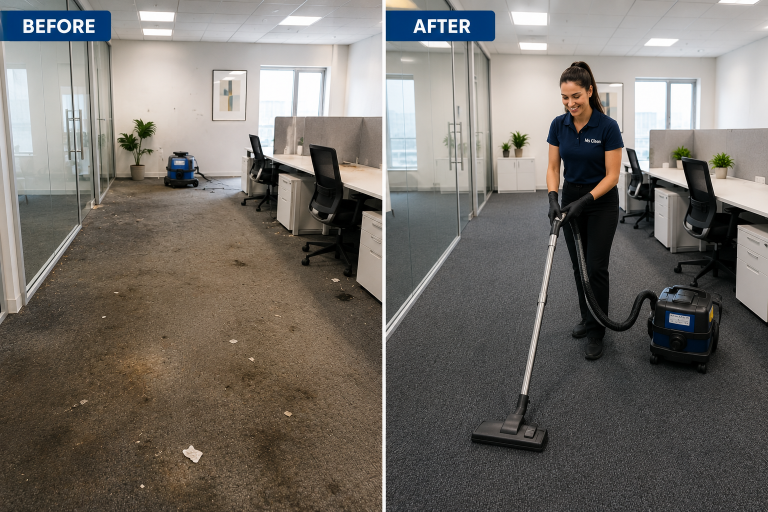

It happens to every office at some point.
A water cooler leaks overnight. A pipe bursts in the bathroom and water creeps under the door. Someone leaves a window open during a sudden Adelaide storm. And by 7am Monday, you’re standing in the doorway looking at wet carpet with staff arriving in two hours.
That feeling of dread? We get it. We’ve walked into dozens of Adelaide offices in exactly that situation.
The good news is that wet office carpet can almost always be saved if you act quickly and do the right things in the right order. The damage isn’t the water itself. It’s what grows in the water if you leave it too long.
This guide gives you a clear, step-by-step plan. Whether it’s a small spill in a meeting room or a full floor water event, you’ll know exactly what to do and when to call for help.
| The 48-Hour Rule : Mould starts growing in wet carpet within 24 to 48 hours. In Adelaide’s winter months , when offices are closed on weekends and ventilation is limited that clock runs fast. Every hour you wait makes the job harder and more expensive. If you’re reading this after a water event, stop and act now. |
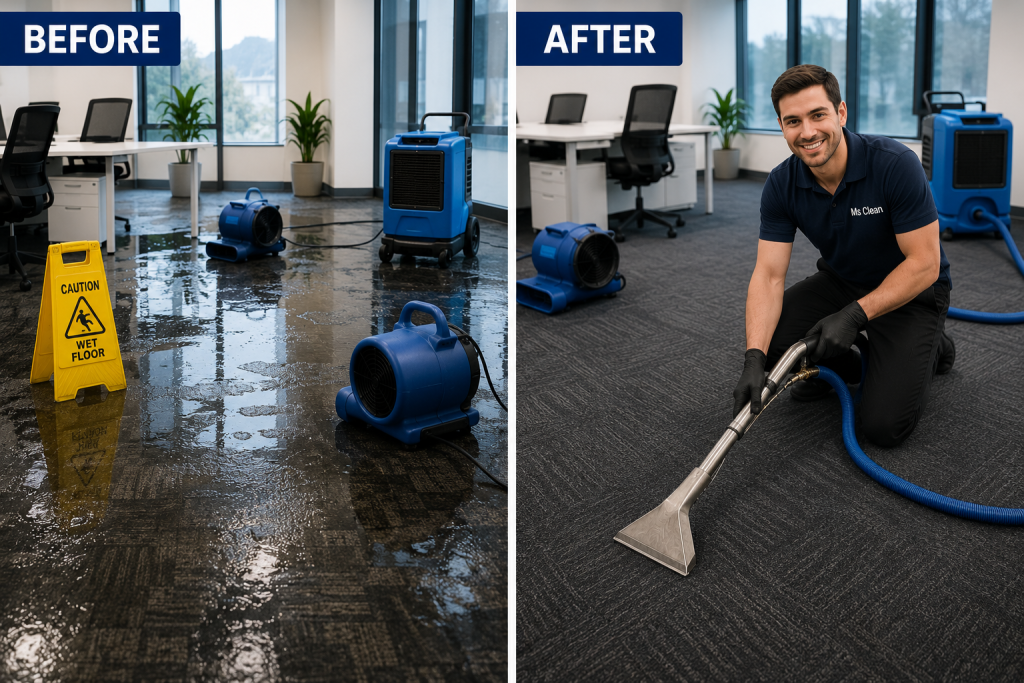
Why Wet Carpet in an Office Is More Serious Than at Home
Most people think about wet carpet the same way at home or in the office. But an office is a completely different situation. And the stakes are higher.
Here’s why office wet carpet needs faster action:
- Offices are often unattended overnight and on weekends. A Saturday leak has 48 hours to sit before anyone notices. By Monday, the mould has already started.
- Commercial carpets are typically glued directly to concrete. Concrete holds moisture like a sponge. The water doesn’t just sit in the fibres; it soaks into the slab and takes much longer to dry.
- Office buildings have limited airflow when the HVAC is off. Stagnant air and moisture are mould’s best friends.
- There are real business costs. Wet carpet means staff can’t use the space. That means lost productivity, potential WHS concerns, and possible landlord or insurance complications.
- Adelaide’s commercial leases often hold the tenant liable for carpet damage. A slow response can turn a $300 dry-out into a $3,000+ carpet replacement and a lease dispute.
We’re not saying this to alarm you. We’re saying it because acting fast genuinely makes the difference between a carpet you save and a carpet you replace.
The First 30 Minutes: What to Do Right Now
If the water event just happened or you just discovered it, here’s exactly what to do. Don’t overthink it. Just move through this list.
Step 1: Stop the Water Source
- Find where the water is coming from and stop it.
- Burst pipe? Locate the water main shutoff for your tenancy or building and turn it off.
- Roof leak? Move equipment and furniture away from the affected area and place buckets or waste bins to catch ongoing drips.
- Overflow from a sink or toilet? Turn off the water at the isolation valve behind the fixture.
- If you can’t identify the source or stop it yourself, call your building manager immediately, even if it’s after hours. They have an emergency maintenance number. Use it.
Step 2: Get the Furniture Off the Carpet
- Move all chairs, desks, and equipment off the wet carpet as fast as possible.
- Wet furniture legs stain carpet permanently, especially timber or metal legs. Once those stains set, they don’t come out.
- If you can’t move heavy items like filing cabinets, put a plastic sheet or aluminium foil under the legs right now.
- Move any electrical equipment immediately. Water and power are not a combination you want in an office.
Step 3: Extract as Much Water as You Can
- If your office has a wet-dry vacuum, sometimes called a shop vac, get it out now. Run it slowly over the wet area, overlapping passes.
- Don’t have one? A mop and bucket can remove a lot of surface water quickly. It’s not perfect, but it buys you time.
- For large areas, use old towels or absorbent mats and press them into the carpet. Walk on them to push them down into the pile. Wring them out and repeat.
- The goal here is to remove standing water and reduce surface saturation. You won’t get it fully dry at this stage, that’s fine. You’re just reducing the load.
Step 4: Get Air Moving
- Open every window and door you can access.
- Turn on the HVAC system if it’s off, as air circulation slows mould growth significantly.
- Set up any fans you have pointing across the wet area. Airflow is more effective than heat for drying carpet quickly.
- If you have a dehumidifier in the building, get it running in the affected room immediately.
| Call Your Cleaner Now 0480 321 027 While you’re doing Steps 1 to 4, have someone else call a professional Adelaide commercial carpet-cleaning company. Many offer emergency same-day response. The earlier you call, the sooner they arrive, and that window matters enormously for the outcome. |
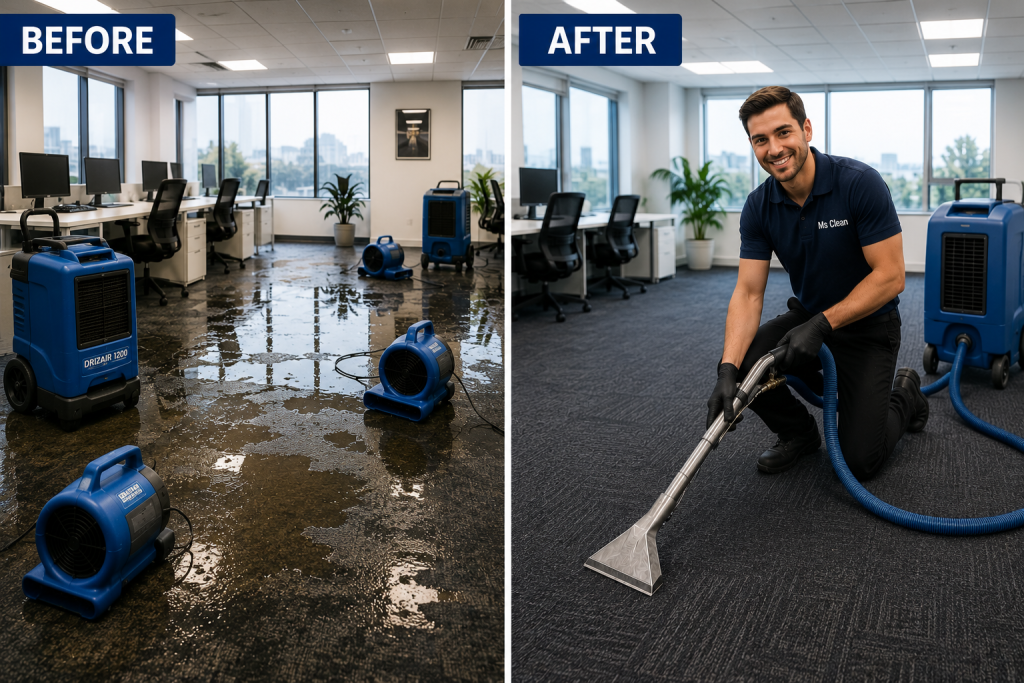
How to Dry Wet Office Carpet: Every Method Explained
Once you’ve done the immediate steps, here’s how the drying actually works and which methods are best for an office environment.
Air Movers (Industrial Fans)
These are the workhorses of professional carpet drying. They look like snail-shaped blowers and push a high volume of air across the carpet surface at low angles.
A single air mover covers roughly 9–12 square metres of carpet. A professional team will typically deploy one per affected area and leave them running continuously.
They’re loud — about 70–75 decibels, similar to a vacuum cleaner. But they’re the most effective tool for drying carpet quickly without damaging the fibres or the adhesive beneath.
Most Adelaide commercial cleaning companies include air movers in their water damage response. Ask when you call.
Dehumidifiers
A dehumidifier pulls moisture out of the air as the carpet evaporates. Without one, you’re just moving humid air around the room which slows drying significantly.
In an office environment, a commercial dehumidifier running alongside air movers can cut drying time by 30–50% compared to fans alone.
For Adelaide’s winter months, when outdoor air is cool and humid, a dehumidifier is especially important. Don’t open windows in cold, damp conditions without one running inside.
Wet-Dry Vacuum Extraction
This is the first step a professional will take. A commercial wet-dry extractor is far more powerful than a domestic shop vac it pulls moisture from deep in the carpet pile and backing, not just the surface.
Multiple passes in different directions extract significantly more water than a single pass. Professional technicians often make 4 to 6 passes over badly saturated areas before moving to the drying phase.
If your in-house wet-dry vacuum is small, it’s worth renting a commercial unit from a tool hire company in the Adelaide metro area while you wait for professional help. Every litre you remove speeds up the drying time.
Heating
Warmth helps, but it’s not as important as airflow. And it comes with a catch.
In an office setting, turning up the building temperature speeds evaporation from the carpet. But too much heat in a poorly ventilated space simply moves the moisture into the air and walls, where it can cause secondary damage and mould in wall cavities.
The right approach is warmth plus airflow plus dehumidification. All three working together. Heat alone won’t dry your carpet it just moves the water somewhere else.
Lifting the Carpet (When Necessary)
In severe cases, particularly when the water has reached the concrete subfloor, a professional may recommend lifting sections of the carpet to dry the subfloor directly.
This sounds drastic, but it’s often the only way to prevent mould in the backing and underlay. The carpet can usually be relaid after drying without replacement.
Don’t attempt this yourself unless you know what you’re doing. An incorrectly lifted commercial carpet often can’t be relaid and needs to be replaced, which is far more expensive.
How Long Does It Take to Dry Wet Office Carpet?
This is the question every office manager wants answered. Here’s an honest breakdown:
| Situation | Drying Time (Professional) | Drying Time (DIY Only) | Risk Level |
| Small spill (< 1m²), surface only | 2–4 hours | 4–8 hours | Low |
| Medium spill (1–5m²), into backing | 6–12 hours | 24–48 hours | Medium |
| Large area (5m²+), saturated backing | 24–48 hours | 48–72 hours (if at all) | High |
| Reached the concrete subfloor | 48–72 hours | Often not possible | Very High |
| After flooding (full room) | 3–5 days | Carpet usually replaced | Critical |
These are honest estimates. Every situation is different; the type of carpet, the amount of water, the ventilation, and Adelaide’s weather on the day all affect the result.
What the table shows clearly: the gap between professional and DIY drying times is large. And in an office, that gap means extra days of disruption and a much higher mould risk.
| 🌧️ Adelaide Winter NoteAdelaide’s winters (June–August) are wet and cool, with average humidity around 70%. This significantly slows carpet drying compared to summer. If your water event happens in winter, always use professional drying equipment. DIY methods in winter conditions rarely achieve full drying before mould sets in. |
The Mistakes We See in Adelaide Offices All the Time
We’ve responded to hundreds of water events in Adelaide commercial spaces. The same mistakes come up again and again. Here’s what not to do.
| Mistake | Why It Happens | What It Costs You |
| Waiting until Monday | Water event discovered Friday. Office manager decides to deal with it after the weekend. | 48+ hours of mould growth. Often requires underlay replacement and mould remediation — 3–5x the cost of early treatment. |
| Using a domestic fan only | It’s what’s available. Feels like it’s doing something. | Domestic fans move too little air to dry commercial carpet in time. Mould grows underneath while the surface feels dry. |
| Not moving furniture fast enough | Takes time to organise. Seems like a lower priority. | Timber and metal legs stain carpet permanently within hours. Stains that don’t come out, even professionally. |
| Steam cleaning a wet carpet | Someone thinks it will clean and dry at once. | Steam adds moisture. It makes saturation worse and can spread mould spores if mould has already started. |
| Declaring it ‘dry’ by touch | The surface feels dry. Feels fine to put furniture back. | The backing and subfloor are still wet. Mould grows from the bottom up. You won’t know until the smell hits — weeks later. |
| Not documenting for insurance | No photos taken before cleanup starts. | Insurance claims often rejected without evidence of the event, the extent of damage, and the response steps taken. |
When to Call a Professional: Be Honest With Yourself
We know the instinct is to handle it in-house. It feels faster. It saves money. And for small, surface-level spills, that’s often the right call.
But there are situations where DIY will cost you more in the long run. Be honest with yourself about these:
- The wet area is larger than 2 square metres. At that size, you need industrial equipment to dry it properly within the mould window.
- The carpet has been wet for more than 12 hours. Especially overnight or over a weekend.
- You can feel dampness when you press your hand into the carpet and the moisture doesn’t just come from the surface.
- The water came from a contaminated source a toilet overflow, stormwater, or a drain backup. This is a biohazard. Full professional sanitation is required.
- There’s already a musty smell. That means mould has started. You need professional mould treatment, not just drying.
- The carpet is still showing moisture after 24 hours of your own drying efforts.
- You have WHS obligations to meet before staff return to the space.
| 💼 Landlord and Lease ConsiderationsMany Adelaide commercial leases require tenants to maintain carpet in ‘good condition’. If a water event causes damage, your landlord may require professional remediation documentation as part of any bond or lease-end discussion. A professional job with a written report protects you. DIY efforts — even if they work — don’t give you that paper trail. |
What Does Professional Carpet Drying Cost in Adelaide? (2026)
We get asked this a lot. Here’s what Adelaide commercial carpet and water damage companies charge in 2026:
| Service | Price (AUD) | What’s Included | Best For |
| Emergency call-out fee | $80 – $150 | Same-day or after-hours arrival | All water events |
| Water extraction (per room) | $150 – $350 | Commercial wet vacuum, multiple passes | Initial response |
| Air mover hire + placement | $60 – $120 / unit / day | Industrial drying fans left on-site | All drying jobs |
| Dehumidifier hire | $80 – $180 / day | Moisture removal from air | Medium to large jobs |
| Subfloor drying | $200 – $600+ | Lifting carpet, treating concrete, relaying | Severe saturation |
| Mould treatment (if required) | $120 – $250 per room | Antifungal treatment + extraction | Post-water mould |
| Insurance documentation report | $80 – $200 | Written moisture readings + photo report | Insurance claims |
| Full flood remediation | $800 – $3,500+ | End-to-end extraction, drying, mould check | Major water events |
For a typical single-room office water event caught within 12 hours, you’re usually looking at $300–$600 all in. That includes extraction, fans, and a follow-up moisture check.
Caught after 48 hours? Realistically $800–$1,500 — because mould treatment gets added to the drying cost.
Caught after a week? You’re likely replacing carpet. Commercial carpet replacement in Adelaide runs $40–$85 per m² installed. A 50m² office floor is a $2,000–$4,000 job.
The maths on acting fast are pretty clear.
Real Adelaide Office Jobs: What Happened and What It Cost
The Friday Night Pipe Burst — Salisbury Business Park
An accounting firm in Salisbury had a water supply line fail on a Friday evening. The office manager got an alert from the building’s water sensor at 11pm and called us immediately.
By the time we arrived at midnight, roughly 35m² of carpet in the open-plan area was saturated. The water had reached the concrete subfloor under the main workstation cluster.
We deployed six air movers and two commercial dehumidifiers. Lifted one section of carpet near the server room to dry the subfloor directly. Ran equipment continuously over the weekend.
By Monday morning, moisture readings were at acceptable levels. Staff returned to work on Monday afternoon with minor furniture rearrangement. No mould. No carpet replacement.
Total cost: $1,250. The firm’s office insurance covered it in full with our moisture report and photos.
The Forgotten Spill — CBD Co-Working Space
A co-working space in the Adelaide CBD called us about a persistent musty smell in one of their private offices. Turned out a water cooler had been slowly leaking for about two weeks without anyone noticing.
The carpet surface looked fine. But when we lifted the corner, the underlay was black with mould.
We removed and disposed of the underlay, treated the concrete with antifungal solution, and installed new underlay. The carpet itself was saved — it had been protected from the worst of the mould by the underlay acting as a barrier.
Total cost: $780. If they’d caught it at the two-day mark, it would have been a $400 dry-out. The extra $380 was the underlay replacement and mould treatment.
The Storm Leak — Northern Suburbs Medical Centre
A medical centre in Parafield Gardens had a roof gutter overflow during a heavy June storm. Water came through a ceiling join and soaked a 12m² waiting room carpet.
The centre manager called us the next morning — about 16 hours after the event. The carpet was cold and damp. There was already a faint smell beginning.
We extracted immediately, deployed three air movers and a dehumidifier, and applied a preventative antifungal spray. Drying took 36 hours. The smell was gone by day two.
Total cost: $620. The centre was able to use the waiting room — with seating moved to one side — after the first 24 hours.
How to Reduce the Risk in Your Adelaide Office
You can’t control when a pipe bursts or a storm hits. But you can make sure you catch it fast and respond well.
- Install a water sensor. Small, inexpensive smart sensors (available from Bunnings or JB Hi-Fi for $30–$80) sit on the floor near water sources, coolers, bathrooms, kitchenettes, and alert your phone the moment they detect moisture. They’ve saved dozens of our clients from weekend disasters.
- Know your water shutoffs. Walk through the office and locate the isolation valves for every water source. Label them. Make sure at least two people in your team know where they are.
- Keep a wet-dry vacuum on site. A decent commercial shop vac costs $150–$300. It pays for itself the first time you need it.
- Schedule annual professional carpet cleaning. A yearly hot water extraction removes the organic build-up that feeds mould if a water event occurs. It also keeps your carpet in better condition to survive a water event.
- Check your commercial lease for carpet obligations. Know what you’re responsible for before a problem happens — not after.
- Have your cleaner’s number saved. Not in an email thread. In your phone. The first 30 minutes matter you don’t want to spend them Googling.
Quick Reference: Wet Office Carpet Action Plan
| Time Since Water Event | Risk Level | Recommended Action |
| 0–2 hours | Low | DIY extraction + fans + call cleaner to assess |
| 2–12 hours | Medium | Call professional immediately — same-day response |
| 12–24 hours | High | Emergency professional — extraction, drying, mould prevention |
| 24–48 hours | Very High | Professional — expect mould treatment to be required |
| 48+ hours | Critical | Full remediation — underlay likely needs replacing |
| 1 week+ | Severe | Carpet replacement likely — call insurer and cleaner together |
| Water Event in Your Adelaide Office? Call Us Now We respond to commercial water events across all Adelaide suburbs — including northern suburbs like Salisbury, Elizabeth, Parafield Gardens, and Golden Grove. Same-day emergency response available. We bring the equipment, handle the drying, and give you a written report for insurance. Call Now |
| Adelaide’s Commercial Carpet Specialists : water damage technicians. Insurance documentation included. Available 7 days including after-hours emergency. Trusted by offices, medical centres, schools, and retail spaces across Adelaide since 2012. Call: 0480 321 027 | https://msclean.au/ | 24/7 Emergency Line Available |
Frequently Asked Questions
Q1: How do you dry wet carpet fast in an office?
Extract as much water as possible first use a wet-dry vacuum or mop. Then get air moving immediately: open windows, run the HVAC, and set up fans pointing across the carpet at a low angle. If you have a dehumidifier, run it in the same room. For large or saturated areas, call a professional. Commercial air movers and extractors dry office carpet 3–4 times faster than domestic equipment.
Q2: How long does wet office carpet take to dry?
With professional equipment, commercial air movers and a dehumidifier, a moderately wet office carpet dries in 6–24 hours. A severely saturated carpet or one with water in the subfloor can take 48–72 hours. With DIY methods only, expect the same job to take twice as long, which often puts you past the 48-hour mould window.
Q3: Can wet carpet be saved, or does it need replacing?
Most office carpet can be saved if you act within 24 hours. The carpet itself is usually fine — it’s the underlay and the backing that suffer. If the underlay has been saturated for more than 48 hours, it often needs replacing. The carpet on top can usually be relaid. Full replacement is typically only needed when mould has penetrated the carpet fibres themselves — which happens after prolonged neglect.
Q4: Is it safe for staff to work in an office with wet carpet?
It depends on how wet and how long. A fresh small spill in one area? Generally fine with proper ventilation. A saturated carpet that’s been wet overnight? Not ideal — especially for staff with asthma or allergies. Any visible mould or musty smell means the space should not be used until professionally treated. Your WHS obligations as an office manager require you to provide a safe working environment.
Q5: How much does carpet water damage cost to fix in Adelaide?
A single-room office water event caught within 12 hours typically costs $300–$600 for professional extraction and drying. Caught after 24 to 48 hours with mould present: $800–$1,500. Full remediation after a major flood: $1,500 to $3,500+. Carpet replacement runs $40–$85 per m² installed. Calling a professional early is almost always cheaper than replacing the carpet.
Q6: Should I use a steam cleaner on wet office carpet?
No, not on a wet carpet. Steam adds moisture. On already-wet carpet, it makes saturation worse and can spread mould spores if mould has started. Steam cleaning is only appropriate after the carpet has been fully dried and treated. It’s a useful final sanitising step not a drying method.
Q7: Will insurance cover wet carpet damage in my Adelaide office?
Most commercial property and contents policies cover sudden water damage burst pipes, appliance leaks, storm ingress. They typically don’t cover gradual leaks or maintenance failures. You’ll need to document the event with photos before cleanup, and your insurer will likely require a professional assessment report. Call your insurer as early as possible ideally at the same time you call your cleaner.
Q8: Do Adelaide commercial carpet cleaners respond after hours?
Yes — many do. Water damage emergencies don’t happen at 9 am on a Tuesday, so reputable Adelaide commercial cleaners offer after-hours and weekend emergency call-outs. Expect a surcharge of $80–$150 for after-hours response. It’s worth it. The longer wet carpet sits, the more the damage compounds.