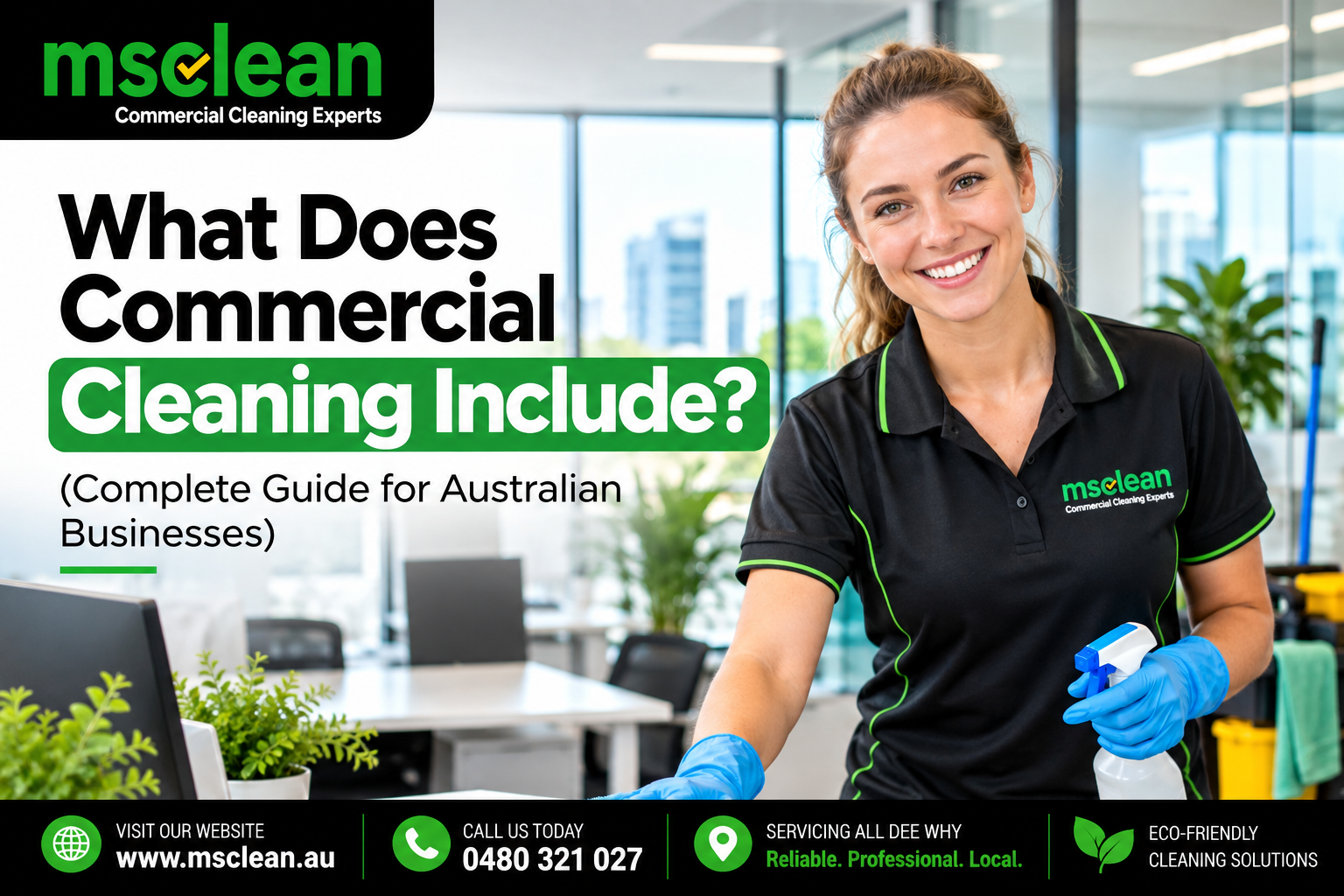
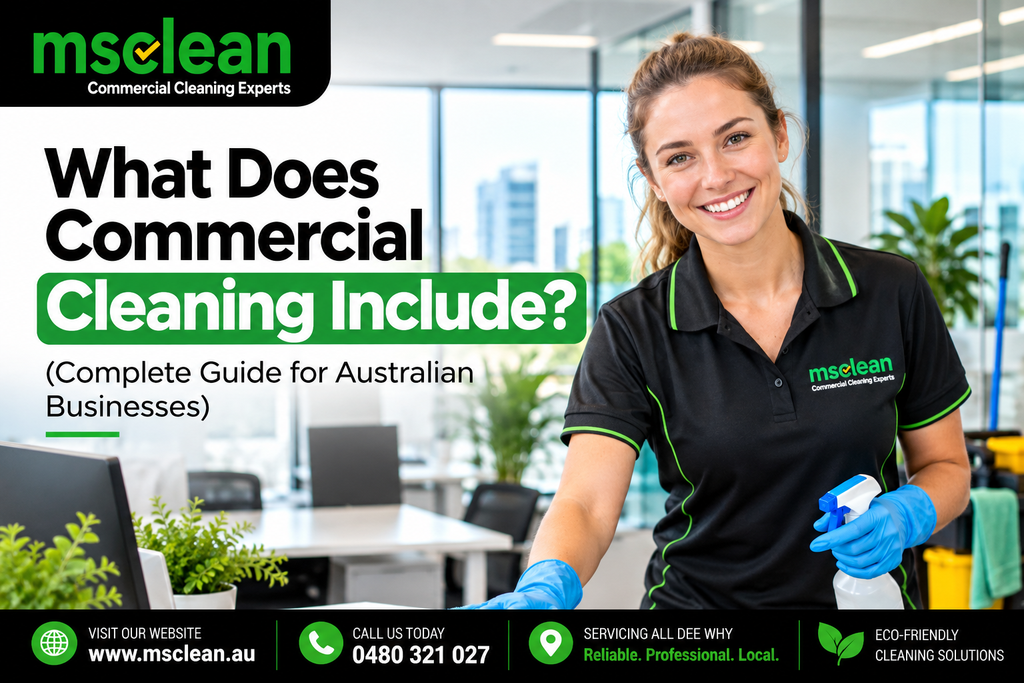
Commercial cleaning includes routine upkeep and deep cleaning tasks for non residential spaces like offices, retail stores, and medical facilities. Standard daily and weekly tasks cover trash removal, surface dusting, floor care, high touch surface sanitization, and kitchen and breakroom cleaning. Restroom sanitization covers scrubbing and disinfecting toilets and sinks, restocking consumables, and mopping floors with disinfectants. Periodic specialized services include carpet extraction, hard floor stripping and buffing, window washing, and post construction clean up. The exact scope depends on the facility type, size, and the specific cleaning contract, which is why getting a written scope of works before signing anything is the single most important thing any Adelaide business should do.
What does commercial cleaning include?
Commercial cleaning includes routine upkeep and deep cleaning tasks for non residential spaces like offices, retail stores, and medical facilities. Standard daily and weekly tasks include trash removal emptying trash cans and recycling bins and replacing liners; surface dusting wiping down desks, tables, counters, and electronics; floor care vacuuming carpets and sweeping or mopping hard floors; high touch sanitisation disinfecting door handles, light switches, and elevator buttons; and kitchen and breakroom cleaning wiping sinks, tables, and exterior appliance surfaces. Restroom sanitization includes fixture cleaning, scrubbing and disinfecting toilets, urinals, and sinks; supply restocking, refilling toilet paper, paper towels, and hand soap; and odour and waste removal, emptying sanitary bins and mopping floors with disinfectants. Periodic specialized services include deep floor care such as carpet extraction, hard floor stripping, waxing, and buffing; window washing for interior and exterior glass; and facility support, including day porter services or post-construction clean up.
How this guide helps you
The most common source of frustration between Adelaide businesses and their cleaning companies is not that the cleaning is bad. It is that neither party agreed on what was included before work started.
A facility manager assumes the kitchen fridge gets cleaned weekly. The cleaning contract says “kitchen cleaned” without specifying what that means. The cleaner wipes the benchtop and considers the kitchen done. Six months later, the facility manager opens the fridge and finds the inside hasn’t been cleaned since the contract started.
That scenario happens constantly, not because the cleaner is cutting corners, and not because the facility manager is unreasonable. It happens because “commercial cleaning” is not a defined standard. It is a category of services that can mean anything from bins and floors to a comprehensive facility hygiene programme, depending entirely on what is written into the agreement.
This guide gives you a complete, specific answer on what commercial cleaning includes: standard daily and weekly tasks, restroom sanitization, periodic specialized services, facility-type-specific requirements, and the critical list of what is typically not included by default. By the end, you will know exactly what to expect, what to confirm in writing, and what questions to ask before signing any commercial cleaning contract in Adelaide.
What Commercial Cleaning Is (and What It Is Not)
Before covering what commercial cleaning includes, it helps to understand the definition clearly, because people often confuse it with two related but different things.
Commercial cleaning refers to professional cleaning services provided to non residential facilities: offices, retail premises, medical centres, schools, aged care facilities, industrial environments, and any other commercial or institutional space.
Janitorial cleaning and commercial cleaning are often used interchangeably, but they differ in practice. Janitorial cleaning typically refers to routine, lower frequency maintenance tasks such as sweeping, mopping, bin emptying, and surface wiping, performed on a scheduled basis. Commercial cleaning encompasses the full range of services, from routine janitorial maintenance to specialist deep cleaning, periodic restoration services, and compliance-focused cleaning for regulated environments.
Residential cleaning (house cleaning, apartment cleaning) differs from commercial cleaning in products used, equipment, scheduling, compliance requirements, pricing models, and the contractual framework. A company that primarily cleans homes is not automatically equipped to clean a commercial facility to the standard a business environment requires.
For Adelaide businesses, the practical definition of commercial cleaning is: a professionally delivered, scheduled cleaning programme for a non residential facility, structured around a written scope of works that defines every area, every task, and every frequency.
Standard Daily and Weekly Commercial Cleaning Tasks
These are the tasks that form the core of any commercial cleaning contract. They happen on every scheduled service visit and represent the baseline of what any professional commercial cleaner should deliver.
Trash Removal
Emptying trash cans and recycling bins, then replacing liners.
Every bin in the facility: offices, workstations, reception, meeting rooms, kitchen, bathrooms, corridors is emptied, the liner replaced, and the bin exterior wiped if visibly soiled. Recycling bins are sorted correctly where a separation programme is in place.
Trash removal is always done first in the cleaning sequence. This removes the most contaminated items from the facility at the start of the clean, prevents re touching bin areas after they have been cleaned, and allows a single efficient bin run rather than multiple trips back to specific locations.
What trash removal does not always include: Taking waste to an external skip or managing waste beyond the building’s standard bin collection. Industrial or clinical waste requiring specialist disposal. These are scope specific additions.
Surface Dusting
Wiping down desks, tables, counters, and electronics.
Surface dusting works high to low ceiling vents and high shelving before desk surfaces and filing cabinet fronts. Dust dislodged from upper surfaces settles on lower surfaces. Cleaning in the wrong order requires re cleaning areas you have already addressed.
Desk surfaces receive a wipe or dust with a microfibre cloth. Electronic surfaces monitor frames, computer towers, printer tops are dusted. Telephone sets are wiped. Meeting room tables receive a full wipe. Reception counters are cleaned.
What surface dusting does not always include: Moving items on desks to clean underneath them this requires specific authorisation from the facility manager. Personal items at workstations are typically dusted around, not moved. This should be clarified in the scope.
Floor Care
Vacuuming carpets and sweeping or mopping hard floors.
Floor care is always done last in the cleaning sequence. Everything dislodged from surfaces during dusting, everything tracked in from outside, everything dropped during the clean accumulates on the floor. Cleaning floors first and then everything else means you clean the floors twice.
Carpeted areas are vacuumed with a commercial grade vacuum in regulated environments or facilities with allergen sensitive staff, a HEPA filter vacuum is the appropriate standard. Hard floors vinyl, tile, timber, polished concrete are dry swept first to remove loose debris, then wet mopped with the appropriate product for the floor type.
Floors are mopped working from the far corner of each room toward the exit. This ensures the cleaner does not walk across a freshly mopped floor before it dries.
What standard floor care does not include: Carpet hot water extraction, hard floor stripping and resealing, machine scrubbing, or any specialist floor treatment. These are periodic services included in the specialised services section below.
High Touch Surface Sanitisation
Disinfecting door handles, light switches, and elevator buttons.
High touch surface disinfection is the hygiene core of any commercial cleaning service. These surfaces carry concentrated contact load from every person in the facility throughout the operating day and are the primary indirect transmission pathway for workplace illness.
High touch surfaces in a standard commercial facility that require disinfection on every service visit:
All door handles throughout the facility entry, exit, meeting rooms, kitchen, bathrooms. Every person who moves through the building touches these. Disinfectant is sprayed onto a cloth never directly onto the surface and the surface is wiped with the dwell time observed for the product being used.
Light switches and dimmer controls in all occupied areas.
Elevator call buttons in multi level facilities.
Shared keyboard and mouse surfaces in hot desk or open plan environments.
Telephone handsets at reception and in meeting rooms.
EFTPOS terminals and shared payment hardware.
Reception counters both the client facing and staff side surfaces.
Kitchen appliance touch points microwave handle and controls, kettle switch, coffee machine controls, fridge handle.
Kitchen and Breakroom Cleaning
Wiping sinks, tables, and exterior appliance surfaces.
The kitchen or breakroom is the highest hygiene risk area in most commercial offices from a food safety and bacterial spread standpoint. Standard kitchen cleaning on every service visit covers benchtops fully wiped and sanitised, sink scrubbed and sanitised including drain surround, microwave exterior and interior wiped, kettle and coffee machine exterior wiped, table and chair surfaces wiped, floor swept and mopped, and bins emptied and relined.
What standard kitchen cleaning does not include: Fridge interior (typically included on a weekly or fortnightly periodic basis, not every daily visit), descaling appliances, inside of cupboards, and dishwasher operation unless specifically included in the scope.
Restroom Sanitisation
Restroom cleaning is the area most representative of a facility’s overall cleaning standard in the perception of every person who uses it staff, visitors, and clients. It is also the highest contamination risk zone in the building.
Fixture Cleaning
Scrubbing and disinfecting toilets, urinals, and sinks.
Every toilet in the facility receives: bowl scrubbed with toilet cleaner and brush, seat and lid disinfected on top and underside, outer bowl and base wiped, and flush mechanism disinfected as a high touch surface.
Urinals where present receive cleaning and deodourising.
Basins receive a thorough scrub and sanitisation including the tap handles one of the highest contact surfaces in any commercial bathroom, touched before and after handwashing by every user.
Mirrors are cleaned streak free.
Supply Restocking
Refilling toilet paper, paper towels, and hand soap.
Every commercial cleaning visit checks and restocks consumables in every bathroom. A depleted soap dispenser or empty toilet paper holder in a commercial facility represents a hygiene failure that affects every subsequent user until it is noticed and addressed. Whether the cleaning company or the business supplies the consumables depends on the contract this must be explicitly stated before work starts.
Odour and Waste Removal
Emptying sanitary bins and mopping floors with disinfectants.
Sanitary bins receive liner replacement at every service. Where sanitary bin services are contracted through a separate provider, the cleaning contractor manages the external bin housing.
Bathroom floors are mopped using a hospital grade or commercial disinfectant floor cleaner. The mop used in the bathroom is zone dedicated — it never enters the kitchen or open office areas. In a professional commercial cleaning operation, this is enforced through a colour coded mop system where the bathroom mop is a specific colour that physically prevents it from crossing zones.
Periodic Specialised Commercial Cleaning Services
These services are not part of the regular daily or weekly clean. They are scheduled on a periodic basis: monthly, quarterly, biannual, or annual and are typically priced separately from the routine cleaning contract.
Deep Floor Care
Carpet extraction: hot water extraction of commercial carpet removes the embedded particulate, allergens, and soiling that daily vacuuming lifts from the surface but does not fully reach at the fibre base. For most Adelaide commercial offices, quarterly hot water extraction maintains carpets in genuine clean condition rather than surface clean condition.
Hard floor stripping and resealing: vinyl and linoleum commercial floors require periodic stripping of the old protective coating and application of a fresh seal. Without this cycle, the floor dulls, stains more easily, and shows wear that no amount of mopping reverses.
Hard floor scrubbing: machine scrubbing removes the embedded soiling from hard floor surfaces that standard mopping cannot address. Monthly or quarterly scrubbing maintains commercial hard floors between stripping and resealing cycles.
Hard floor buffing and polishing : restores the surface sheen on sealed commercial floors between major treatments.
Window Washing
Interior and exterior glass cleaning.
Internal window cleaning is part of the regular commercial cleaning scope for most contracts. External window cleaning above ground floor level requires specialist access equipment : extension poles, water fed pole systems, or elevated work platforms: and is typically a separate periodic service.
For Adelaide commercial buildings in the CBD or multi storey environments, external window cleaning is scheduled quarterly or biannually and priced by square metre or per building.
Day Porter Services
Day porter services provide a cleaning presence during business hours to maintain high traffic areas throughout the operating day. This is particularly relevant for high volume retail, large corporate buildings, medical facilities, and any environment where the end of day clean cannot address the accumulated traffic load without daytime support.
A day porter manages restroom checks and restocking, spill response in common areas, lift lobby and entry maintenance, and high touch surface resets during peak traffic periods.
Post Construction Clean Up
Post construction or post renovation cleaning addresses the specific soiling profile of a space that has been through building works : cement dust, paint overspray, adhesive residue, construction debris, and the fine particulate that settles on every surface during construction activity. This is a specialist service priced differently from standard commercial cleaning and is not part of a regular maintenance contract.
What Commercial Cleaning Includes by Facility Type
Different facility types have different primary cleaning requirements. Here is a quick reference for what commercial cleaning includes based on the specific facility.
Office Buildings and Corporate Spaces
Standard daily commercial cleaning for an office building covers all areas described in Sections 2 and 3. Periodic services include quarterly carpet extraction, biannual external window cleaning, and periodic floor treatment.
Additional considerations for corporate offices: Written scope specifying whether desk items are moved or cleaned around. Protocol for whiteboards never erased without explicit instruction. After hours scheduling as standard to avoid disruption to staff.
Retail Premises and Shopfronts
Retail commercial cleaning adds a specific focus on front of house presentation: the entry glass, the shopfront floor, the display surfaces, and the fitting room areas that carry heavy customer contact throughout the trading day.
Entry glass cleaning is typically daily for retail premises in high foot traffic locations. Floor care may require multiple passes per day in very high traffic environments. After hours or pre opening scheduling is standard for retail commercial cleaning.
Medical Centres and Healthcare Facilities
Medical commercial cleaning goes beyond standard commercial cleaning in three specific ways: TGA listed hospital grade disinfectants are required on all clinical contact surfaces, a colour coded zone equipment system is mandatory to prevent cross contamination between clinical and bathroom zones, and completion documentation is required for RACGP, SA Health, and other regulatory compliance.
Medical commercial cleaning is a distinct discipline from general commercial cleaning. A standard commercial cleaning company that adds medical to their service list without the appropriate products, training, and documentation protocols is not providing medical commercial cleaning.
Schools and Childcare Centres
School commercial cleaning requires child safe products, HEPA vacuuming for allergen management, and scheduling entirely outside occupied hours: holiday periods for major deep cleaning, pre opening for daily maintenance.
Aged Care Facilities
Aged care commercial cleaning requires resident safe products, Aged Care Quality and Safety Commission documentation, outbreak response protocols, and scheduling that minimises disruption to residents. This is a regulated commercial cleaning environment with specific compliance requirements distinct from standard office cleaning.
What Commercial Cleaning Does Not Include (By Default)
This is the section most frequently absent from commercial cleaning discussions: and the source of most post signing scope disputes.
These items are not included in a standard commercial cleaning contract unless explicitly stated:
External window cleaning above ground floor. Internal glass is standard. External windows requiring specialist access equipment are a separate periodic service.
Carpet steam extraction. Vacuuming is standard. Hot water extraction is a periodic add on.
Fridge interior. Exterior wipe is standard. Interior is typically weekly or fortnightly and must be specified.
Inside of cupboards and storage areas. External cabinet fronts are standard. Inside of cupboards is periodic and scope specific.
Descaling appliances. The exterior of kettles and coffee machines is standard. Descaling the interior is a periodic or deep clean add on.
Consumables supply. Whether the cleaning company supplies toilet paper, hand soap, bin liners, and paper towels or the business does must be explicitly stated. Most contracts treat consumables as a separate cost.
Rubbish removal beyond building bins. Emptying bins to the building’s waste management system is standard. Arranging council bin collection or external waste disposal beyond this is the client’s responsibility.
Specialist or industrial cleaning. Chemical spill response, laboratory cleaning, clinical waste disposal, and any task requiring specialist training or licensing beyond standard commercial cleaning scope.
Clinical waste and sharps management. In medical environments, sharps container disposal and biohazard bag management sit with the clinical waste contractor and clinical staff, not the cleaning contractor.
Deep cleaning tasks on daily visits. Daily visits maintain. Deep cleaning restores. These are different scopes at different frequencies and should be priced separately.
Commercial Cleaning Pricing in Adelaide 2026
Understanding what commercial cleaning costs in Adelaide helps businesses evaluate whether a quote matches the scope they are being offered.
| Facility Type and Scope | Typical Monthly Cost Adelaide 2026 |
| Small office (50 to 150m2), weekly service | $215 to $520 per month |
| Medium office (150 to 400m2), three times weekly | $680 to $1,300 per month |
| Large office (400m2 plus), daily service | $1,800 to $3,500 per month |
| Medical centre (150 to 300m2), daily service | $1,500 to $3,000 per month |
| Retail shopfront, daily | $400 to $900 per month |
| School (full building), term holiday deep clean | $500 to $3,000 per clean |
| Post construction clean, per square metre | $6 to $14 per m2 |
| Carpet hot water extraction, per room | $23 to $46 per room |
Contract cleaning runs at $32 to $56 per hour or $1.76 to $3.44 per square metre per month in Adelaide in 2026. The rate depends on frequency, fit out density, after hours scheduling requirements, and whether the environment is a standard commercial office or a regulated facility type.
What a Commercial Cleaning Contract Must Include
The most important thing any Adelaide business does before engaging a commercial cleaning company is get the scope in writing. Not a verbal description. A written document that specifies every area, every task, and every frequency.
Every commercial cleaning contract should include:
A scope of works — by area and by task. Not “clean the office” but a specific list of every space and what happens in it on every scheduled visit.
Frequency for every task — which tasks happen daily, which happen weekly, which happen on a periodic cycle.
Inclusions stated explicitly — what is covered in the quoted price.
Exclusions stated explicitly — what is not covered and would require a separate quote.
Consumables statement — who supplies toilet paper, hand soap, bin liners, and cleaning products.
After hours access arrangements — confirmed scheduling window, key or code access arrangements, and notification process if the schedule needs to change.
Insurance confirmation — public liability and workers compensation certificates available on request.
Contract term and notice period — typically three months minimum with thirty day mutual notice.
GST statement — all pricing stated exclusive and inclusive of GST.
Documentation and reporting — what records are produced after every service visit and in what format.
A commercial cleaning contract without most of these elements doesn’t protect either party, and the absence of a written scope is almost always what disputes come back to when something goes wrong.
Why you choose MS Clean?
Ms Clean has provided professional commercial cleaning to Adelaide offices, medical centres, retail premises, aged care facilities, and specialist commercial environments since 2015. The scope descriptions in this guide reflect the operational standard Ms Clean applies across every commercial cleaning contract in Adelaide: written scopes confirmed before work starts, fixed pricing, completion documentation after every service, and the same team on every visit. We update this guide when market conditions or compliance requirements change materially.
FAQs — What Does Commercial Cleaning Include?
What is included in a standard commercial cleaning service?
Commercial cleaning includes routine upkeep and deep cleaning tasks for non residential spaces. Standard inclusions are trash removal and bin relining, surface dusting from high to low, floor vacuuming and mopping, high touch surface disinfection, kitchen and breakroom cleaning, and restroom sanitisation including consumable restock. The exact scope depends on the facility type, size, and the written agreement ,which is why confirming the scope in writing before signing is essential.
What is not included in standard commercial cleaning?
By default, standard commercial cleaning excludes external window cleaning above ground floor, carpet hot water extraction, fridge interior, inside of cupboards, appliance descaling, consumables supply (unless specified), rubbish removal beyond building bins, clinical waste management, and specialist or industrial cleaning tasks. Every exclusion should be stated explicitly in the written scope of works.
What is the difference between janitorial cleaning and commercial cleaning?
Janitorial cleaning typically refers to routine, lower frequency maintenance tasks: sweeping, mopping, bin emptying, and surface wiping: performed on a scheduled basis. Commercial cleaning encompasses the full range from routine janitorial maintenance through to specialist deep cleaning, periodic restoration services, and compliance focused cleaning for regulated environments. Many Australian commercial cleaning companies use both terms interchangeably for the same services.
Does commercial cleaning include restroom supplies?
Whether consumables: toilet paper, hand soap, paper towels, and bin liners :are included in the commercial cleaning contract or supplied separately by the business depends entirely on the agreement. Many Australian commercial cleaning contracts do not include consumables in the base rate and treat them as a separately invoiced cost. This must be explicitly confirmed before work starts.
What does commercial cleaning include for medical facilities?
Commercial cleaning for medical facilities includes all standard tasks plus TGA listed hospital grade disinfectants on clinical contact surfaces, a colour coded zone equipment system to prevent cross contamination, HEPA filter vacuuming, zone specific cleaning frequencies matched to infection risk levels, clinical waste identification and management, and completion documentation formatted for RACGP, SA Health, or other regulatory compliance review. Medical commercial cleaning is a distinct discipline from standard office commercial cleaning.
How often should commercial cleaning happen?
The right frequency depends on staff headcount, daily foot traffic, visitor volume, facility type, and the specific areas involved. Small offices of under 8 staff can manage on weekly or twice weekly service. Medium offices of 8 to 20 staff work well on two to three times weekly. Large offices of 20 plus staff generally need daily cleaning. Medical, healthcare adjacent, and high traffic facilities need daily cleaning as a minimum.
What should I ask a commercial cleaning company before signing?
Ask for a written scope of works specifying every area and task. Ask what is excluded. Ask who supplies consumables. Ask what documentation they produce after every service visit. Ask for proof of public liability and workers compensation insurance. Ask whether staff are direct employees or subcontractors. Ask what the contract term and notice period are. And ask for a fixed price rather than an hourly estimate that can vary on the invoice.
Does commercial cleaning include window cleaning?
Internal glass cleaning is typically included in standard commercial cleaning contracts. External window cleaning above ground floor level requires specialist access equipment and is typically a separate periodic service priced separately from the routine cleaning contract. Confirm what “window cleaning” means in your specific quote before signing.
Actionable Takeaways
1. Get the scope in writing before signing anything. The source of most commercial cleaning disputes is not the quality of the cleaning — it is the gap between what was assumed and what was agreed. A written scope of works with every area, every task, and every frequency eliminates this gap.
2. Confirm what the exclusions are before the first invoice. Ask specifically about fridge interior, external windows, carpet extraction, consumables supply, and appliance descaling. These are the most commonly assumed inclusions that are not standard.
3. Confirm who supplies consumables before the contract starts. A business that discovers the cleaning company does not supply toilet paper on the day after the first service has an avoidable problem.
4. Ask what documentation is produced after every service visit. A completion checklist confirms what was done, protects you in any scope dispute, and provides the compliance evidence that regulated facilities need for accreditation review.
5. Treat medical and specialist facility cleaning as a distinct category. A standard commercial cleaning company is not automatically equipped for medical, aged care, NDIS, or food service environments. Verify the specific compliance credentials, products, and documentation for regulated environments before engaging.
6. Book a free Ms Clean site assessment for your Adelaide facility. Ms Clean visits your premises, assesses the scope, and provides a written proposal specifying every area, every task, every frequency, and every exclusion with fixed pricing confirmed before work starts.
Conclusion
Commercial cleaning is not a single defined service. It is a category that can mean almost anything which means what you get depends entirely on what you agreed to before the first visit.
Ms Clean provides professional commercial cleaning across all Adelaide metro suburbs with written scopes, fixed pricing, the same team on every visit, and completion documentation after every service. Every contract starts with a free site assessment and a detailed written proposal that answers every question before work begins.
Call Now
Ms clean Au
Address: 71 Alexandra Street, Prospect, SA-5082
M : 0480 321 027
E-Mail: contact@msclean.au


