
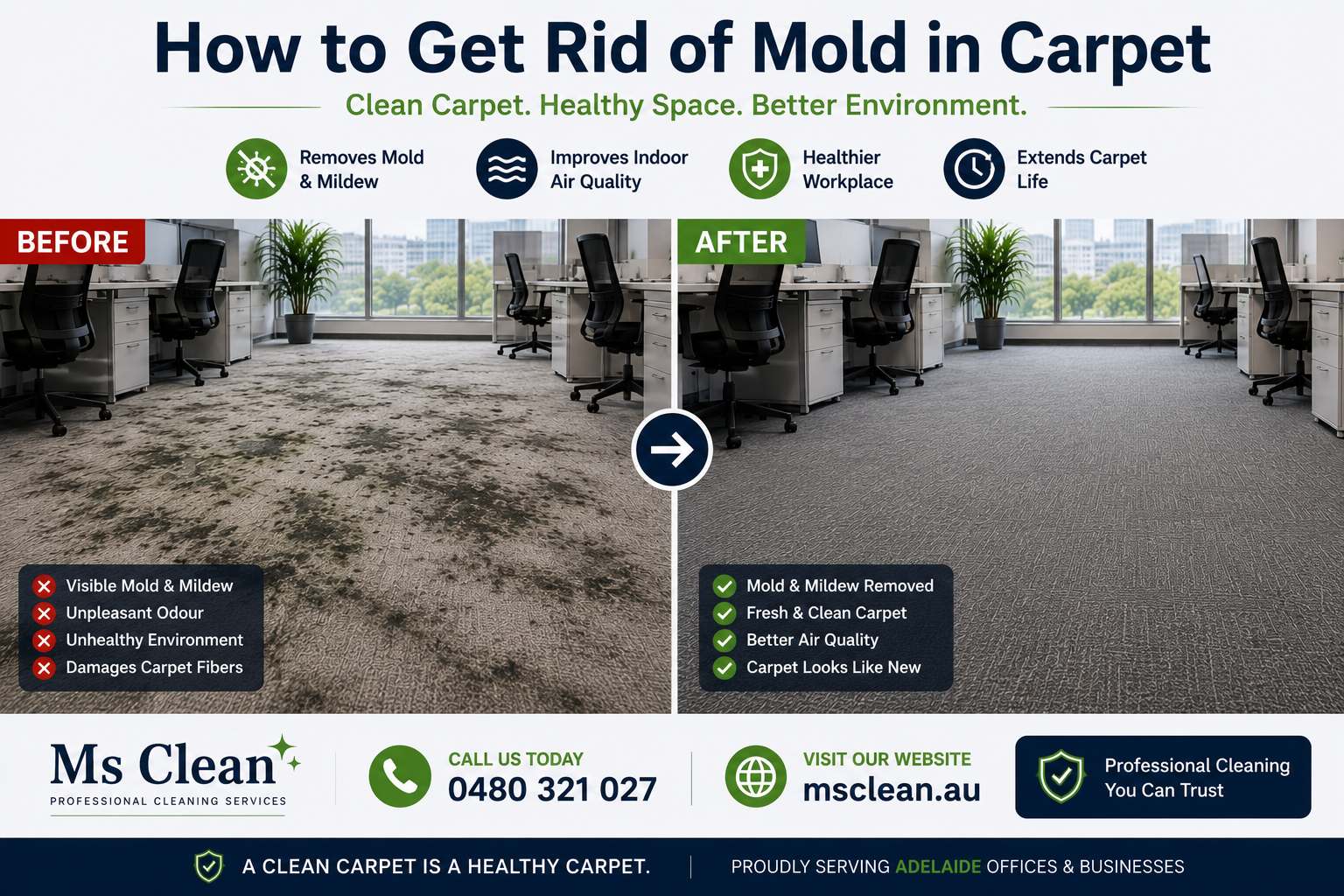
How do you get rid of mold in carpet?
To get rid of mold in carpet: ventilate the room, dry-vacuum with a HEPA filter to capture spores, apply an enzyme-based anti-fungal treatment and allow 20 to 30 minutes contact time, then extract with hot water at 90 to 95°C. Dry completely within 4 hours using industrial air movers. Important: if mold has reached the carpet backing, underlay, or subfloor common in Adelaide after winter rain or flooding professional removal is the only effective solution. DIY methods fail below the surface.
First Understand What You’re Actually Dealing With
Not everything dark on your carpet is mold. And not all mold is the same. Getting this right determines whether your DIY approach has any chance of working or whether you’re wasting time while the problem gets worse underground.
How to Tell If It’s Actually Mold
Mold in carpet has a distinct profile that separates it from ordinary stains or dirt:
- Fuzzy, powdery, or velvety texture, not just flat discolouration
- Dark colours: black, dark green, grey, or white patches, often with irregular edges
- A persistent musty, damp, or earthy smell that returns even after vacuuming
- Location pattern: corners, under furniture, along walls, near windows, in rooms with past water exposure
- Household members experiencing unexplained sneezing, coughing, or itchy eyes when in the affected room
The 4 Most Common Carpet Mold Species in Adelaide
| Mold Species | Appearance | Risk Level | Adelaide Context |
|---|---|---|---|
| Aspergillus | Grey, green, white | Medium-High | Most common — found in damp rooms after winter rainfall |
| Cladosporium | Olive, black | Medium | Common under rugs, behind furniture in older Adelaide offices |
| Penicillium | Blue-green | Medium | Fast-spreading — accelerates post-flood in northern suburbs |
| Stachybotrys (black mold) | Black, slimy | HIGH | Found where moisture has persisted for weeks — toxic mycotoxins |
If You Suspect Black Mold (Stachybotrys) — Stop and Call a Professional
Stachybotrys chartarum produces mycotoxins that cause serious respiratory and neurological symptoms with prolonged exposure. It requires professional containment and remediation following IICRC S520 standards. Do not attempt to scrub, vacuum without HEPA containment, or apply bleach — all of which spread spores rather than containing them. Ms Clean provides same-day emergency mold assessment across all Adelaide suburbs.
What Causes Mold in Carpet? (Adelaide-Specific Triggers)
Mold needs three things to grow: moisture, organic material to feed on, and warmth. Your carpet provides the last two permanently. Which means moisture is the variable you need to understand — and in Adelaide, there are several common sources:
| Cause | How It Creates Mold | Adelaide Risk Factor |
|---|---|---|
| Winter rain & flooding | Water penetrates underlay and subfloor within hours | HIGH — June–Aug Adelaide wet season |
| DIY wet cleaning — slow drying | Damp carpet left 12+ hours begins mold in backing | HIGH — common DIY mistake in winter |
| Burst pipes / leaks | Hidden moisture migrates under carpet without visible signs | HIGH — older housing in northern suburbs |
| High indoor humidity | Condensation saturates carpet fibres gradually over weeks | MEDIUM — sealed offices in Adelaide winter |
| Spills not fully dried | Liquid reaches backing before evaporating from surface | MEDIUM — any household year-round |
| Poor sub-floor ventilation | Ground moisture rises through concrete slabs into carpet | HIGH — pre-1980 Adelaide brick offices |
Adelaide Winter = Peak Mold Season
Adelaide’s June to August rainfall averages 60–80mm per month. Combined with closed-up offices, reduced ventilation, and older housing stock particularly across Prospect, Salisbury, Elizabeth, Pooraka, and Modbury this creates ideal carpet mold conditions every year. If your carpet was wet at any point during the last winter and you’re now noticing a smell or discolouration, mold is the most likely explanation.
How to Get Rid of Mold in Carpet — What You Can Do Yourself
DIY mold removal works only for surface mold — growth limited to carpet fibres with no penetration into backing, underlay, or padding. If there is any smell, if the area is larger than about 30cm x 30cm, or if moisture has come from below the carpet, skip to the professional section. For genuine surface-only mold, here is the correct approach:
What You Need Before You Start
- N95 or P2 respirator mask -standard masks do not filter mold spores
- Rubber gloves and eye protection — mold contact irritates skin and eyes
- HEPA-filter vacuum — standard vacuums recirculate spores back into the air
- Enzyme-based anti-fungal spray — not vinegar, not bleach (see warning below)
- Clean white cloths for blotting — never coloured fabric, which can transfer dye
- Fan heater or high-airflow fan for drying
Do Not Use Bleach or Vinegar on Carpet Mold
Bleach cannot penetrate carpet fibres to reach mold in the backing it bleaches surface colour while leaving the mold alive underneath. Vinegar is antifungal at full concentration but evaporates before reaching the backing mold and does not remove mold matter, only suppresses it temporarily. Both create false confidence that the problem is solved when it is not. Use only enzyme-based anti-fungal products rated for soft furnishings.
STEP 1 Ventilate the Room Fully
Open all windows and doors before starting. Place a fan to direct airflow out of the room — not into adjacent areas. This reduces airborne spore concentration during treatment. Do not run reverse-cycle air conditioning on recirculate mode, which spreads spores throughout the office.
STEP 2 HEPA Dry Vacuum — Don’t Skip This
Vacuum the entire affected area slowly using a HEPA-filter vacuum. This removes loose spores and dry mold matter from the carpet surface before any liquid is applied. Applying liquid to dry loose mold embeds it deeper into the fibre. Empty the HEPA canister directly into a sealed plastic bag outdoors — never indoors.
STEP 3 Apply Enzyme Anti-Fungal Treatment
Spray an enzyme-based anti-fungal product rated for carpets and soft furnishings onto the affected area. Ensure the product is damp but not saturated — over-wetting is itself a mold risk. Allow the full recommended contact time (typically 15–30 minutes). The enzyme compounds break down mold cell walls at the molecular level rather than simply suppressing surface growth.
STEP 4 Blot — Never Scrub
Using a clean white cloth, blot the treated area firmly to lift dissolved mold matter and enzyme solution from the fibres. Work from the outer edge of the affected area inward to avoid spreading. Replace the cloth as soon as it becomes discoloured. Scrubbing damages carpet fibres and spreads contamination laterally.
STEP 5 Dry Completely Within 4 Hours
This is the most critical step. Aim carpet at a fan heater set to medium heat and direct airflow across the pile. The carpet must be fully dry — not just surface-dry — within 4 hours. Press a dry cloth firmly into the pile and check for any moisture transfer. If the carpet is still damp after 4 hours, mold will re-establish in the backing.
STEP 6 Inspect at 48 Hours
Return to the area after 48 hours. Check for any returning discolouration, texture change, or odour. If any sign of mold has returned, DIY treatment has failed — the mold is below the surface and professional remediation is required. Do not repeat DIY treatment; you are compounding the moisture problem.
Not Sure If DIY Is Enough? Get a Free Assessment.
Ms Clean’s Adelaide technicians will tell you honestly whether DIY can handle it — or whether professional treatment is needed. No pressure. No hidden fees.
Book Free Mold Assessment → Ms Clean.au | Call 08 (0480 321 027 ) | 7 Days

When You Must Call a Professional — Non-Negotiable Situations
These situations require professional carpet mold removal. DIY treatment in any of these cases will not solve the problem and may make it significantly worse by spreading spores and adding more moisture:
- The musty smell persists after 48 hours of DIY treatment — mold is in the backing or underlay
- The affected area is larger than 0.3 square metres (roughly 60cm × 60cm)
- The carpet was soaked by flooding, a burst pipe, storm water, or a roof leak
- Discolouration appears on the backing when you lift a corner of the carpet
- The property houses children under 5, elderly residents, or immunocompromised individuals
- You suspect Stachybotrys (black mold) based on the colour, texture, or smell
- The mold has returned after a previous treatment — professional or DIY
- The property is an aged care facility, childcare centre, NDIS office, or commercial space
Professional Carpet Mold Removal — Ms Clean’s Complete Process
Here is exactly what happens when Ms Clean’s team removes carpet mold in an Adelaide property — from the first inspection call to the post-treatment clearance:
Phase 1 Inspection & Moisture Mapping
Before any treatment begins, our technician uses calibrated moisture meters to map the true extent of mold penetration through every carpet layer: surface pile, backing, underlay, and subfloor. This tells us the severity category, the correct treatment protocol, and whether underlay replacement is required. No honest mold assessment can be done by eye alone.
Phase 2 Spore Containment
The affected room is isolated and negative air pressure is established using HEPA air scrubbers to prevent spores migrating to other rooms during treatment. Entry points are sealed. This step, almost universally skipped by general carpet cleaners, is what separates mold remediation from mold spreading.
Phase 3 HEPA Extraction of Dry Mold Matter
Commercial HEPA vacuums remove loose and semi-attached mold matter from the carpet surface and pile before any liquid treatment is applied. All waste is sealed in containment bags and removed from the property.
Phase 4 Enzyme Anti-Fungal Pre-Treatment
GECA-approved enzyme anti-fungal solution is applied to the full affected zone, including adjacent carpet areas identified by moisture mapping as at-risk. Contact time of 20–30 minutes is maintained. Our products are non-toxic and safe for children, elderly residents, and pets — critical for Adelaide’s regulated care facilities and family offices.
Phase 5 Hot Water Extraction at 90–95°C
Our truck-mounted and portable hot water extraction units deliver water at 90–95°C through the carpet pile, backing, and into the top of the underlay — flushing dissolved mold matter, enzyme solution, and residual spores from the full depth of the carpet in a single high-pressure pass. Domestic carpet cleaners operate at 60–70°C, which does not achieve the same penetration or kill rate.
Phase 6 Industrial Drying (4–8 Hours)
Industrial-grade air movers and dehumidifiers are deployed to reduce carpet drying time to 4–8 hours — versus 24–48 hours for domestic drying. This is critical: extended dampness after treatment is itself a mold risk. Our drying protocol is what allows us to guarantee the treatment.
Phase 7 Post-Treatment Clearance Check
Final moisture readings confirm the carpet has returned to safe levels. For commercial, aged care, childcare, and NDIS properties, a written post-treatment clearance certificate is issued — documenting the treatment method, products used, temperature achieved, and final moisture readings. This supports SA Health and ACECQA compliance records.
How Much Does Carpet Mold Removal Cost in Adelaide? (2026 Guide)
Cost is one of the most searched aspects of carpet mold removal — and one of the least honestly answered online. Here is Ms Clean’s transparent 2026 Adelaide pricing:
| Service | Standard | Emergency / Same-Day | What’s Included |
|---|---|---|---|
| Single Room — Residential | From $149 | From $199 | HEPA vacuum, enzyme treatment, extraction, industrial dry |
| 2–3 Rooms | From $279 | From $379 | Full zone treatment + drying + moisture check |
| Whole office (4+ rooms) | From $399 | From $549 | All areas + final clearance report |
| Commercial — Office / Gym | From $299 | From $499 | Zone containment + treatment + compliance cert |
| Aged Care / Childcare | Quote required | Same-day available | Full IICRC protocol + SA Health compliance certificate |
| NDIS Property | Quote required | Priority available | NDIS-compliant report + documentation package |
What Determines Your Quote
The single biggest cost driver is mold depth surface-only treatment costs significantly less than full backing and underlay remediation. Other factors: carpet fibre type, suburb accessibility, time of booking (standard vs emergency), and whether underlay replacement is needed. All Ms Clean quotes are fixed-price, confirmed in writing before work begins. No surprises.
How to Stop Mold Coming Back in Your Carpet
Removing mold without fixing the moisture source is a temporary fix. Here is how to prevent carpet mold from returning after treatment — specific to Adelaide’s climate and housing conditions:
Indoor Humidity Control
- Keep indoor humidity below 55% use a digital hygrometer ($12–$25 from Bunnings) to monitor during Adelaide’s wet season
- Run a portable dehumidifier in high-risk rooms (ground floor, rooms over concrete slabs) from June through August
- Open windows for at least 20 minutes daily even in winter ventilation is the most effective mold prevention measure available
- Avoid drying laundry indoors during winter this alone can raise indoor humidity by 10–15%
Post-Cleaning Drying Protocol
- After any wet cleaning, direct a fan heater across the carpet surface for a minimum of 4 hours
- Never leave carpet even slightly damp overnight; damp carpet left for 12 hours begins mould growth in backing
- If you use a DIY carpet shampooer, follow immediately with maximum fan speed and open windows
- Book annual professional cleaning in autumn (April ti May) before Adelaide’s wet season begins
Structural Fixes for High-Risk Adelaide offices
- Have sub-floor vents inspected and cleared critical for pre-1980 Adelaide offices with timber floors over earth
- Repair any roof, window frame, or plumbing leak within 48 hours even minor seepage creates carpet mold within 2 days
- Consider moisture-resistant underlay in ground-floor rooms particularly in northern suburb offices on older slabs
- Install door sweeps on external-facing doors to reduce winter condensation entering ground floor rooms
Adelaide Suburbs We Serve for Carpet Mold Removal
Ms Clean provides professional carpet mold removal across the full Adelaide metropolitan area, 7 days a week, with same-day emergency availability:
- Northern Suburbs: Prospect · Salisbury · Elizabeth · Pooraka · Modbury · Gawler · Para Hills · Ingle Farm · Golden Grove
- Inner Adelaide: North Adelaide · Norwood · Unley · Parkside · Bowden · Hindmarsh · Adelaide CBD
- Southern Suburbs: Mitcham · Blackwood · Morphett Vale · Happy Valley · Noarlunga · Flagstaff Hill
- Eastern Suburbs: Burnside · Magill · Campbelltown · Newton · Tea Tree Gully · Athelstone
- Western Suburbs: Henley Beach · Grange · Semaphore · Woodville · Findon · Pennington · Royal Park
Related Services from Ms Clean — Adelaide Carpet & Cleaning Specialists
Carpet mold removal is often connected to broader moisture and cleaning needs. Explore related Ms Clean services:
- Remove Mould From Carpet Adelaide our cornerstone mold remediation service page
- Flooded Carpet Drying Adelaide emergency drying within hours to prevent mold establishing post-flood
- Wet Carpet Water Extraction Adelaide industrial extraction for water-damaged carpets
- Commercial Carpet Cleaning Adelaide scheduled maintenance for offices and commercial premises
- Aged Care Cleaning Adelaide SA Health-compliant mold remediation with compliance certificates
- Childcare Centre Cleaning Adelaide ACECQA compliant, GECA approved treatments
Frequently Asked Questions — Getting Rid of Mold in Carpet
Q1. Can carpet mold be removed completely, or does the carpet need to be replaced?
In most cases, carpet mold can be fully removed without replacement provided treatment is carried out before the mold has structurally damaged the backing or underlay. Carpets where mold has caused significant backing deterioration, or where subfloor contamination is severe, may require partial or full replacement. Ms Clean provides an honest assessment before any work begins. We will never recommend replacement if restoration is viable.
Q2. Is it safe to stay in the house while carpet mold is being removed?
For surface-level mold in a single room, the rest of the house is generally safe to occupy during treatment. For larger mold jobs particularly those involving suspected Stachybotrys or multiple rooms we recommend vacating the affected areas during active extraction. Our containment protocols prevent spore migration, but occupants with respiratory conditions should leave for the duration. We advise case by case during the initial assessment.
Q3. How quickly can mold grow in wet carpet in Adelaide?
Mold can begin colonising wet carpet within 24 to 48 hours at typical Adelaide indoor temperatures. In summer (25–30°C), growth can begin in under 12 hours. In winter (15–20°C), the window extends to 48–72 hours. This is why water extraction within 24 hours of flooding or leaking is critical Ms Clean offers emergency same-day response for all Adelaide suburbs.
Q4. Does carpet mold removal remove the smell permanently?
Yes when mold is fully eliminated at the source, the associated musty smell disappears permanently. The smell is produced by volatile organic compounds (VOCs) released by active mold metabolism. If smell returns after treatment, it means mold was not fully removed and is still active in the backing or underlay. Ms Clean’s hot water extraction process removes mold matter from all carpet layers, which is why post-treatment odour elimination is consistently complete.
Q5. Can I use a steam cleaner to get rid of carpet mold?
Standard steam cleaners operate at 60–70°C and do not include anti-fungal pre-treatment, HEPA spore containment, or adequate extraction. At this temperature, mold is inhibited but not killed in carpet backing. Without extraction, you are adding moisture to an already mold affected surface which worsens the problem. Professional hot water extraction operates at 90–95°C with enzyme pre-treatment and immediate extraction, which is fundamentally different from consumer steam cleaning.
Q6. What should I do if I find mold under my carpet (in the underlay)?
Stop walking on that area and call a professional immediately. Mold in the underlay indicates moisture has penetrated from below either from a subfloor moisture source, flooding, or a long-standing leak. This level of contamination requires IICRC S520-standard professional remediation, and in most cases the underlay will need to be replaced while the carpet itself may be salvageable. Ms Clean provides same-day emergency inspection across all Adelaide suburbs.
Q7. How long after professional mold removal can I walk on the carpet?
With Ms Clean’s industrial drying equipment, carpets are typically ready to walk on within 4 to 6 hours of treatment completion. Without industrial drying, this extends to 12–24 hours. We advise keeping foot traffic minimal for the first hour after our team completes drying and conducts the final moisture check. For childcare and aged care facilities, we time treatments during unoccupied periods to ensure full drying before residents or children return.
Q8. Does Ms Clean Cleaning Services provide mold removal in Adelaide’s northern suburbs?
Yes. Ms Clean regularly services Prospect, Salisbury, Elizabeth, Modbury, Pooraka, Para Hills, Golden Grove, Ingle Farm, and Gawler for carpet mold removal. Northern Adelaide suburbs have higher-than-average carpet mold incidence due to older housing stock, concrete slab construction with limited sub-floor ventilation, and proximity to flood-prone areas. Same-day emergency response is available in all northern suburbs 7 days a week.
Ready to Get Rid of Carpet Mold for Good?
Local office Employee Only Team · Same-Day Adelaide · Compliance Certificates Available
Get Your Free Quote → Ms Clean.au | Call (0480 321 027 ) | Open 7 Days ]