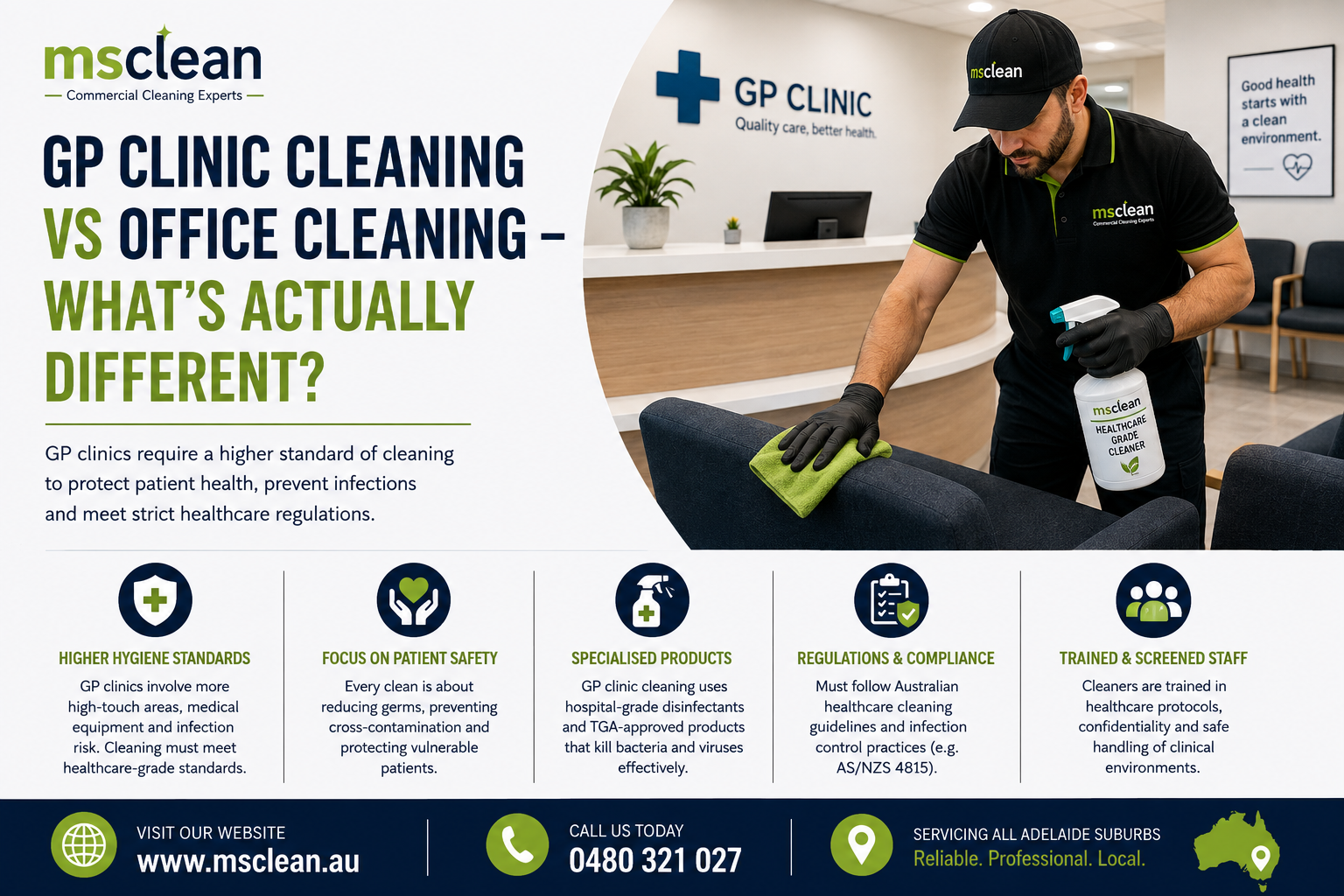
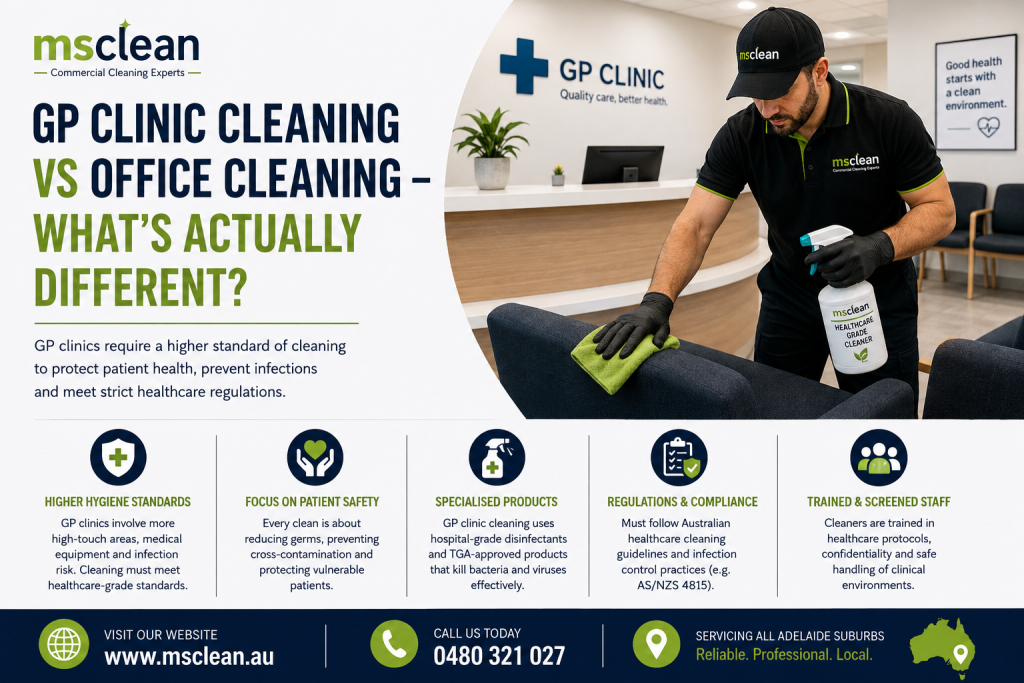
Office cleaning removes visible dust and grime, keeps spaces tidy, and maintains a professional appearance. GP clinic cleaning does all of that, plus disinfects surfaces to a clinical standard using TGA-listed hospital-grade products, applies a colour-coded system to stop pathogens crossing between zones, requires infection control-trained and police-cleared staff, and produces signed compliance documentation for RACGP accreditation. The products are different. The training is different. The method is different. And the legal accountability to SA Health, WHS legislation and the RACGP accreditation framework has no equivalent in standard commercial office cleaning.
The five main differences, confirmed across multiple healthcare sources:
- The goal: Office cleaning makes spaces look tidy. GP clinic cleaning stops pathogens spreading between patients and staff.
- Cleaning products: Offices use standard detergents and glass sprays. Clinics use TGA-listed hospital-grade disinfectants that kill dangerous bacteria at verified dwell times.
- Staff training: Office cleaners need no specialist health training. Clinical cleaners must complete infection control inductions covering biohazard handling, sharps awareness, PPE and patient privacy.
- Waste handling: Offices discard paper and general rubbish. Clinics follow regulated procedures for clinical and biohazard waste.
- Method: Offices clean every room the same way. Clinics use colour-coded tools by zone so pathogens from examination tables cannot transfer to waiting room chairs.
Your practice manager rings a commercial cleaning company. They ask whether the company cleans medical centres. The company says yes. The price is competitive. The contract starts next Monday.
By week three, your RACGP accreditation coordinator asks for the cleaning records. There are none. She asks which TGA-listed products the cleaner is using. Nobody knows. She asks about the colour-coded zone system for cross-contamination prevention. The cleaner has never heard of it.
This is not a hypothetical. It happens in Adelaide GP clinics every year. Not because the cleaning company is dishonest; they do clean your clinic, but because the word “cleaning” covers two completely different services depending on the environment.
This article explains what makes GP clinic cleaning different from standard office cleaning, why those differences exist, and what they mean in practice for Adelaide medical centres.
The Core Difference Is Not the Dust, It Is the Risk
An office gets dirty because people sit at desks, drink coffee, and track in grime from outside. The main risk of an inadequately cleaned office is that it looks unprofessional and feels unpleasant.
A GP clinic gets dirty because sick people pass through it all day. They sit in the waiting room chairs. They touch the reception counter. They use the bathroom. They sit on the examination table. Every one of those interactions deposits pathogens on surfaces that the next patient will contact.
The consequence of inadequate office cleaning is an unpleasant workspace. The consequence of inadequate GP clinic cleaning is an infection risk for patients whose immune systems are already compromised.
That difference in consequence drives every other difference between the two types of cleaning.
Products: What Each Environment Actually Needs
This is where the gap shows up most clearly and where most general cleaning companies fall short without realising it.
What standard office cleaning uses
General-purpose detergents, glass cleaners, surface sprays and multi-purpose wipes. These products clean visible soiling effectively. They remove dust, smears and general grime. Most do not carry TGA registration for pathogen kill claims.
What GP clinic cleaning requires
TGA-listed disinfectants with an ARTG (Australian Register of Therapeutic Goods) number. The Therapeutic Goods Administration has evaluated these products against specific pathogens. The label specifies which organisms the product kills, at what concentration, and how long the surface must remain wet before the disinfectant has done its job this is the dwell time.
Applying a TGA-listed disinfectant and wiping it off immediately is not disinfection. It is moistening. The dwell time typically two to ten minutes depending on the product and target pathogen must be observed for the product to deliver its claimed efficacy.
Standard commercial cleaning products do not have ARTG numbers. They clean surfaces. They do not disinfect them to a clinical standard. A GP clinic that relies on standard commercial products on examination tables, waiting room chairs and bathroom surfaces is not meeting the cleaning requirements that SA Health and the RACGP expect of a healthcare facility.
Here is what that looks like side by side:
| Product Factor | Office Cleaning | GP Clinic Cleaning |
| Product category | General detergents, multipurpose sprays | TGA-listed hospital-grade disinfectants |
| Regulatory status | No specific requirement | ARTG registration required for clinical surfaces |
| Dwell time | Not applicable | 2 to 10 minutes per product/pathogen specification |
| Surface residue | Acceptable | Low-VOC, patient-safe products required |
| Fragrance | Standard | Fragrance-free available for sensitive clinical environments |
| Product documentation | Not required | Product data sheets with ARTG numbers for RACGP records |
Staff Training: The Gap Nobody Talks About
Ask any commercial cleaning company whether their staff are trained. They will all say yes. The question worth asking is: trained for what?
Office cleaning induction
Covers how to operate cleaning equipment, which products to use on which surfaces, basic workplace safety, and site-specific instructions like which rooms are locked and where supplies are stored. This is appropriate for the work being done.
GP clinic cleaning induction
Covers all of the above, plus:
- SA Health risk zone classification and how it determines cleaning method and frequency by area
- TGA disinfectant dwell time requirements for each product in the cleaning kit
- Colour-coded zone protocols — which colour goes to which zone, why crossing zones matters, what to do when a cloth leaves its zone
- PPE selection: which gloves, mask and apron are required for which cleaning task
- Sharps recognition and avoidance — never touching, moving or repositioning any sharps container regardless of apparent fullness
- Biohazard signage recognition and correct response
- Blood and bodily fluid spill protocol: contain, treat with appropriate disinfectant, document, dispose
- Patient privacy obligations: documents are not read, screens are not looked at, conversations are not repeated
- Site-specific protocols for each clinic
A clinical cleaning induction is not a single afternoon’s training. Ms Clean’s healthcare cleaning team members complete a structured induction before their first day in any medical facility, and training records are held on file for each technician.
The gap between these two training programmes is one reason why GP clinic cleaning costs more than office cleaning and why it should.
The Practical Point
Here is a specific example of why training matters in a clinical environment.
A standard office cleaner empties a bin. They take the bag out, tie it off, and replace it. In an office, this is correct.
A clinical cleaner checks whether the bin has clinical waste before touching it. If it does, they do not touch the contents. They alert the practice manager and follow the clinical waste handling protocol. They document the observation.
An office cleaner who has not had clinical waste training in a GP clinic does not make this distinction. They empty the bin. If there is contaminated material in it, they handle it without appropriate PPE.
This is not an edge case. It is a foreseeable scenario in any functioning GP clinic. It is one of the reasons that healthcare cleaning requires specific training rather than a standard commercial cleaning induction.
Waste Handling: Legally Different Categories
Office waste is largely paper, packaging, food waste from the kitchen, and general rubbish. Most Australian offices operate a two-stream system: general waste and recycling.
GP clinic waste includes all of the above, plus:
- Clinical waste (sharps, contaminated dressings, blood-stained materials, pathological waste)
- Pharmaceutical waste (expired or unused medications)
- Cytotoxic waste in practices with oncology services
Under South Australian waste management legislation and SA Health clinical waste guidelines, each of these categories has specific handling, containment, labelling and disposal requirements. Clinical waste in South Australia must be disposed of through licensed clinical waste contractors. Sharps require approved sharps containers, correct storage and licensed collection.
A GP clinic cleaning provider is not responsible for collecting or disposing of clinical waste — that responsibility sits with clinical staff and licensed waste contractors. But a clinical cleaning provider must recognise clinical waste, must not handle it outside their training scope, and must flag any compliance concern immediately.
A standard office cleaner who has not received clinical waste training cannot reliably make these distinctions. The risk is not theoretical. Handling clinical waste without appropriate training and PPE carries genuine health risk for the cleaner and liability risk for the practice.
Method: How Each Environment Gets Cleaned
Office cleaning applies a consistent method across the entire space. The same cloth cleans the boardroom table and the staff kitchen bench. The same mop covers the reception floor and the bathroom floor.
In a GP clinic, this approach is not acceptable because it moves pathogens between zones.
The colour-coded system
Every cloth and mop in a GP clinic cleaning programme carries a colour designation. Each colour belongs to a specific zone. No cloth or mop crosses zone boundaries.
- Red: High-risk clinical areas — examination rooms, procedure rooms, treatment areas
- Yellow: Bathrooms and sanitary facilities
- Blue: General patient areas — waiting room, reception, corridors
- Green: Staff areas — kitchen, lunchroom, administration offices
When a yellow cloth cleans a bathroom, it goes into a sealed laundry bag. A new blue cloth cleans the reception counter. They never change places.
In addition, clinical cleaners use single-use cloths per room. One cloth enters one consultation room. When the room is done, the cloth goes directly into a sealed laundry bag. The next consultation room gets a fresh cloth.
No office cleaning programme operates at this level of cross-contamination control because no office environment creates the same cross-contamination risk.
The clean-to-contaminated sequence
Clinical cleaning always moves from the least contaminated areas to the most contaminated within any session. Staff areas are cleaned before patient areas. Waiting rooms before bathrooms. Consultation rooms before procedure rooms.
This sequence is not intuitive most people would start with the worst-looking area. But it prevents contamination from higher-risk zones being carried backward into lower-risk spaces through the cleaner’s equipment or movements.
Dwell times: the step office cleaning skips because it doesn’t need to
After applying a disinfectant in a GP clinic, the surface must remain wet for the specified dwell time before it gets wiped. This is the period during which the product kills its target pathogens. In an office, most spray-and-wipe products are safe to remove immediately because the goal is cleaning rather than disinfection.
In a clinical zone, wiping a disinfectant off before its dwell time expires wastes the product and delivers no disinfection benefit whatsoever. The surface looks clean because it has been wiped. It is not disinfected because the product did not have time to work.
Documentation: Where the Difference Becomes Legally Relevant
This is the area where the consequences of choosing the wrong cleaning provider become most tangible for Adelaide GP clinics.
Office cleaning documentation
Most commercial office cleaning contracts produce no formal documentation. The cleaner comes, cleans and leaves. If you need to confirm that the office was cleaned on a specific date, you are largely relying on memory or checking whether the bins were emptied.
GP clinic cleaning documentation
Every professional healthcare cleaning visit should produce a signed cleaning record specifying:
- Date and time of the clean
- Areas cleaned
- Products used, including product name and ideally the TGA ARTG number
- Dwell times applied
- Attending technician’s name
This record has three uses. It demonstrates to a RACGP accreditation assessor that cleaning is being performed at the required frequency and to the required standard. It supports your WHS obligations under South Australian workplace health and safety legislation. And it provides an evidence base if an infection control concern is ever investigated.
No cleaning record means no evidence. An Adelaide GP clinic that cannot produce signed cleaning records for the past 12 months has a documentation gap that an RACGP accreditation review will identify.
Standard commercial cleaning providers do not produce this documentation as a matter of course. Healthcare cleaning specialists do, because their clients need it.
Cost: Why GP Clinic Cleaning Costs More
The premium is not arbitrary. Each element that differentiates GP clinic cleaning from office cleaning adds real cost.
TGA-listed disinfectants cost more than standard commercial products. The additional induction training required before a technician works in a clinical facility costs time and resources. The documentation systems — cleaning record templates, filing, review processes — add administrative overhead. Police clearances for every staff member add per-person costs. The colour-coded equipment system adds material costs per site.
General commercial cleaning in Adelaide costs $35 to $55 per hour. GP clinic cleaning costs $55 to $75 per hour or more. That difference is not margin. It is the cost of the additional requirements that make a clinical cleaning service genuinely different from an office cleaning service.
A practice that chooses a general commercial cleaner at $38 per hour to save money against a clinical cleaning quote at $65 per hour is not comparing equivalent services. They are comparing two different products. The cheaper option delivers a clean space. The more expensive option delivers a clean space plus compliance documentation, TGA-listed products at verified dwell times, infection control-trained staff and cross-contamination prevention systems.
The Practical Test: Can Your Current Cleaner Pass This Check?
If you are unsure whether your current cleaning provider is delivering office cleaning or clinical cleaning in your GP clinic, ask these five questions. The answers will tell you immediately.
1. What TGA-listed products do you use on clinical surfaces?
A clinical cleaning specialist can name the products and provide the ARTG numbers. A general commercial cleaner either does not know or names products that are not TGA-listed for clinical use.
2. Do you use a colour-coded zone system?
Any clinical cleaning specialist can describe the system without hesitation — Red clinical, Yellow bathrooms, Blue patient areas, Green staff. If your provider does not use one, pathogens are crossing between zones on every visit.
3. Do you provide signed cleaning records after every visit?
Clinical cleaning requires this. Office cleaning does not. If your provider does not provide records, you have no compliance documentation for your RACGP accreditation file.
4. Are your cleaners police cleared and healthcare-inducted?
Every clinical environment handling patient information requires police-cleared staff. Healthcare-specific induction covers sharps, biohazard, PPE and patient privacy. If your provider cannot confirm both, they have not prepared their staff for a clinical environment.
5. Do your staff know what to do if they encounter clinical waste in a bin?
The correct answer is: do not touch it, alert the practice manager, follow the clinical waste protocol. If the honest answer is that they would empty the bin like any other, the training gap is real.
Adelaide GP Clinic Context
The cleaning requirements described in this article apply to every GP clinic in South Australia. They reflect the SA Health Environmental Cleaning Policy 2021 and the RACGP accreditation standards under which Adelaide practices operate.
Ms Clean provides GP clinic cleaning across Adelaide: CBD, Norwood, Unley, Prospect, Salisbury, Mawson Lakes, Burnside, Mitcham, Campbelltown, Glenelg, Marion and surrounding suburbs. Every contract includes TGA-listed products, a colour-coded zone system, signed cleaning records, police-cleared, infection-control-trained staff, and $20 million public liability insurance.
Call Now
Ms clean Au
Address: 71 Alexandra Street, Prospect, SA-5082
M : 0480 321 027
E-Mail: contact@msclean.au
FAQs
Q1. What is the main difference between GP clinic cleaning and office cleaning?
The goal is different. Office cleaning keeps spaces looking tidy and removes visible grime. GP clinic cleaning kills pathogens on surfaces to a clinical standard using TGA-listed disinfectants at verified dwell times, prevents cross-contamination between clinical zones using colour-coded systems, requires infection control-trained staff, and produces signed compliance records for RACGP accreditation. The products, training, method and documentation requirements are all distinct from standard commercial cleaning.
Q2. Can a regular office cleaner clean a GP clinic?
Technically, an office cleaner can enter a GP clinic and clean it. Whether they deliver the infection control standard that a functioning GP clinic requires is a separate question. An office cleaner without clinical training does not know the dwell time requirements for TGA-listed disinfectants, does not use a colour-coded zone system, cannot produce compliance documentation and has not been inducted on sharps awareness or biohazard protocols. Using an office cleaner in a clinical environment creates compliance gaps that a RACGP accreditation assessor will identify.
Q3. Why do GP clinics need TGA-listed disinfectants rather than standard cleaning products?
TGA-listed disinfectants carry an ARTG number confirming that the Therapeutic Goods Administration has evaluated them against specific pathogens at specific concentrations and dwell times. Standard cleaning products make no such regulatory claim. In a GP clinic where surfaces contact patients who are unwell and immunocompromised, products without validated efficacy against clinical pathogens do not provide the infection control protection that the environment requires.
Q4. What is the colour-coded cleaning system and why does GP clinic cleaning use it?
The colour-coded system assigns specific cloths and mops to specific zones — Red for high-risk clinical areas, Yellow for bathrooms, Blue for waiting room and reception, Green for staff areas. No equipment crosses zone boundaries. Combined with single-use cloths per room, this prevents pathogens from examination tables being carried to waiting room chairs, or bathroom contaminants reaching clinical surfaces. Office cleaning does not require this level of zone control because the infection risk profile is fundamentally different.
Q5. What documentation does GP clinic cleaning produce that office cleaning does not?
GP clinic cleaning produces a signed cleaning record after every visit specifying areas cleaned, products used, dwell times applied, and the attending technician. This documentation serves RACGP accreditation assessors, WHS compliance requirements, and any infection control investigation. Office cleaning rarely produces any documentation beyond an invoice.
Q6. How much more does GP clinic cleaning cost than office cleaning in Adelaide?
General commercial office cleaning in Adelaide costs $35 to $55 per hour. GP clinic cleaning costs $55 to $75 per hour or more. The difference reflects TGA-listed products, clinical staff training and induction, police clearances, documentation systems and cross-contamination prevention equipment — not additional margin.
Q7. What happens if a GP clinic in Adelaide uses an office cleaning service instead of a clinical cleaning provider?
The most immediate risk is a compliance gap in RACGP accreditation documentation. The infection control risk comes from surfaces not being disinfected to the clinical standard required TGA-listed products at correct dwell times, colour-coded zone systems, between patient room preparation. Over time, this creates an environment where the risk of healthcare-associated infections among patients is higher than it should be, and the practice is exposed to accreditation failure and potential regulatory scrutiny.