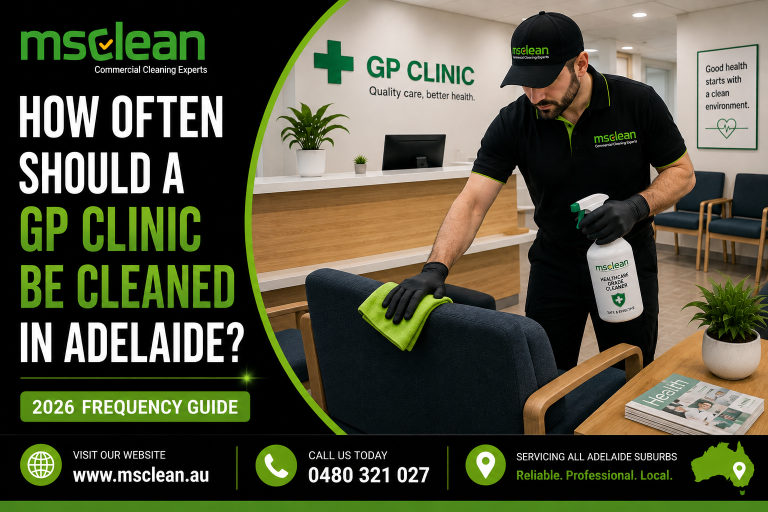

Adelaide GP clinics must follow four overlapping compliance frameworks simultaneously. The RACGP Infection Prevention and Control Guidelines require a documented cleaning policy, zone-specific risk analysis, TGA listed hospital grade disinfectants on all clinical contact surfaces, colour coded cross-contamination prevention, disinfection of examination beds between patients, formal waste segregation, and monitoring of cleaning effectiveness. The SA Health Environmental Cleaning Policy 2021 sets risk zone classifications and minimum cleaning frequencies for South Australian healthcare facilities. The WHS Act 2012 (SA) requires safe work procedures and trained staff for clinical cleaning tasks. TGA registration requirements mandate ARTG-listed products on clinical surfaces. Non-compliance with any of these exposes the practice to accreditation failure, WHS liability and elevated patient infection risk.

The core rules Adelaide GP clinics must follow, confirmed by RACGP and SA Health sources:
Hospital-grade products:
- Use only TGA-listed disinfectants on all clinical contact surfaces
- Standard household or commercial sprays do not meet this requirement
High-touch areas:
- Clean and disinfect frequently touched surfaces at least daily, or immediately if soiled
- This includes reception counters, door handles, EFTPOS terminals and waiting room chair armrests
Between patients:
- Disinfect examination beds, headrests and direct contact tools after each patient use
- Not end of day — after each patient
Cross-contamination control:
- Use colour-coded cleaning equipment and appropriate PPE
- No tool crosses zone boundaries
Waste and management:
- Safely separate clinical, biohazard and general waste
- Keep clear cleaning logs and written infection control policies
- Ensure all staff and cleaning teams receive formal infection control training
Every Adelaide GP clinic gets cleaned. The compliance question is not whether cleaning happens it is whether what is happening meets the specific standards the clinic is legally and professionally obligated to follow.
The RACGP Infection Prevention and Control Guidelines are the primary framework. SA Health’s Environmental Cleaning Policy 2021 is the state-level standard. The WHS Act 2012 (SA) is the law. TGA product requirements are the regulatory baseline for every disinfectant that comes into contact with a clinical surface.
These are not suggestions. They are requirements, and they apply simultaneously, not as alternatives.
Most Adelaide practice managers know cleaning is important. Fewer know exactly what each framework requires and how to demonstrate compliance when an accreditation assessor asks. This guide explains both, in plain language, with the specific requirements from each framework laid out clearly.
The Four Frameworks and How They Overlap
Understanding which standard applies where helps practice managers know whom they are accountable to and for what.
RACGP Infection Prevention and Control Guidelines
This is the professional accreditation standard. It governs what GP clinics must have in place to achieve and maintain RACGP accreditation. Chapter 9 of these guidelines directly covers cleaning, laundry, and waste management.
The key language is must. The practice must have a current cleaning policy. It must perform a risk analysis. It must use TGA-listed products. These are accreditation requirements, not recommendations. A practice that cannot demonstrate compliance with these requirements during an accreditation review faces findings that must be remediated before the next cycle.
SA Health Environmental Cleaning Policy 2021 (v1.0 revised final)
This is the South Australian state government policy for environmental cleaning in healthcare facilities. It classifies every area in a healthcare setting by risk zone and specifies minimum cleaning frequencies, disinfectant categories and documentation requirements.
Adelaide GP clinics operate in South Australia. This policy applies to them directly. It is the framework that determines which areas of your clinic need which level of cleaning, at what frequency, and with which products.
Work Health and Safety Act 2012 (SA)
This is South Australian workplace safety law. It makes practice owners and managers directly responsible for maintaining a safe environment for staff and patients. In the context of clinical cleaning, inadequate training for cleaning staff, the absence of spill protocols, and insufficient cleaning frequency all create WHS exposure.
This is the framework that moves non-compliance from a professional accreditation question to a legal liability question.
TGA Product Requirements
The Therapeutic Goods Administration governs which disinfectant products carry validated clinical efficacy claims in Australia. Products used on clinical contact surfaces in Adelaide GP clinics must be listed on the Australian Register of Therapeutic Goods (ARTG). Using products without ARTG registration on clinical surfaces means the disinfection claim has not been verified by any Australian regulatory authority.
The Core Rules, Explained One by One
Rule 1: Hospital-grade products only on clinical surfaces
Use only TGA-listed disinfectants on all clinical contact surfaces. This is not about product marketing. The RACGP and SA Health frameworks require products with validated efficacy claims against the healthcare pathogens Staphylococcus aureus and Pseudomonas aeruginosa, as well as the broader spectrum of organisms that circulate in a GP clinic environment.
Hospital-grade in Australia means being TGA-listed under Therapeutic Goods Order No. 54 and having ARTG registration. The ARTG number on the product confirms the TGA has evaluated the efficacy claim. A product without an ARTG number has not been evaluated.
Standard commercial cleaning products, even those labelled “kills 99.9% of germs” do not carry ARTG registration for clinical use. They are not compliant with clinical contact surfaces, regardless of how effective they may be in general household or commercial environments.
What compliance looks like: Your cleaning provider names the TGA-listed products they use and provides ARTG numbers. Product data sheets are on file for your RACGP accreditation records.
Rule 2: High-touch surfaces cleaned and disinfected at least daily, or immediately if soiled
Clean and disinfect frequently touched surfaces at least daily, or immediately if soiled. The “immediately if soiled” clause matters as much as the daily minimum.
High-touch surfaces in an Adelaide GP clinic include reception counters, EFTPOS terminals, door handles in all patient-facing areas, waiting room chair armrests, patient information stands, telephone handsets and any surface a patient contacts during their visit. These surfaces pose the primary risk of contact transmission in any primary care environment.
Daily minimum disinfection covers the baseline. Soiling — a visible spill, a contamination event, a patient who coughs directly onto a surface — triggers immediate attention regardless of where in the daily schedule it occurs.
What compliance looks like: Intra-day disinfection rounds cover high-touch surfaces at least three times during operating hours, plus immediate response to any visible soiling.
Rule 3: Between-patient disinfection of examination beds, headrests and contact tools
Disinfect examination beds, headrests, and direct-contact tools after each patient use. Not end-of-day after each patient.
This is the rule most general commercial cleaners physically cannot deliver because their model involves one visit per day outside operating hours. A specialist medical cleaning team structures between-patient preparation as part of the clinical workflow — a three- to five-minute disinfection of the examination surface, patient seating, equipment surrounds, and door handles after each patient leaves the room.
TGA-listed disinfectant applied at the correct concentration. Dwell time observed before wiping. Single-use cloth — not the same cloth used in the previous patient’s room. This is what the RACGP Infection Prevention and Control Guidelines mean by scheduled cleaning of examination rooms.
What compliance looks like: For every consultation room where physical examination occurs, a documented between-patient cleaning protocol exists, is resourced, and is followed.
Rule 4: Colour-coded equipment and appropriate PPE throughout
Use colour-coded cleaning equipment and appropriate PPE. Cross-contamination is the primary risk of surface-transmitted infection in a GP clinic. The colour-coded system directly prevents it.
Every cloth and mop carries a zone designation. Red for high-risk clinical areas. Yellow for bathrooms. Blue for waiting room and reception. Green for staff areas. No tool crosses zone boundaries. A cloth that enters a bathroom does not enter a consultation room. A mop head used on the clinical floor does not touch the bathroom floor.
PPE requirements vary by task. Gloves for all clinical surface cleaning. Eye protection where splashing is possible. Apron for high-risk zones and spill response. The correct PPE for each task is specified in the practice’s cleaning policy and in the cleaning provider’s site-specific induction.
What compliance looks like: Your cleaning provider uses a documented colour-coded system. PPE requirements are specified for each task type in the cleaning plan. Technicians wear appropriate PPE observed on entry to each zone.
Waste Segregation: The Rule Most Clinics Get Partially Right
Safely separate clinical, biohazard and general waste. Most Adelaide GP clinics have some waste segregation system. Fewer have a system that fully meets the SA Health clinical and related waste management requirements.
The waste categories that apply in an Adelaide GP clinic:
| Waste Category | Examples | Segregation Requirement |
| Sharps | Needles, lancets, scalpel blades | Approved sharps containers, never manually recapped, licensed collection |
| Infectious clinical waste | Contaminated dressings, blood-soiled materials, pathological waste | Yellow clinical waste bags, separate from general waste, licensed contractor |
| Pharmaceutical waste | Expired or unused medications | Separate disposal stream, not general waste |
| Recyclable clinical waste | Some packaging from single-use items | Check SA Health guidance — not all are recyclable |
| General waste | Paper, food, standard packaging | Standard waste stream |
The two most common compliance failures:
First, clinical waste placed in general waste bins — most commonly blood-contaminated dressings or used gloves in consultation room general bins. This is both a WHS failure and a breach of clinical waste regulations.
Second, sharps containers not collected by licensed contractors before they reach full fill level. SA Health requires collection before the safety line is reached. A sharps container overfilled to the point where caps cannot be safely applied is a needle-stick injury risk and a compliance breach simultaneously.
What cleaning teams do and do not do:
A professional medical cleaning team empties general waste bins and replaces liners. They identify clinical waste and do not handle it. They flag any compliance concern to the practice manager and document it. They do not transport or dispose of clinical waste, sharps containers or pharmaceutical waste; these tasks require licensed clinical waste contractors.
Documented Schedules and Cleaning Logs
Keep clear cleaning logs and written infection control policies. This is where many Adelaide GP clinics have the largest gap relative to RACGP requirements.
The RACGP does not simply require cleaning. It requires documented evidence that cleaning happened, to the required standard, using the required products, at the required frequency.
What a compliant cleaning log contains after every professional visit:
- Date and time of the clean
- Areas cleaned, room by room
- Products used — name and ARTG number
- Dwell times observed for each disinfectant
- PPE worn during each zone’s cleaning
- Technician name and signature
- Any observations — soiling events, waste compliance concerns, areas needing attention
What a cleaning log cannot be:
A text message from your cleaner saying “done.” An invoice confirming a visit took place. A verbal confirmation from the technician. None of these constitutes a cleaning record that an RACGP accreditation assessor can review.
The written infection control policy:
The practice must have a current written cleaning policy that identifies staff responsibilities, WHS issues, and procedures for routine scheduled cleaning, unscheduled cleaning, and monitoring of effectiveness. This policy is a live document; current means it is reviewed and updated regularly, not written once in 2019 and left unchanged since.
Staff Training: Who Needs Training and on What
Ensure all staff and cleaning teams receive formal infection control training. This requirement applies to both the professional cleaning team and the clinical staff of the practice.
For the professional cleaning team:
Before their first visit to any clinical facility, every cleaning technician must complete a healthcare-specific induction covering SA Health risk zone classification, TGA disinfectant dwell time requirements, colour-coded zone protocols, PPE selection for each task type, sharps recognition and avoidance, blood and body fluid spill response, biohazard signage recognition, clinical waste identification and patient privacy obligations. Training records must be held on file.
For clinical staff:
All staff, including those without primary responsibility for cleaning, must understand and follow the practice’s cleaning and hygiene policies throughout the practice. Reception staff, nurses and clinical staff all have a role in maintaining the infection control environment between professional cleaning visits, particularly for intra-day disinfection of high-touch surfaces, immediate response to soiling events and correct waste disposal at the point of generation.
What training records must show:
The date training was completed. The content covered. The staff member’s name. Confirmation of competency. Training records must be available for RACGP accreditation review. Informal verbal briefings do not constitute documented training.
The SA Health Risk Zone Classification for Adelaide GP Clinics
SA Health’s Environmental Cleaning Policy 2021 classifies every area within an Adelaide GP clinic into risk zones. The zone determines the minimum cleaning frequency and the required disinfectant category.
| SA Health Risk Zone | Examples in a GP Clinic | Minimum Cleaning Frequency |
| Very High Risk | Procedure rooms, wound care areas | Between every patient, end-of-day terminal clean |
| High Risk | Examination rooms, pathology collection | Between every patient or twice daily minimum |
| Significant Risk | Waiting room, reception, corridors | High-touch disinfection 3 to 4 times daily, daily full clean |
| Low Risk | Administration offices, staff areas | Daily |
| Bathroom and Sanitary | All patient and staff bathrooms | Minimum 3 times per operating session |
A GP clinic that applies the same cleaning programme to every room, regardless of its risk zone classification, has not conducted the risk analysis required by the RACGP guidelines and has not met the SA Health minimum frequency standard for high- and very high-risk zones.
The risk analysis is not optional. It is part of the written cleaning policy the practice must maintain.
What Non-Compliance Actually Costs
Most practice managers understand compliance as an accreditation requirement. The costs of non-compliance extend further than an accreditation cycle finding.
RACGP accreditation impact
A practice that cannot produce cleaning records, cannot name the TGA-listed products its cleaner uses, or cannot demonstrate a documented risk analysis for cleaning zones faces accreditation findings that must be remediated — typically within a defined timeframe — before the next review. Repeated findings in the same area can affect accreditation status.
WHS liability
The WHS Act 2012 (SA) creates personal liability for practice owners and managers for workplace safety failures. A cleaning staff member who encounters an unidentified sharps item in a waste bin and sustains a needle-stick injury — because the waste segregation training was absent or inadequate — creates a WHS incident with direct employer liability. A patient who acquires an infection from a contaminated surface in a clinic where disinfection standards were not being met creates a different but equally real liability exposure.
Patient safety consequences
Healthcare-associated infections are a documented outcome of inadequate environmental cleaning. In a GP clinic environment, the patients most likely to acquire a surface-transmitted infection are those already most unwell: elderly patients, immunocompromised patients, patients presenting with existing respiratory or systemic illness. Non-compliant cleaning in an Adelaide GP clinic creates a measurable additional risk of infection for the most vulnerable patients in the practice’s population.
Adelaide-Specific Compliance Context
The four frameworks described in this guide apply to every Adelaide GP clinic. The SA Health Environmental Cleaning Policy 2021 applies specifically to South Australian healthcare facilities it is not a national document but a state-level standard that Adelaide practices must follow alongside the national RACGP guidelines.
Ms Clean provides GP clinic cleaning across Adelaide aligned to all four compliance frameworks : RACGP, SA Health 2021, WHS Act 2012 (SA) and TGA product requirements. Every contract includes TGA-listed products with ARTG documentation, colour-coded zone systems, between-patient room preparation, signed cleaning records formatted for RACGP accreditation, police-cleared, infection-control-trained direct employees, and monthly supervisor quality review.
Call Now
Ms clean Au
Address: 71 Alexandra Street, Prospect, SA-5082
M : 0480 321 027
E-Mail: contact@msclean.au
Five things to check today:
- Ask your cleaning provider for the name and ARTG number of every product used on clinical surfaces — verify them on the TGA register at tga.gov.au
- Confirm you have a current written cleaning policy that includes risk analysis by zone, staff responsibilities and procedures for both routine and unscheduled cleaning
- Check your cleaning records — do they exist after every visit and do they contain the information an RACGP assessor would need to see?
- Confirm your waste segregation system covers all five waste streams correctly — particularly sharps containers and infectious clinical waste
- Check that both your professional cleaning team and your clinical staff have documented infection control training records on file
FAQs
Q1. What cleaning standards must GP clinics follow in Adelaide?
Adelaide GP clinics must meet four simultaneously: the RACGP Infection Prevention and Control Guidelines requiring documented cleaning policy, TGA-listed products and risk analysis by zone; the SA Health Environmental Cleaning Policy 2021 specifying risk zone classifications and minimum frequencies; the WHS Act 2012 (SA) requiring safe work procedures and trained staff; and TGA product registration requirements mandating ARTG-listed disinfectants on clinical contact surfaces.
Q2. What does the RACGP require specifically for cleaning in GP clinics?
The RACGP requires a current written cleaning policy identifying staff responsibilities and WHS issues; a risk analysis determining methods, frequency and products by zone; TGA-listed hospital-grade disinfectants on clinical surfaces; colour-coded cross-contamination prevention systems; between-patient disinfection of examination beds and contact tools; formal waste segregation; documented cleaning logs after every professional visit; and monitoring of cleaning effectiveness.
Q3. What is the SA Health Environmental Cleaning Policy 2021?
The SA Health Environmental Cleaning Policy 2021 (version 1.0 revised final) is South Australia’s governing document for environmental cleaning in healthcare facilities. It classifies every area by risk zone — Very High Risk through Low Risk and Bathroom — and specifies minimum cleaning frequencies and disinfectant categories for each. Adelaide GP clinics must align their cleaning programmes with this classification.
Q4. Must GP clinic examination rooms be cleaned between patients?
Yes. The RACGP Infection Prevention and Control Guidelines require disinfection of examination beds, headrests, and direct-contact tools after each patient use. This is a between-patient requirement, not an end-of-day requirement. GP clinics that rely solely on a nightly professional clean for examination room disinfection are not meeting this standard.
Q5. What are the waste segregation requirements for Adelaide GP clinics?
Clinical waste — including sharps, contaminated dressings, blood-soiled materials and pathological waste — must be segregated from general waste at the point of generation and disposed of through licensed clinical waste contractors. Pharmaceutical waste requires a separate disposal stream. The practice must have a written waste management policy that conforms to SA Health waste management requirements and national standards for the management of clinical and related waste.
Q6. Do all Adelaide GP clinic cleaning staff need infection control training?
Yes. All cleaning staff working in clinical facilities must complete formal infection control training before their first visit. All practice staff, clinical and administrative, must understand and follow the practice’s infection control and hygiene policies. The RACGP requires that training records be kept on file and available for accreditation review.
Q7. What happens if an Adelaide GP clinic does not meet cleaning standards?
Non-compliance operates at three levels. RACGP accreditation: cleaning documentation gaps and absent compliance systems produce accreditation findings requiring remediation. WHS: inadequate cleaning training and unsafe work procedures create legal liability under the WHS Act 2012 (SA). Patient safety: non-compliant cleaning in a clinical environment creates a measurable additional risk of infection for patients — particularly those who are already immunocompromised, elderly, or acutely unwell.