
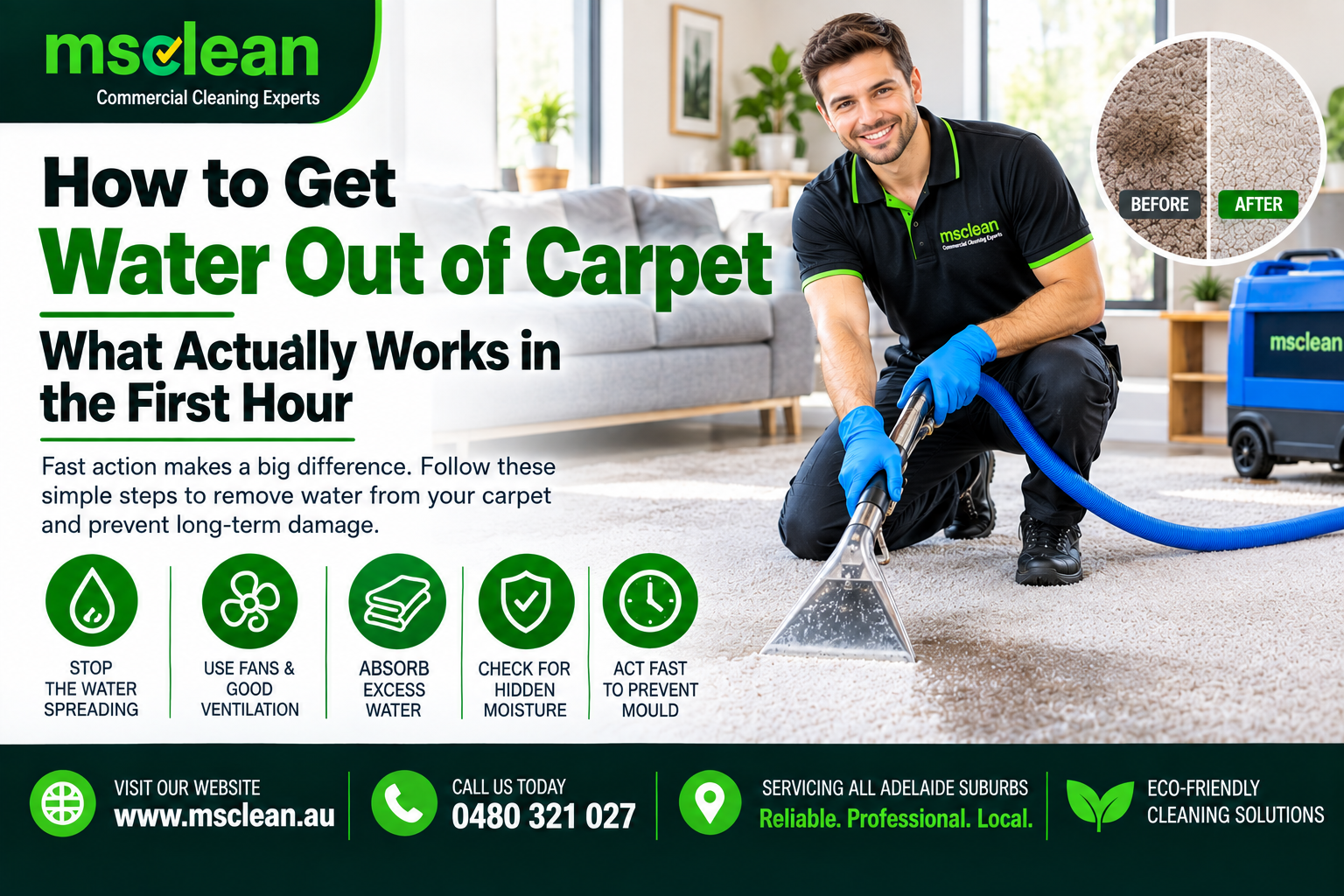
To remove water from carpet, remove as much as possible in the first 30 minutes, before it penetrates the backing and underlay. Use a wet/dry vacuum, not a standard household vacuum, to extract standing water and saturated surface moisture. Press heavy dry towels into the carpet in areas the vacuum cannot reach and replace them as they saturate. Peel back a corner to check the underlay: remove soaked foam underlay because it cannot dry in place. Deploy fans and a dehumidifier and run them for 24 to 48 hours. The faster extraction and drying begin, the better the outcome; mould can establish in wet carpet backing within 24 hours of saturation.
Getting water out of carpet requires acting within the first hour of the water event to prevent damage to the carpet backing, underlay and subfloor. The primary extraction tools are a wet/dry vacuum for standing water, heavy absorbent towels for residual moisture, and industrial air movers for accelerated drying. Never use a standard household vacuum on wet carpet—the motor isn’t designed for liquid and creates an electrical hazard. The water source matters: clean water from a pipe or appliance supply line can be managed with DIY extraction. Grey water from drains or black water from sewage or stormwater requires professional remediation. Once the surface appears dry, the carpet backing and subfloor may still hold moisture — confirming complete dryness requires pressing a dry cloth to the surface and feeling for coolness, not just looking at the visible pile.
The carpet is wet. You have a window a narrow one to make a real difference.
In the first 30 minutes, water is mostly in the surface fibres. Extractable. Manageable. In the first two hours, it has reached the backing layer. Harder to remove but still possible with the right tools. After six hours, it has penetrated the underlay. Now you are in recovery mode rather than prevention mode. After 24 hours, mould conditions are established regardless of what the surface looks like.
Everything that determines whether the carpet survives, whether mould develops, and whether the subfloor is affected happens in the hours immediately after the water event. Not the next day. Not when you get around to it. Now.
This guide covers what to do in that window, in the right order, with the specific tools and techniques that actually work.
The First 5 Minutes: Stop the Source and Assess the Water
Before touching the carpet, two things need to happen.
Stop the water source if it is still running
A burst pipe, an overflowing washing machine, a leaking appliance the source of the water needs to be stopped before extraction makes any sense. Extracting from a carpet while water keeps flowing in is a losing exercise. Find the water shutoff for the affected pipe or appliance and stop the source first.
For an overflowing bath or toilet: turn off the supply valve at the base of the fixture. For a burst pipe: turn off the main water supply at the meter if the specific pipe valve is not accessible. For a washing machine: turn off the machine and the supply tap behind it.
Identify the water type
This is a safety decision, not a cleaning decision.
Clean water (Category 1): Comes from a supply pipe, dishwasher supply, washing machine supply, bath overflow with clean water, or rainwater entering through a roof. Safe to handle with normal precautions. DIY extraction is appropriate.
Grey water (Category 2): Comes from a washing machine drain, dishwasher drain, bath or shower drain overflow, or a backed-up sink. Contains detergents, soap residue and microbiological contamination. Wear gloves. DIY extraction is possible for small areas. Professional extraction is recommended for large areas.
Black water (Category 3): Comes from a sewage backup, an overflowing toilet with faecal contamination, or stormwater flooding. Contains dangerous pathogens. Do not handle without protective equipment. Do not attempt DIY treatment beyond containing the area. Call a professional water restoration service immediately.
If you are not certain of the category, assume the higher risk level.
Tools for Getting Water Out of Carpet and How to Use Each One
Wet/dry vacuum (the most important tool)
A wet/dry vacuum, also called a shop vacuum, is the most effective tool for extracting water from carpet at home. It is designed for liquid extraction. A standard household vacuum is not.
Never use a standard household vacuum on wet carpet. Water entering the motor causes an electrical short that can produce a shock or fire.
How to use a wet/dry vacuum on wet carpet:
Remove the paper or fabric filter if your wet/dry vacuum has one; liquid will destroy a standard filter. Check whether your machine needs a foam filter for wet use or no filter at all (this varies by model).
Work in slow, overlapping passes across the saturated area. Maintain firm contact between the floor tool and the carpet surface; the seal creates suction. Move at roughly half the speed you would for dry vacuuming. The slower the pass, the more moisture is extracted per square foot.
Empty the tank when it is two-thirds full; a full tank significantly reduces suction. For a large water event, you will empty the tank multiple times.
Apply additional passes to areas that appear heavily saturated under where the water pooled, areas near walls where water ran before soaking in, and any areas where the carpet looks visibly darker from moisture.
What a wet/dry vacuum can reach: Surface water and the upper fibre layer. It does not reach the backing layer or the underlay.
Heavy absorbent towels
Once the wet/dry vacuum has extracted standing water, use heavy dry towels to absorb residual moisture from areas the vacuum cannot reach and to draw moisture upward from the upper backing layer.
Technique: Lay the towel flat on the wet area. Press down firmly with both hands. Better yet: stand on the towel and shift your weight across it. Lift the towel straight up — do not drag. The towel should feel visibly heavier. Replace with a dry towel and repeat.
Fold the saturated towel and set it aside; if you have a large area, you can run it through the dryer and reuse it as it dries.
What towels reach: The surface fibres and the very upper layer of the backing. They accelerate the vacuum extraction by drawing moisture from areas with less direct vacuum contact.
For thick or plush carpet: The pile height means the wet/dry vacuum sits above the moisture in the lower pile. Pressing towels hard into thick carpet after vacuuming extracts additional moisture that the vacuum tool could not reach because of the pile height.
Fans and air movers
Fans do not extract water—they accelerate evaporation of remaining moisture after physical extraction is complete. They are essential for the drying phase but cannot substitute for the wet/dry vacuum and towel extraction phases.
Position fans to direct airflow across the carpet surface rather than overhead; horizontal airflow across the surface accelerates evaporation far more than overhead air circulation.
Household fan vs industrial air mover:
A household floor fan moves approximately 250 to 500 cubic feet of air per minute. An industrial air mover (the type professional water restoration companies deploy) moves 1,500 to 3,000 cubic feet per minute. The industrial unit is 5 to 10 times more effective and dries significantly faster, which matters when the mould clock is running.
Industrial air movers are available for hire in Adelaide from equipment hire companies. For a significant water event affecting multiple rooms, hiring two to three industrial air movers is worth the cost compared to running household fans for twice as long.
Dehumidifier
A dehumidifier removes moisture from the ambient air. As carpet releases moisture through evaporation, room humidity rises, which slows evaporation by reducing the humidity differential between the wet carpet and the surrounding air. A dehumidifier keeps room humidity low throughout the drying process, allowing evaporation to continue at its maximum rate.
Without a dehumidifier in a sealed room, you are essentially evaporating moisture from the carpet into the room air and then leaving it there. Opening windows helps in dry weather; in Adelaide’s summer, this works very well. In Adelaide’s winter, with ambient humidity at 65 to 75 percent, a dehumidifier is near-essential for effective indoor drying.
How Water Moves Through Carpet Layers and Why It Matters
Understanding this shows why time pressure is real and what each tool is trying to achieve.
Layer 1 — Carpet pile (surface to mid-fibre)
Water sits here for the first 10-20 minutes. A wet/dry vacuum extracts it effectively. Towel blotting works here. This layer dries fastest because airflow reaches it directly.
Layer 2 — Carpet backing (the fabric base layer)
Water reaches the backing layer within the first hour of saturation in most carpets. The wet/dry vacuum reaches the upper edge of this layer but cannot penetrate deeply into it. Once water is in the backing, it needs to evaporate upward through the pile—which is why fan direction and air mover placement across the surface matter.
Layer 3 — Underlay/foam padding
Water reaches the underlay within one to several hours depending on carpet thickness and saturation level. This is the critical layer. Foam underlay compresses when wet and traps moisture in its core where airflow cannot reach — even with fans running directly above. If the underlay is soaked, you must remove it for the carpet to dry properly.
How to check: peel back a corner of the carpet at the wall edge. Press the back of your hand into the foam underlay. If it is cold and damp, it is wet. If it is very cold or you can hear water, it is soaked.
Layer 4 — Subfloor (timber or concrete)
Water that has passed through all three carpet layers reaches the subfloor. Timber subfloors absorb water and begin to swell, which can warp them and create structural problems. Concrete subfloors hold moisture long after the surface appears dry — moisture metres are the accurate way to confirm dryness in concrete.
If water has reached the subfloor, remove the carpet and underlay and dry the subfloor before replacing anything. This is when professional water restoration is almost always the right call.
How to Get Water Out of Carpet Without a Vacuum
If you don’t have a wet/dry vacuum, you can still take meaningful action before equipment arrives—but you have to work fast.
Maximum towel extraction method:
Collect every large, heavy towel in the house. Lay them flat across the wet area in overlapping layers. Stand on them and walk back and forth, shifting your weight to press the towels into the carpet from every direction. Your weight compresses the carpet pile and backing enough to force moisture upward into the towels.
Swap the saturated towels for dry ones every five to ten minutes. Continue until the towels show minimal new moisture absorption.
This is significantly less effective than wet/dry vacuum extraction — but it removes a meaningful amount of surface and upper-pile moisture in the 30 to 60 minutes before better equipment arrives. Any moisture removed during this period does not reach the backing or underlay.
Borrow or hire a wet/dry vacuum
If you don’t own one, call a neighbour or nearby contact with a wet/dry vacuum to save significant time. Hiring one from a hardware store in Adelaide or a hire company is a practical option for a significant water event.
Do not wait until tomorrow morning. The drying window is now.
Getting Water Out of Car Carpet
Car carpet presents a specific challenge because the confined space, limited ventilation, acoustic insulation layers, and typically non-removable carpet make extraction and drying harder than with household carpet.
What causes water in car carpet:
- Window left open in rain
- Door seal failure — water enters at the door base
- Sunroof leak
- Air conditioning condensation drain blockage
- Flooded area driven through
How to extract water from car carpet:
A wet/dry vacuum with a crevice tool works well on car carpet — the narrow tool reaches between seats and into footwell edges. Remove the floor mats first and extract them separately.
For significant saturation, the most effective approach is to remove the front seat(s) — typically four bolts — to access the full footwell and the carpet beneath the seat. This also lets you check whether the acoustic padding beneath the car carpet is saturated, which it likely is if the footwell had standing water.
Drying car carpet:
Park the car in a warm, sunny location. Open all four doors. Direct a fan into the footwell area. A dehumidifier positioned at the door opening helps significantly. Run the car’s fan heater on maximum airflow (without recirculation—set to fresh air intake) to direct warm air across the carpet surfaces.
Car carpet that stays damp for more than 24 to 48 hours can develop mould under the acoustic matting. The characteristic musty smell in a car is almost always wet acoustic padding beneath the carpet, not the carpet itself.
Adelaide Context — Water Damage in SA Homes
Adelaide’s climate and housing stock create specific wet carpet scenarios that affect how you respond.
Summer burst pipes: Adelaide summer heat causes more pipe fitting failures than cooler months. A burst pipe discovered after returning from work — five to eight hours after the event is a common Adelaide summer scenario. By then, the carpet backing and likely the underlay are saturated. Begin extraction immediately and call a professional water restoration service.
Winter flooding: Adelaide’s June to August rainfall, combined with older stormwater infrastructure in suburbs including Prospect, Salisbury, parts of the northern suburbs, and low-lying areas near the Torrens, can cause stormwater entry. This is Category 3 water; do not attempt DIY treatment. The contamination risk and the volume of water typically involved are both beyond household management.
Washing machine overflow: A common source of wet carpet events in Adelaide homes. Usually Category 2 (grey water from the drain) or Category 1 (clean water from a supply hose failure). Washing machine events are often discovered during or shortly after the machine’s cycle, giving a short window before the water spreads significantly. Quick wet/dry vacuum extraction followed by immediate fan deployment produces good outcomes when caught early.
60-minute professional response: Ms Clean provides emergency wet carpet extraction across all Adelaide metro suburbs, aiming to arrive within 60 minutes for water damage events. For any water event beyond a small localised spill, professional commercial extraction equipment produces significantly better outcomes than household tools alone, particularly for the backing and underlay layers that household wet/dry vacuums cannot fully reach.
How Long to Dry and How to Know When It’s Done
The 24 to 48 hour drying target
With fans and a dehumidifier running continuously, most residential carpet events involving Category 1 water with prompt extraction should reach surface dryness within 24 hours and backing dryness within 48 hours,s assuming the underlay has been removed if it was soaked.
This is the target, not a guarantee. Carpet thickness, room humidity, ambient temperature and the extent of saturation all affect actual drying time.
How to test for dryness — the back-of-hand test
Press the back of your hand firmly into the carpet surface. Feel for:
- Coolness: Moisture evaporating from the carpet will produce a perceptible cooling effect on the skin. No coolness = the surface is dry.
- Dampness: Lift your hand and check whether any moisture has transferred. Even very slight dampness indicates residual moisture in the upper pile.
Repeat in multiple locations, including areas furthest from the fans that dry last.
Do not rely on visual appearance alone. Carpet pile that looks dry can have residual moisture in the backing that continues to evaporate over the following days. The surface appearance dries faster than the deeper layers.
Confirming subfloor dryness
For significant water events, peel back the carpet and check the subfloor. Concrete should feel dry to the back of your hand and room temperature, not cool. Timber should feel dry and firm,m not soft, swollen or discoloured.
Actionable Takeaways
In the first 30 minutes:
- Stop the water source if still running
- Identify Category 1/2/3 (call professionals immediately for Category 3)
- Wet/dry vacuum over the entire wet area — slow passes, multiple cycles
- Press heavy dry towels into areas the vacuum cannot fully reach
- Peel back a corner and check the underlay — if soaked, remove it
In the first two to four hours:
- Deploy all available fans directing airflow horizontally across the carpet surface
- Set up a dehumidifier if available
- Open windows if Adelaide weather is warm and dry
- Keep everything running continuously
At the 24-hour mark:
- Test for dryness using the back-of-hand method across multiple locations
- If any coolness or dampness remains, continue drying — do not replace furniture
- If a musty smell is present, the backing or subfloor still holds moisture — call a professional
FAQs — How to Get Water Out of Carpet
Q1. How do you get water out of carpet quickly?
Use a wet/dry vacuum immediately — not a standard household vacuum, which creates an electrical hazard on wet surfaces. Work in slow, overlapping passes over the entire wet area. Press heavy dry towels into areas the vacuum cannot reach. Deploy fans to direct airflow horizontally across the carpet surface, and run them continuously. The faster you start extraction, the less water penetrates the backing and underlay.
Q2. How do you get water out of carpet without a vacuum?
Use multiple heavy towels laid flat over the wet area. Stand on them and shift your weight to compress the carpet pile and back moisture upward into the towels. Replace saturated towels with dry ones every five to ten minutes. This removes surface and upper-pile moisture while you arrange wet/dry vacuum access. It is significantly less effective than a wet/dry vacuum but removes meaningful moisture in the critical first 30 to 60 minutes.
Q3. How long can carpet stay wet before mould develops?
Mould can begin establishing in wet carpet backing within 24 to 48 hours of sustained saturation. The surface pile dries faster than the backing — carpet that appears dry on the surface may still have backing moisture within the mould development window. Start extraction immediately and dry the backing within 24 hours.
Q4. Do I need to remove the underlay if it gets wet?
Suppose the foam underlay is soaked through, yes. Wet foam underlay compresses and traps moisture in its core, where airflow cannot reach it, even with fans running directly above the carpet. Fans dry the carpet above but not the foam beneath — the foam remains wet, and mould establishes in it regardless. Removing soaked underlay and replacing it after the subfloor dries is less expensive than addressing mould in underlay and subfloor.
Q5. How do I get water out of car carpet?
Use a wet/dry vacuum with a crevice tool. Remove floor mats and extract them separately. Remove the front seats, if possible, to access the full footwell and the acoustic padding beneath. Park in sunlight with all doors open. Direct a fan into the footwell. Run the car fan heater on fresh air intake at maximum airflow. Car carpet that stays damp for 24 to 48 hours grows mould under the acoustic matting — the source of the characteristic musty car smell.
Q6. When should I call a professional for water in carpet?
For any black water (sewage or stormwater flooding) event. When the wet area exceeds two rooms. When you didn’t discover the event until more than 12 hours after it occurred. When you can already smell mouldy or mildewy. When water has reached timber framing, wall cavities or a timber subfloor that feels soft. When household extraction and 24 hours of fan drying have not produced a dry result. Professional water restoration equipment extracts at volumes household tools cannot match and includes moisture mapping to confirm all layers, including the subfloor, are genuinely dry.
Q7. How do I know when the carpet is completely dry?
Press the back of your hand firmly into the carpet across multiple locations. Feel for any coolness (moisture evaporating) or dampness transferred to your hand. Both indicate residual moisture. The carpet should feel room temperature with no coolness and produce no moisture transfer. Also peel back a corner to check the backing and any remaining underlay — these layers hold moisture longer than the visible pile surface.
Call Now
Ms clean Au
Address: 71 Alexandra Street, Prospect, SA-5082
M : 0480 321 027
E-Mail: contact@msclean.au


