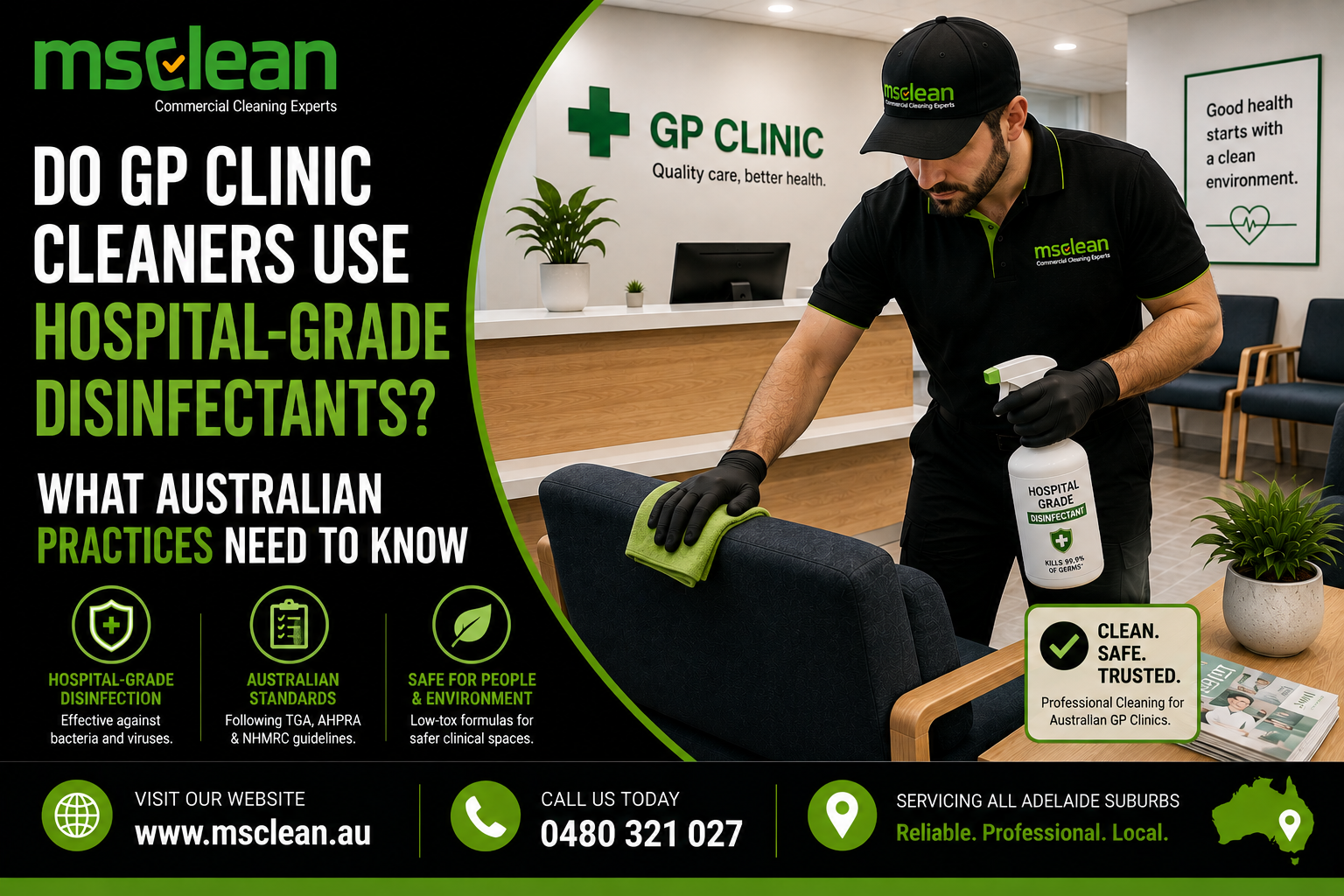
Do GP clinic cleaners use hospital-grade disinfectants in Australia?
They should, but not all of them do. A genuine specialist medical cleaning provider uses TGA-listed hospital-grade disinfectants with ARTG registration on examination tables, counters and all high-touch surfaces in clinical zones. Standard household sprays do not reliably kill clinical pathogens. Medical facilities require specialised chemical formulations applied at the correct dilution and left wet on the surface for a specified dwell time to control bacteria and viruses. In Australia, the Therapeutic Goods Administration governs which disinfectants carry validated clinical efficacy claims. A GP clinic cleaner using products without ARTG registration cannot verify that their disinfectant kills the pathogens it claims to kill.
GP clinic cleaners should use hospital-grade registered disinfectants on exam tables, counters and high-touch objects — here is why:
- Pathogen control: Hospital-grade disinfectants are formulated to eliminate resilient bacteria like Staphylococcus aureus and bloodborne viruses that standard products cannot reliably kill
- Regulatory compliance: Australian health guidelines mandate TGA-registered disinfectants over standard commercial or domestic cleaners for clinical surface use
- Cross-contamination prevention: Cleaners use colour-coded microfibre systems alongside these chemicals to separate exam rooms from waiting areas and restrooms
The Australian equivalent of EPA registration (the US standard) is TGA ARTG listing. Any Australian GP clinic cleaner claiming hospital-grade compliance should be able to provide the ARTG number for every product they use on clinical surfaces.
Your GP clinic gets cleaned every night. The cleaner arrives with a spray bottle and a cloth and wipes down the examination table, the reception counter and the waiting room chairs.
Here is the question most Adelaide practice managers have never asked: what is actually in that spray bottle?
It matters more than it might seem. Standard household and commercial cleaning products do not kill clinical pathogens. A disinfectant that eliminates common household bacteria is not the same as one validated against the pathogens that circulate in a GP waiting room — influenza virus, rhinovirus, Staphylococcus aureus, norovirus and bloodborne pathogens.
The difference between a product that works in a GP clinic and one that does not is not visible on the label to an untrained eye. It is visible in the ARTG number — the Therapeutic Goods Administration registration that confirms the product has been evaluated against specific pathogens at specified concentrations and dwell times.
This article explains what hospital-grade means in Australia, why it matters in a GP clinic, how dwell time determines whether a disinfectant works, and how to verify that your cleaner is using the right products.
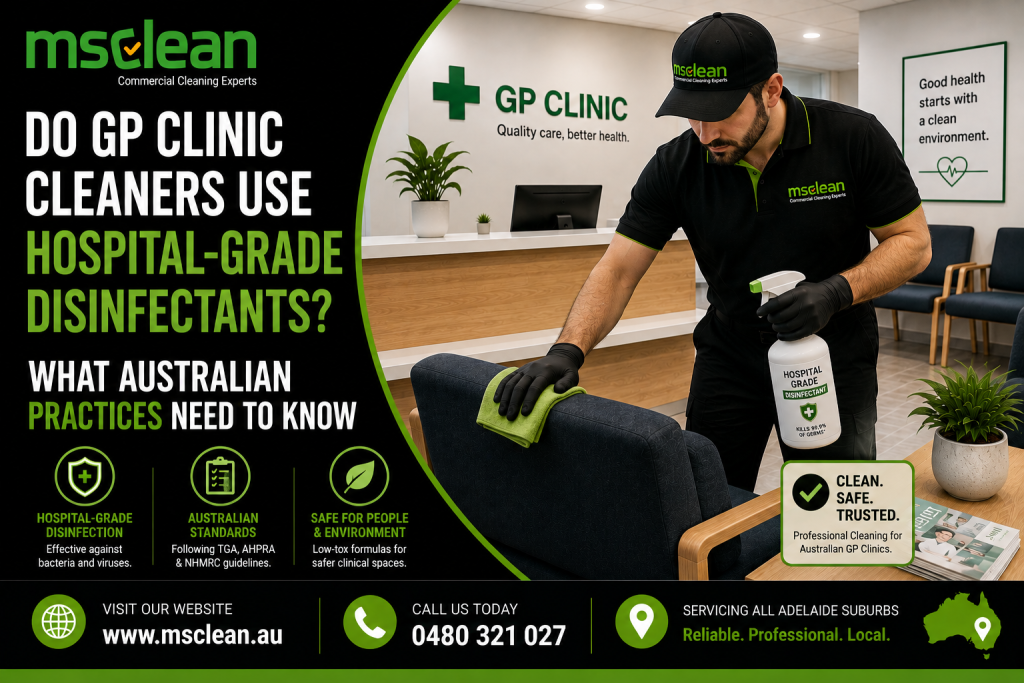
What “Hospital-Grade” Actually Means in Australia
The term hospital-grade gets used freely in cleaning marketing. Most people assume it means something stronger or better than standard products. The reality is more specific.
In Australia, the Therapeutic Goods Administration administers the Australian Register of Therapeutic Goods (ARTG). Disinfectants that make specific efficacy claims — killing named pathogens at specified concentrations — must be registered on the ARTG. Products that carry ARTG registration have been evaluated against evidence for their claimed efficacy. Products without it have not.
The specific Australian classification that matters for GP clinics is hospital-grade disinfectant. Under Therapeutic Goods Order No. 54, hospital-grade disinfectants must demonstrate efficacy against at minimum:
- Staphylococcus aureus (a resilient gram-positive bacterium responsible for a significant proportion of healthcare-associated infections)
- Pseudomonas aeruginosa (a gram-negative bacterium particularly relevant in immunocompromised patients)
Products claiming broader spectrum efficacy against mycobacteria, viruses, fungi or spore-forming bacteria must demonstrate additional evidence for each additional claim.
The references EPA-registered disinfectants. The EPA is the US Environmental Protection Agency. In Australia, the equivalent regulatory body is the TGA. When Australian healthcare guidelines require registered hospital-grade disinfectants, they mean TGA-listed products with ARTG numbers — not US EPA registration. Any Australian medical cleaning provider who references EPA-registered products is either working from US resources or not familiar with the Australian regulatory framework.
Why Standard Cleaning Products Fail in a GP Clinic
Standard household disinfectant sprays, general-purpose commercial cleaners and multipurpose surface wipes are not formulated or evaluated for clinical pathogen kill. Here is the specific science behind why they fall short.
The pathogen spectrum is different
A household disinfectant is typically evaluated against common domestic bacteria at the concentrations those bacteria present in a household environment. A GP clinic deals with a different pathogen spectrum — the bacteria and viruses that sick, immunocompromised people bring in throughout the day.
Standard household sprays do not kill clinical pathogens. Medical facilities require specialised chemicals and wet contact times — dwell times — to control bacteria and viruses at the level a clinical environment requires.
The specific pathogens circulating in an Adelaide GP waiting room during flu season include influenza A and B, rhinovirus, respiratory syncytial virus (RSV), norovirus and a range of bacterial organisms including methicillin-resistant Staphylococcus aureus (MRSA) in practices serving patients from hospital or residential aged care settings. Standard commercial products carry no validated efficacy claims against this pathogen spectrum.
The concentration is different
Hospital-grade disinfectants require specific dilution ratios to achieve their claimed efficacy. Too dilute and the product does not reach the concentration required to kill its target pathogens. Too concentrated and it can damage surfaces or create chemical safety risks.
A standard commercial cleaning company uses products off the shelf without the training to verify that dilution ratios are being maintained correctly for each product. A specialist medical cleaning team trains on dilution requirements for every product in their kit and has quality control systems to verify compliance.
The contact time is different
This is the factor most commonly overlooked — the dwell time. A disinfectant achieves its claimed kill efficacy by remaining wet on the surface for a specified period, typically ranging from two to ten minutes depending on the product and target pathogen.
A cleaner who sprays a surface and immediately wipes it has not disinfected that surface. They have moistened it. The pathogen-kill claim on the product label applies at the correct dilution and after the correct dwell time. Neither variable can be skipped without invalidating the product’s efficacy.
The Dwell Time Problem: The Most Common Failure in GP Clinic Disinfection
Dwell time is the single most important cleaning concept that most Adelaide GP practice managers have never heard discussed in relation to their cleaning programme.
Here is how it works.
When a TGA-listed hospital-grade disinfectant is applied to a clinical surface, the active ingredient — typically quaternary ammonium compounds, hydrogen peroxide, sodium hypochlorite, accelerated hydrogen peroxide or another validated biocide — begins working against target pathogens. But the kill process is not instantaneous. It requires sustained contact between the active ingredient and the pathogen for a minimum period.
That minimum period — the dwell time — varies by product and target pathogen. Common dwell times for hospital-grade disinfectants used in GP clinics:
| Product Category | Typical Dwell Time | Target Pathogens |
| Quaternary ammonium compounds | 5 to 10 minutes | Bacteria, enveloped viruses |
| Accelerated hydrogen peroxide | 30 seconds to 5 minutes | Broad spectrum including non-enveloped viruses |
| Sodium hypochlorite (bleach-based) | 1 to 10 minutes | Broad spectrum including blood spills |
| Alcohol-based products | 30 seconds to 2 minutes | Bacteria, enveloped viruses (limited spore efficacy) |
The dwell times above are the periods during which the surface must remain visibly wet with the disinfectant for the product to achieve its claimed efficacy. A surface that looks clean because a cloth was wiped across it is not disinfected unless the product was present at the correct concentration for the required dwell time before that cloth arrived.
How to tell if your cleaner observes dwell times
Ask them. Specifically: what is the dwell time for each disinfectant you use in our clinic, and how do you ensure your staff observe it?
A genuine specialist healthcare cleaning provider answers this for every product without hesitation. They know the dwell times because their staff are trained on them as a non-negotiable element of clinical cleaning compliance.
A general commercial cleaner will often not know the answer — or will give a response that reveals they are not differentiating between cleaning and disinfecting.
Colour-Coded Microfibre and Why the Cloth Matters as Much as the Chemical
Hospital-grade disinfectants address pathogen kill. The colour-coded cleaning system addresses pathogen transfer. Both are required. Either one without the other produces an incomplete infection control outcome.
The AI Overview confirms this directly: cleaners use colour-coded microfibre systems alongside these chemicals to separate exam rooms from waiting areas or restrooms.
Here is why the cloth matters.
Microfibre cloths trap particles at the sub-micron level rather than simply pushing them around the surface. A standard cotton or polyester cloth used with a disinfectant spray distributes the disinfectant across the surface but does not achieve the same level of particle capture on removal. Microfibre cloths used with appropriate hospital-grade disinfectants produce better surface disinfection outcomes than standard cloths with the same chemical.
But no cloth quality compensates for cross-zone contamination. A microfibre cloth used to clean a patient bathroom and then used to clean a reception counter carries whatever pathogens were present in the bathroom to the reception surface — regardless of how good the cloth material is.
The colour-coded system prevents this:
| Zone | Cloth and Mop Colour | Areas Covered |
| High-risk clinical | Red | Examination rooms, procedure and treatment areas |
| Bathrooms and sanitary | Yellow | All patient and staff toilet and bathroom facilities |
| General patient areas | Blue | Waiting room, reception, corridors, consultation rooms |
| Staff areas | Green | Kitchen, lunchroom, staff offices and break areas |
A clinical cleaning team using the colour-coded system changes cloths at every zone boundary. A red cloth enters an examination room. When the room is done, that cloth goes directly into a sealed laundry bag. A new red cloth is used for the next examination room. A blue cloth covers the waiting room and reception. Yellow only ever enters bathroom areas.
How to Verify Your GP Clinic Cleaner Uses TGA-Listed Products
Most Adelaide practice managers accept a cleaning company’s claim to use hospital-grade products without verifying it. Here is how to do that verification properly, in under 30 minutes.
Step 1: Ask for the product name and ARTG number
Every TGA-listed disinfectant carries an ARTG number on its label. Ask your cleaning provider to give you the name and ARTG number for every product they use on clinical surfaces in your clinic.
Step 2: Verify on the TGA public register
Go to tga.gov.au and use the ARTG search function. Enter the ARTG number. The register confirms whether the product is listed, what claims it carries, and whether the registration is current.
This takes approximately five minutes per product. If the number your cleaner provides returns no result, the product is either not TGA-registered or the number is incorrect. Either outcome is significant.
Step 3: Check the product’s listed efficacy claims
An ARTG-listed disinfectant specifies which pathogens it is validated against and at what concentration. Confirm that the products used in your high-risk clinical zones carry efficacy claims against the pathogen spectrum relevant to a GP clinic — minimum Staphylococcus aureus and Pseudomonas aeruginosa for hospital grade, with broader spectrum claims where procedure rooms or blood-contact surfaces are involved.
Step 4: Ask about dilution ratios and dwell times
Products used at incorrect dilution do not achieve their claimed efficacy. Products wiped before the dwell time has elapsed do not achieve their claimed efficacy. Ask what dilution ratio each product is prepared at, and what the dwell time requirement is. A specialist provider answers both from memory.
Step 5: Ask for the Safety Data Sheet
Every TGA-listed disinfectant has a Safety Data Sheet (SDS) — formerly called a Material Safety Data Sheet (MSDS). This document contains the product’s active ingredient, concentration, storage requirements and efficacy claims. Your cleaning provider should be able to supply the SDS for every product they use in your clinic within 24 hours of a request.
What a Compliant Medical Cleaning Product Programme Looks Like
The minimum product standard for a compliant Adelaide GP clinic cleaning programme covers these bases.
For examination rooms and clinical contact surfaces:
TGA-listed hospital-grade disinfectant with efficacy against Staphylococcus aureus and Pseudomonas aeruginosa as a minimum. Applied at the correct dilution. Left wet for the product’s full specified dwell time before wiping. Applied with a colour-coded microfibre cloth designated for that clinical zone only. Single-use cloth per room — not reused between rooms.
For waiting rooms and reception areas:
The same standard applies because these areas are significant-risk zones under SA Health’s Environmental Cleaning Policy 2021. Waiting room chairs, reception counters and all patient contact surfaces receive the same TGA-listed product, the same dwell time and the same colour-coded cloth discipline — Blue zone tools only.
For bathrooms:
Hospital-grade disinfectant on all surfaces — toilet, basin, taps, door handle, floor. Yellow zone tools only. No yellow cloth or mop enters any other zone. Bathrooms sanitised a minimum of three times per operating session in any functioning GP clinic.
For blood and body fluid spills:
Sodium hypochlorite-based disinfectant at appropriate concentration — typically 1:10 dilution in water for significant biological contamination. Applied after bulk material is removed and contained. Correct PPE worn. The spill area treated and the contaminated materials disposed of as clinical waste. The entire event documented.
Products that do not meet the standard:
Standard supermarket disinfectant sprays — even those labelled “kills 99.9% of germs” — are not evaluated against the clinical pathogen spectrum and carry no ARTG registration for clinical use. Multipurpose commercial cleaning sprays used in offices and retail environments carry similar limitations. General fragranced surface wipes marketed for household use carry no hospital-grade claim and no TGA registration.
Fragrance-Free and Low-VOC Options for Sensitive Clinical Environments
Not all TGA-listed hospital-grade disinfectants are appropriate for every clinical environment. Fragrance and volatile organic compounds (VOCs) in some standard hospital-grade products create a legitimate concern in specific Adelaide GP clinic settings.
Women’s health and reproductive health clinics serve patients who may have specific chemical sensitivities or allergies to fragrance compounds. Applying strongly fragrant disinfectants in these environments can affect patient wellbeing even after the cleaning is complete and the smell dissipates.
Mental health and counselling practices serve patients for whom strong chemical smells can be distressing or triggering. Unobtrusive, fragrance-free disinfectants allow the space to feel calm and neutral rather than clinical.
Childcare-adjacent medical facilities benefit from GECA-certified products — independently certified as low-toxicity and biodegradable — that maintain hospital-grade efficacy while reducing chemical exposure risk in environments where children are present.
TGA-listed fragrance-free and low-VOC hospital-grade disinfectants are available and in regular use. Selecting a medical cleaning provider that understands which product to use in which clinical environment — not just which product makes a hospital-grade claim — is part of choosing a genuine specialist.
Adelaide GP Clinic Context
Every TGA-listed disinfectant requirement described in this article applies to every Adelaide GP clinic. The SA Health Environmental Cleaning Policy 2021 specifies that clinical contact surfaces in South Australian healthcare facilities must be disinfected with products appropriate to the risk zone which in practice means TGA-listed hospital-grade products for examination rooms, procedure areas and patient bathrooms.
Ms Clean provides GP clinic cleaning across all Adelaide suburbs using TGA-listed hospital-grade disinfectants with ARTG numbers available on request. Every contract includes dwell time training for all technicians, colour-coded zone systems, single-use cloths per room, and RACGP-formatted signed cleaning records after every visit.
Call Now
Ms clean Au
Address: 71 Alexandra Street, Prospect, SA-5082
M : 0480 321 027
E-Mail: contact@msclean.au
Actionable Takeaways
For practice managers:
- Ask your current cleaning provider to name the specific TGA-listed products they use on clinical surfaces in your clinic — not just “hospital-grade products”
- Request the ARTG number for each product and verify it on the TGA public register at tga.gov.au — this takes five minutes
- Ask what the dwell time is for each product they use and how they ensure it is observed — the answer reveals whether this is being managed or ignored
- Request the Safety Data Sheet for each product — a compliant provider can produce this within 24 hours
- If your current provider cannot answer any of these four requests clearly, you are not receiving compliant clinical cleaning regardless of what their contract says
FAQs
Q1. Do GP clinic cleaners in Australia use hospital-grade disinfectants?
They should, but not all of them do. A specialist medical cleaning provider uses TGA-listed hospital-grade disinfectants with ARTG registration on examination tables, counters and all high-touch clinical surfaces. General commercial cleaners often use standard commercial products that have not been evaluated against the clinical pathogen spectrum and carry no TGA registration for clinical use. The way to verify this is to ask for the product name and ARTG number, then confirm it on the TGA public register at tga.gov.au.
Q2. What is a hospital-grade disinfectant in Australia?
In Australia, a hospital-grade disinfectant is a TGA-listed product with ARTG registration demonstrating validated efficacy against Staphylococcus aureus and Pseudomonas aeruginosa as a minimum. The product must be used at the correct dilution and left wet on the surface for its specified dwell time to achieve this efficacy. Standard household and commercial cleaning products do not meet this classification and carry no TGA registration for clinical use.
Q3. What is an ARTG number and why does it matter for GP clinic cleaning?
An ARTG number is an Australian Register of Therapeutic Goods registration number. It confirms that the Therapeutic Goods Administration has evaluated the disinfectant product against specific pathogens at specified concentrations and dwell times. A product with an ARTG number has verified, evidence-based efficacy claims. A product without one has not been evaluated by the Australian regulatory body for its clinical efficacy claims. In a GP clinic, using non-ARTG-registered products on clinical surfaces means the disinfection claim is unverified.
Q4. Why do standard cleaning products fail in a GP clinic?
Standard household and commercial products are not formulated or evaluated for the clinical pathogen spectrum present in a functioning GP clinic. They do not carry TGA ARTG registration for clinical use. Their active ingredient concentrations and dwell time requirements are not validated against healthcare pathogens like Staphylococcus aureus, influenza virus, norovirus or bloodborne pathogens. A product that kills 99.9 percent of common household germs in a domestic environment has not been evaluated against the pathogens that matter in a clinical setting.
Q5. What is dwell time and why does it matter?
Dwell time is the minimum period a disinfectant must remain wet on a surface to achieve its claimed pathogen kill efficacy. Most hospital-grade disinfectants require two to ten minutes of wet contact time. A cleaner who applies disinfectant and immediately wipes it off delivers no clinically significant disinfection — the active ingredient has not had time to work. Observing dwell times is a mandatory part of compliant clinical disinfection, not an optional step.
Q6. Do GP clinics need different disinfectants for different rooms?
The same class of TGA-listed hospital-grade disinfectant is appropriate across clinical zones, but the specific product selected can vary by clinical context. Examination rooms and procedure areas require the full hospital-grade spectrum. Bathrooms may use sodium hypochlorite-based products for blood or biological contamination. Fragrance-free and low-VOC options are appropriate for women’s health clinics, mental health practices and chemically sensitive environments. A specialist medical cleaning provider selects the right product for each zone — not a single product applied uniformly throughout.
Q7. Can I check what disinfectants my GP clinic cleaner uses?
Yes. Ask your cleaning provider for the name and ARTG number of every product they use on clinical surfaces in your clinic. Search the ARTG number on the TGA public register at tga.gov.au to confirm it is listed and what efficacy claims it carries. Also request the Safety Data Sheet for each product — this documents the active ingredient, dilution requirements and efficacy claims. A specialist healthcare cleaning provider can produce all of this within 24 hours. If your current provider cannot, your clinic cleaning programme may not be using TGA-listed products on clinical surfaces.