Commercial cleaning is the professional cleaning and maintenance of non residential spaces such as offices, retail stores, schools, hospitals, aged care facilities, gyms, warehouses, and other business or public facilities. It differs from residential cleaning in three ways: it uses industrial-grade equipment, including floor buffers, auto scrubbers, and commercial extraction machines; it follows health and safety compliance procedures suited to each facility’s industry and risk level; and it focuses on business operations rather than household convenience. Core commercial cleaning services include routine upkeep such as emptying bins, vacuuming, dusting, and cleaning bathrooms; deep cleaning such as carpet extraction and floor stripping; and specialised sanitation such as medical-grade disinfection or industrial degreasing depending on the business type. In Adelaide, established cleaning companies, including Ms Clean, provide commercial cleaning to businesses of all sizes across all sectors.
What is commercial cleaning?
Commercial cleaning — core definition:
Commercial cleaning means professionally cleaning and maintaining non-residential spaces such as offices, retail stores, schools, and hospitals.
Core characteristics:
Non-residential focus: services target workplaces and public facilities rather than private homes.
Industrial-grade equipment: cleaners use heavy-duty tools, including floor buffers, auto-scrubbers, and pressure washers.
Health and safety compliance: procedures follow strict industry rules to reduce germs and maintain hygiene.
Common commercial cleaning services:
Routine upkeep: emptying bins, vacuuming floors, dusting surfaces, and cleaning bathrooms.
Deep cleaning: stripping and waxing hard floors, washing interior windows and extracting carpet stains.
Specialised sanitation: providing medical-grade disinfection or industrial degreasing depending on the business type.
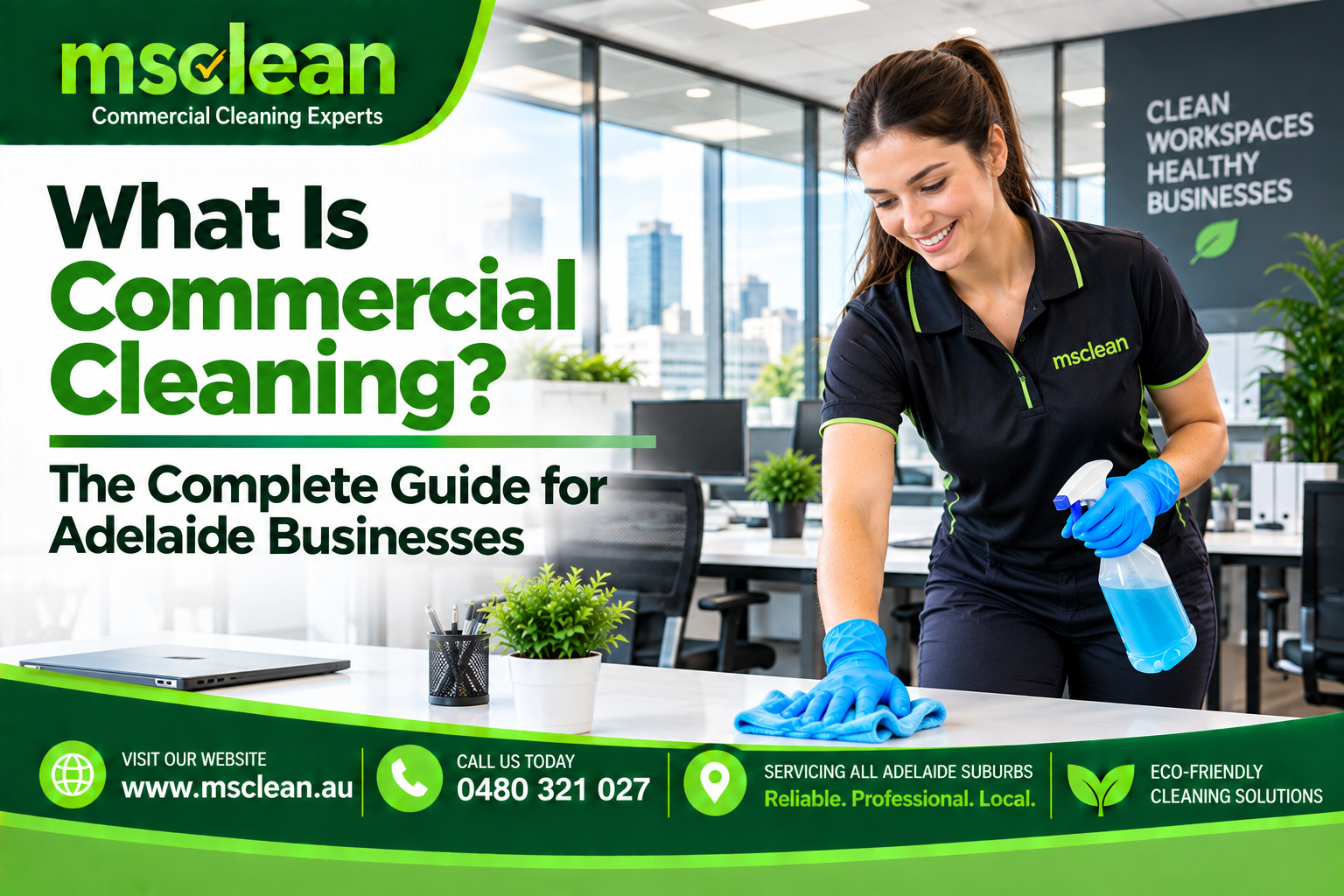
How will this guide help you?
Walk into a clean office on a Monday morning, and you probably think nothing of it.
That is exactly the point. Commercial cleaning done well is invisible. The floor is clean. The bathroom is stocked and fresh. The kitchen bench is clear. The bins are empty. Nothing draws your attention because nothing needs attention.
The moment commercial cleaning stops, the absence is immediately visible. Within days, the floor shows traffic patterns, the kitchen accumulates residue, and the bathroom runs low on supplies. Within weeks, the carpet shows embedded soil that regular vacuuming will not address. Within months, the floor coating degrades, the grout darkens, and the office starts to look tired no matter how well everything else is maintained.
Commercial cleaning is the operating system underneath a functioning workplace. Most businesses never think about it until it fails, and then they think about very little else.
This guide explains what commercial cleaning is, how it differs from residential cleaning, what the service types involve, how it is structured, and what Adelaide businesses need to know when choosing a provider.
What Commercial Cleaning Actually Means
Commercial cleaning is the professional cleaning and maintenance of any space used for business, commercial, industrial, healthcare, educational, or public purposes. The defining characteristic is non-residential: the space is not someone’s home.
Beyond that single defining characteristic, commercial cleaning covers an enormous range of environments and service types. A five-person accounting practice in Norwood and a 500-bed aged care facility in Modbury both require commercial cleaning, but the products used, the training required, the equipment deployed, the compliance documentation produced, and the frequency and intensity of the cleaning differ completely.
This is what separates commercial cleaning from a simple definition. The term describes a category of professional service delivery, not a single fixed scope. Within that category, the specific service depends on the facility type, regulatory environment, industry requirements, and what it takes to maintain a clean, safe, and compliant environment for the people who use it.
What Makes Commercial Cleaning Different from Residential Cleaning
The difference between commercial and residential cleaning is not simply the size of the space. It is the purpose, the equipment, the compliance requirements, the risk profile, and the operating constraints.
Purpose and objective
Residential cleaning maintains a home at a standard that the people living in it find comfortable and presentable. The standard is personal; it reflects the household’s preferences and priorities.
Commercial cleaning maintains a workplace or public facility at a standard that meets business operational requirements, industry compliance obligations, health and safety obligations under the WHS Act 2012 (SA), and the expectations of staff, clients and regulators. The standard is defined by more than personal preference.
A home where the kitchen bench is not wiped daily is a personal choice. An office kitchen where the bench is not wiped daily is a facilities management failure. A patient bathroom in a GP clinic that is not disinfected daily is a WHS Act and RACGP compliance failure. The standard depends on the space’s purpose.
Equipment
Residential cleaning uses consumer grade equipment available at any hardware store: domestic vacuum cleaners, mop systems, and general purpose cleaning sprays.
Commercial cleaning uses industrial-grade equipment that performs at a different level.
Commercial HEPA filter vacuum cleaners:
Capture fine particles down to 0.3 microns, including allergen particles and fine construction dust that domestic vacuums recirculate into the air. Essential for healthcare and education environments, and meaningfully better for allergen management in any commercial space.
Auto scrubbers and floor scrubbing machines:
Machine-driven floor scrubbing and mopping for large hard floor areas including retail, hospitality, healthcare and industrial spaces. Cover 10 to 20 times the floor area per hour that manual mopping achieves, with significantly better soil removal.
Commercial hot water extraction machines:
Apply heated water at 80 to 95 degrees into carpet pile under pressure and extract simultaneously with high-powered suction. Remove embedded soil, allergens and bacteria from the carpet backing layer to a depth that domestic carpet cleaners and hire machines cannot reach.
Pressure washers:
For external hard surfaces, car parks, loading bays, building facades and outdoor areas. Remove compacted soil, algae, mould and contamination from paved surfaces.
Floor buffers, burnishers and polishing machines:
Maintain and restore hard floor coatings including vinyl, tiles, concrete and stone. Restore the reflective surface that daily mopping maintains at a basic level but cannot restore once degraded.
Reach and access equipment:
Boom lifts, scissor lifts, water fed pole systems and extension cleaning tools for high level cleaning including windows, skylights, external facades and high-dusting above standing reach.
Health and safety compliance
In Australia, the Work Health and Safety Act 2012 (SA) establishes the employer’s obligation to maintain a safe and healthy work environment. Commercial cleaning is a direct part of meeting this obligation for the Adelaide businesses that engage professional cleaning services.
Beyond the general WHS framework, specific industries have specific compliance requirements:
Healthcare cleaning must comply with the RACGP Infection Prevention and Control Guidelines and the SA Health Environmental Cleaning Policy 2021, using TGA ARTG-registered disinfectants at specified concentrations and dwell times.
Childcare cleaning must comply with ACECQA standards using child-safe certified products.
Food service cleaning must comply with the Food Act 2001 (SA) requirements for food contact surface sanitation.
Aged care cleaning must comply with Aged Care Quality and Safety Commission requirements with documented cleaning records.
These requirements do not apply to residential cleaning. They apply only to commercial contexts and require training, product knowledge, and documentation that consumer-grade cleaning does not provide.
Operating constraints
Residential cleaning happens when the household is ready, at a time that suits the family’s schedule. Commercial cleaning happens when the business needs it, typically outside operating hours to avoid disrupting the working day.
Most Adelaide commercial cleaning runs after 6 pm on weeknights, on weekends,s or in early-morning windows before business opens. This requires the cleaning team to manage access, security systems and building protocols without supervision. It requires police-cleared staff with trusted access to the facility.
Types of Commercial Cleaning Services
Commercial cleaning is not one service; it is a family of services with different purposes, frequencies and requirements.
Routine commercial cleaning (janitorial services)
Daily or recurring maintenance cleaning that keeps a commercial facility at a consistent baseline standard between deep-cleaning cycles.
Routine commercial cleaning covers:
Emptying and relining all internal bins throughout the facility.
Vacuuming all carpeted areas using commercial HEPA filter equipment.
Sweeping and mopping all hard floor areas with appropriate cleaning solutions.
Clean and disinfect all bathroom and sanitary facilities, and restock consumables.
Wipe all kitchen and breakroom surfaces, and clean sinks and appliance exteriors.
Dusting all accessible surfaces including desks, shelving and window sills.
Disinfect high-touch surfaces, including door handles, light switches, shared equipment, and reception counters.
General tidy of common areas, meeting rooms and reception spaces.
Routine cleaning is the largest category of commercial cleaning by volume and the service that most Adelaide businesses use as their primary ongoing maintenance programme.
Deep commercial cleaning
A more intensive periodic clean that addresses areas and surfaces not fully covered in routine maintenance cleaning.
Deep commercial cleaning covers:
Cleaning behind and under all movable furniture.
Air conditioning vent covers removed, cleaned and replaced.
Detailed skirting board cleaning throughout.
Full interior window and glass partition cleaning.
Kitchen appliance interiors including oven, fridge shelves and exhaust systems.
Bathroom tile grout scrubbing and fixture descaling.
High-level dusting of light fittings, ceiling corners and structural surfaces.
Carpet hot water extraction across all carpeted areas.
Hard floor machine scrubbing and restoration.
Deep commercial cleaning is typically scheduled quarterly, biannually, or annually alongside a routine maintenance programme. It addresses the accumulation that routine cleaning maintains at a stable level but does not fully remove.
Specialised sanitation
Commercial cleaning services specific to industry type, risk profile or contamination scenario.
Medical grade disinfection:
Used in healthcare facilities including GP clinics, dental practices, specialist medical practices, aged care and allied health. Requires TGA ARTG registered hospital grade disinfectants at specified dilutions and dwell times, colour coded zone systems, single use cloths per room and RACGP formatted documentation after every visit.
Industrial degreasing:
Used in commercial kitchens, food processing facilities, manufacturing environments and workshops where grease, oil or chemical contamination accumulates. Uses specific degreasing chemistry suited to the contamination type and food safety requirements where applicable.
Biohazard and trauma cleaning:
Specialist cleaning and remediation of spaces contaminated with blood, body fluids, sewage or other biological hazards. Requires specific PPE, containment procedures, licensed waste disposal and detailed documentation.
Post construction and renovation cleaning:
Removal of construction dust, adhesive residue, paint marks, grout haze and building material debris following fit-out or renovation work. Requires specific products and methods for construction soiling rather than standard office soiling.
End of lease commercial cleaning:
Return to original condition cleaning for commercial tenancies at lease exit. Scope is defined by the lease agreement requirement and the property manager’s inspection standard. Produces a professional receipt confirming the cleaning scope for bond return documentation.
Pressure washing and external cleaning:
Cleaning of external hard surfaces including car parks, entry areas, loading bays, building facades and outdoor common areas. Removes compacted soil, biological growth and weather staining.
Window cleaning:
Internal and external window cleaning for commercial properties. External high-level window cleaning uses water-fed pole systems for lower levels and EWP (elevating work platforms) or rope access for high-rise.
Commercial Cleaning vs Office Cleaning — Are They the Same?
One of the most common questions the AI Overview competitor list highlights is whether commercial cleaning is the same as office cleaning. The answer is that office cleaning is one type of commercial cleaning — not all commercial cleaning is office cleaning.
Office cleaning is commercial cleaning applied to an office environment. It uses commercial cleaning methods, commercial grade equipment and follows WHS compliance requirements for a workplace.
Commercial cleaning also covers retail stores, restaurants, medical centres, schools, aged care facilities, gyms, industrial warehouses, car parks, stadiums and any other non-residential space. The same professional cleaning framework applies across all of these. Still, the specific products, methods, frequencies, compliance requirements and documentation vary significantly between a corporate office and a pathology collection centre.
The distinction matters when choosing a commercial cleaning provider. A company that cleans offices very well may not have the specific training, products or compliance framework needed to clean a medical practice. A company that specialises in industrial cleaning may not be suited to a high-end client-facing professional services firm.
Understanding that commercial cleaning is a category, not a single service, helps Adelaide businesses choose providers that suit their facility type rather than providers that generically offer “commercial cleaning.”
Commercial Cleaning in Australia — The Regulatory Context
Australian commercial cleaning operates within a specific regulatory environment that differs from the US competitors listed in the AI Overview source list.
Work Health and Safety Act 2012 (SA):
Establishes the employer’s duty as a Person Conducting a Business or Undertaking (PCBU) to maintain a safe work environment. Includes maintaining sanitary facilities, providing clean working environments and managing biological hazard risks. Commercial cleaning is one of the primary mechanisms through which Adelaide employers meet this obligation.
TGA ARTG registered disinfectants:
For healthcare and specialised commercial cleaning in Australia, the product requirement is TGA registration rather than US EPA registration. TGA ARTG registered hospital grade disinfectants have validated efficacy claims against specified pathogens evaluated by the Therapeutic Goods Administration.
Fair Work Commission Cleaning Services Award MA000022:
Sets minimum wages and employment conditions for commercial cleaning workers in Australia. Establishes penalty rates for after hours and weekend work that directly affect the pricing structure of commercial cleaning contracts.
RACGP and SA Health frameworks:
For healthcare commercial cleaning in South Australia, the RACGP Infection Prevention and Control Guidelines and SA Health Environmental Cleaning Policy 2021 establish the specific product requirements, zone systems, frequency minimums and documentation standards applicable to general practice and healthcare facility cleaning.
What Adelaide Businesses Need to Know About Commercial Cleaning
Commercial cleaning is not a commodity
The most common mistake Adelaide businesses make when choosing a commercial cleaning provider is treating it as a price-only decision. The cheapest quote is not comparable to the most professional quote if the scope, compliance infrastructure, equipment quality and staff training are different.
A commercial cleaning service at $45 per hour from a sole operator without insurance, without police cleared staff and without commercial grade equipment is a different product from a $65 per hour service from an established, insured, professionally equipped cleaning company. Both are described as “commercial cleaning.” Neither is comparable to the other.
What to look for in a commercial cleaning provider
Public liability insurance: minimum $10 million, ideally $20 million, confirmed by certificate of currency.
Police cleared staff: relevant for any business where staff will be accessing premises unaccompanied after hours.
Fixed price written contracts: specifying exact scope, frequency, inclusions, exclusions and what happens when a standard is not met.
Industry specific knowledge: a provider who understands the specific requirements of your industry — medical, childcare, retail, hospitality — rather than applying a generic cleaning approach to all environments.
HEPA filter commercial vacuuming: not all commercial cleaning companies use HEPA filter equipment. For offices with allergy or asthma-affected staff, or any healthcare adjacent environment, HEPA filtration is a meaningful quality differentiator.
GECA certified eco friendly products: for businesses with environmental policies, staff chemical sensitivities or childcare compliance requirements.
Documentation: signed completion records after every visit, available for WHS compliance records, RACGP accreditation and any other audit requirement.
Commercial cleaning frequency for Adelaide businesses
Different Adelaide businesses need different commercial cleaning frequencies:
Small offices of one to ten employees: two to three professional visits per week.
Medium offices of ten to fifty employees: five visits per week.
Large corporate offices above fifty employees: daily plus daytime porter service.
Medical centres: daily minimum with intra-day high-touch disinfection rounds.
Retail stores: daily after-hours cleaning.
Schools and childcare: every school day with holiday period deep cleaning.
The right frequency is the one that keeps the specific facility at the required standard between visits — not the minimum that fits the budget.
Commercial Cleaning Services Ms Clean Provides in Adelaide
Ms Clean provides the full range of commercial cleaning services across all Adelaide suburbs and regional SA.
Routine commercial office cleaning: Standard scope daily, three times or five times per week. All Adelaide metro suburbs. Fixed price monthly contracts.
Medical office and healthcare cleaning: TGA ARTG registered products, colour coded zones, RACGP formatted documentation, infection control trained police cleared staff.
Deep commercial cleaning: Periodic full-scope cleaning including carpet extraction, window cleaning and high dusting. Scheduled alongside routine maintenance contracts.
End of lease commercial cleaning: Full return-to-condition scope with professional receipt for property manager documentation.
Post renovation cleaning: Construction dust and debris removal following fit-out or renovation work.
Commercial carpet cleaning: Hot water extraction, encapsulation dry cleaning and carpet stain treatment for all commercial environments.
Commercial upholstery cleaning: Office chairs, hospitality seating and commercial lounge furniture.
Childcare and education cleaning: GECA certified child-safe products, ACECQA compliant scope.
Aged care cleaning: Aged Care Quality and Safety Commission documentation, appropriate product selection for vulnerable populations.
Commercial pressure washing: External surfaces, car parks and entry areas.
All services: fixed price confirmed in writing, after-hours scheduling standard, $20 million public liability insurance, police cleared staff.
Adelaide Suburb Coverage
Ms Clean provides commercial cleaning across all Adelaide metro suburbs: CBD, North Adelaide, Norwood, Unley, Prospect, Salisbury, Elizabeth, Modbury, Tea Tree Gully, Mawson Lakes, Burnside, Campbelltown, Mitcham, Marion, Glenelg, Henley Beach, Port Adelaide, Woodville, Findon, West Lakes and all surrounding areas.
Regional SA commercial cleaning available for Adelaide Hills, Barossa Valley, Fleurieu Peninsula and Limestone Coast with advance scheduling.
Actionable Takeaways
For Adelaide businesses evaluating commercial cleaning for the first time:
Define your facility type first: medical, office, retail, hospitality, aged care, education. Your industry determines the compliance requirements and the appropriate cleaning standard, which then determines what to look for in a provider.
Confirm public liability insurance before signing anything. Request the certificate of currency directly.
Ask specifically about HEPA filter vacuuming, the products used in bathrooms and shared surfaces, and whether the price is fixed or an estimate.
Request a site assessment rather than a phone quote for any cleaning contract above $500 per month.
For businesses reviewing existing commercial cleaning:
The standard test: walk through the facility at the end of the busiest day of the week before a scheduled cleaning visit. Is the bathroom acceptable? Is the kitchen at a standard you would be comfortable showing a new client? If not, the frequency or quality of the current service needs review.
FAQs — What Is Commercial Cleaning?
Q1. What is commercial cleaning?
Commercial cleaning is the professional cleaning and maintenance of non residential spaces: offices, retail stores, medical centres, schools, aged care facilities, gyms, warehouses and any other business or public facility. It differs from residential cleaning in its use of industrial grade equipment, industry specific compliance requirements, health and safety procedures and its structure around business operations rather than household convenience. Core services include routine upkeep (bins, vacuuming, bathrooms, kitchen), deep cleaning (carpet extraction, floor stripping, window cleaning) and specialised sanitation (medical grade disinfection, industrial degreasing).
Q2. What is the difference between commercial cleaning and residential cleaning?
Commercial cleaning targets non-residential spaces and uses industrial grade equipment, follows WHS Act and industry-specific compliance requirements, and structures its schedule around business operations rather than household preference. Residential cleaning targets homes and uses consumer-grade equipment, with no regulatory compliance requirements. Commercial cleaning also produces signed completion records and product specifications that residential cleaning does not, for WHS compliance and industry accreditation purposes.
Q3. Is commercial cleaning the same as office cleaning?
No. Office cleaning is one specific type of commercial cleaning. Commercial cleaning also covers retail, medical, aged care, schools, childcare, hospitality, industrial, warehouses and all other non-residential spaces. The cleaning methods, products, compliance requirements and frequency all vary significantly between different commercial environments. An office cleaning company is not automatically suited to medical cleaning, and an industrial cleaning company may not be appropriate for a high-end client-facing professional services office.
Q4. What equipment do commercial cleaners use that residential cleaners do not?
Commercial cleaners use HEPA filter vacuum cleaners that capture fine particles including allergens, auto-scrubbers for hard floor maintenance in large commercial spaces, commercial hot water extraction machines for carpet deep cleaning, pressure washers for external hard surfaces, floor buffers and burnishing machines for hard floor coating maintenance, and reach access equipment for high-level window and facade cleaning. Consumer grade equipment available to residential cleaners does not match the performance of any of these categories.
Q5. What compliance requirements apply to commercial cleaning in Adelaide SA?
The Work Health and Safety Act 2012 (SA) establishes the employer’s obligation to maintain a safe and hygienic workplace, which commercial cleaning services directly support. Healthcare cleaning additionally must comply with RACGP Infection Prevention and Control Guidelines and SA Health Environmental Cleaning Policy 2021, using TGA ARTG registered hospital grade disinfectants. Childcare cleaning must comply with ACECQA standards. Aged care cleaning must meet Aged Care Quality and Safety Commission requirements. Food service cleaning must comply with Food Act 2001 (SA) requirements. The Fair Work Commission Cleaning Services Award MA000022 governs wages and employment conditions for commercial cleaning staff.
Q6. How often should commercial cleaning be done?
Small offices with one to ten employees need professional commercial cleaning two to three times per week. Medium offices with ten to fifty employees need daily or five visits per week. Large corporate offices need daily cleaning plus daytime porter service. Medical centres need daily cleaning with intra-day disinfection rounds. Retail stores need daily after-hours cleaning. Schools and childcare need every school day with holiday period deep cleaning cycles. The right frequency is the one that keeps the specific facility at its required standard between visits.
Q7. How much does commercial cleaning cost in Adelaide?
Standard commercial office cleaning in Adelaide costs $55 to $70 per hour per cleaner for hourly arrangements, or $1.80 to $2.80 per square metre for per-square-metre contracts. Monthly flat rate contracts start from $560 to $900 per month for a small office cleaned three times per week, rising to $2,400 to $3,800 per month for a large office cleaned five days per week. Medical or compliance critical cleaning costs 20 to 30 percent above the standard commercial rate due to TGA product requirements, documentation and specialist training. All Ms Clean commercial cleaning quotes are fixed price confirmed before work begins.
Call Now
Ms clean Au
Address: 71 Alexandra Street, Prospect, SA-5082
M : 0480 321 027
E-Mail: contact@msclean.au