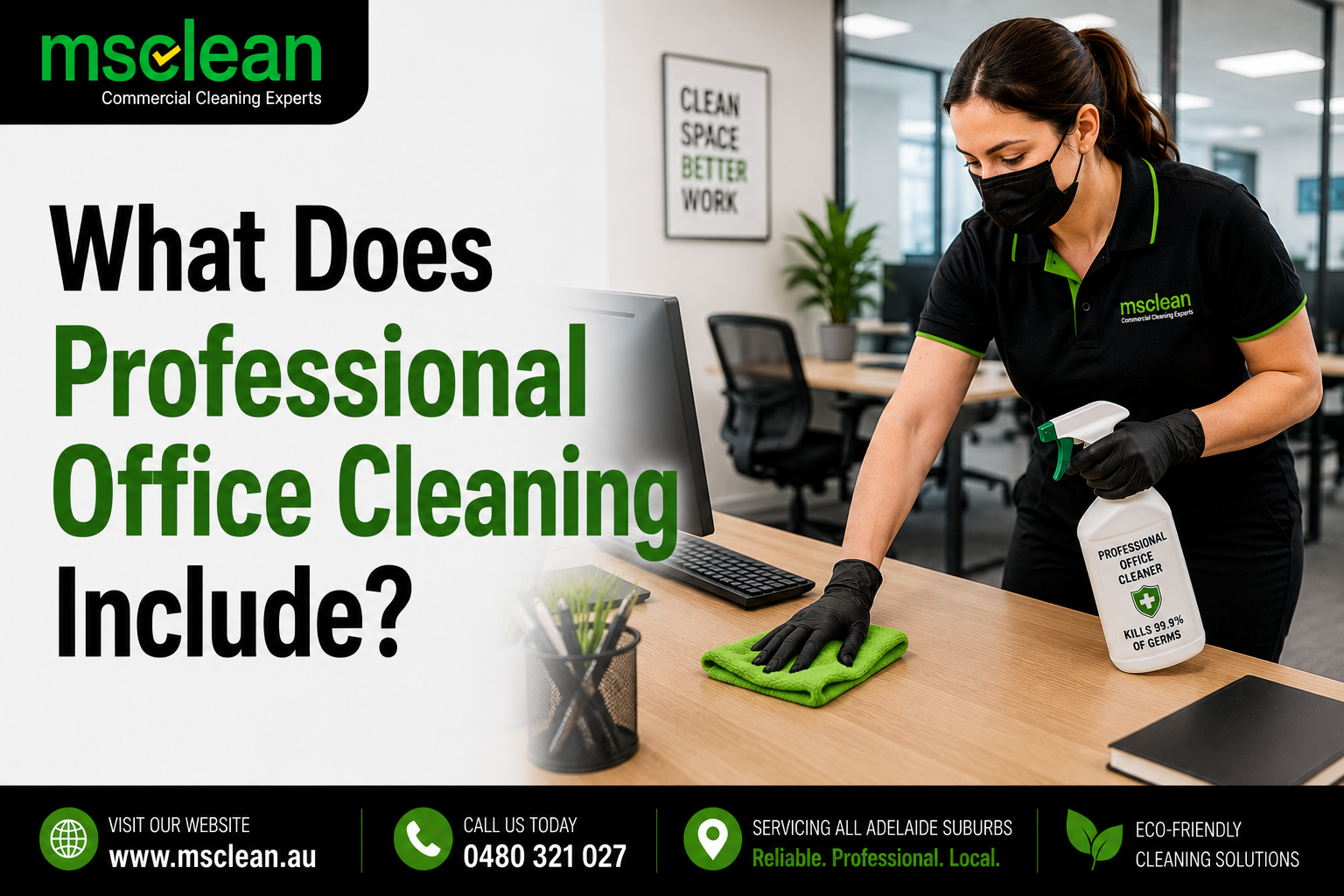
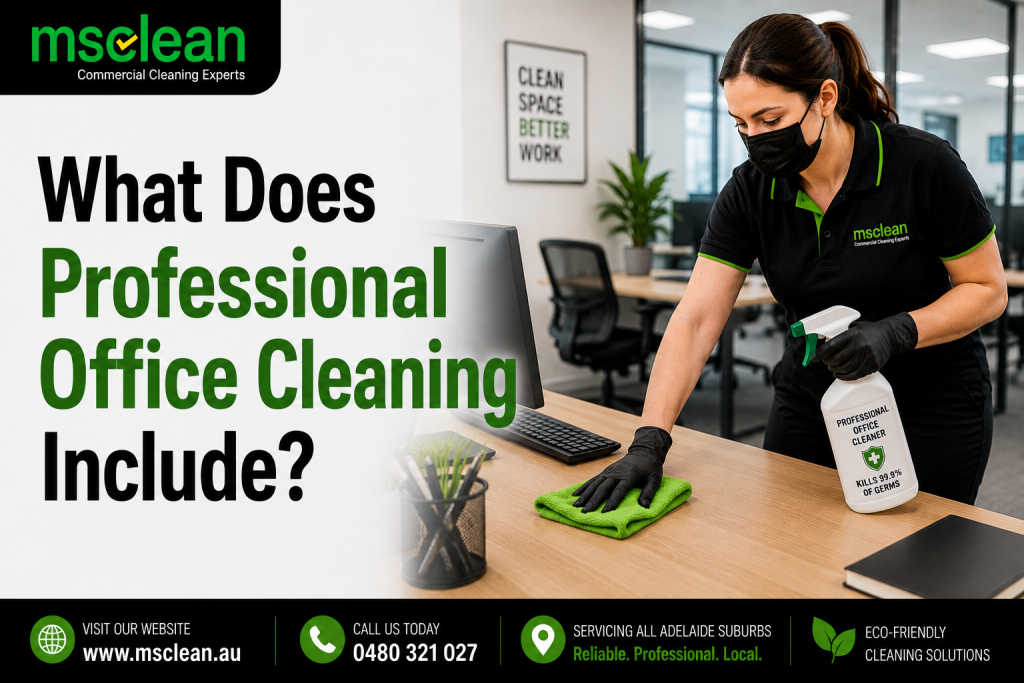
Professional office cleaning in Adelaide typically includes routine surface sanitisation, floor care, waste management, and restroom and kitchen hygiene. Standard tasks cover workstations and desks, flooring, restrooms, kitchen and break rooms, waste management, and common areas. Optional add-ons include internal and external window washing, deep carpet steam cleaning, glass partition cleaning, and hard floor stripping and sealing. The exact scope depends on your office size, staff count, industry, and how clearly the scope is written into the agreement before work starts.
Professional office cleaning in Adelaide covers six standard areas: workstations and desks (dusting, wiping down office desks, chairs, computer peripherals, and high-touch areas like light switches and door handles), flooring (vacuuming carpets and rugs, sweeping or mopping hard floors), restrooms (scrubbing and sanitising toilets, basins, mirrors, and replenishing soap and paper towels), kitchen and break rooms (cleaning countertops, wiping down appliance exteriors, washing sinks), waste management (emptying rubbish bins, recycling containers, and replacing bin liners), and common areas (tidying reception areas, boardrooms, and meeting spaces). Common optional add-ons include window washing, deep carpet steam cleaning, glass partition cleaning, and hard floor stripping and sealing.
You sign up with an office cleaning company. The first few visits go well. Then, six weeks in, you notice the kitchen bench only gets a wipe across the visible section. The phone handsets in the meeting room are dusty. The glass on the entry door has three layers of fingerprints. You raise it. The cleaner says it was not in the scope. You check the contract. It says “general cleaning of office areas.”
That is the problem with most office cleaning contracts in Adelaide. They describe what happens at a surface level without specifying what each word actually means. “General cleaning” can mean anything or nothing. Until you define it in writing, you are leaving interpretation to whoever shows up with a mop.
This guide tells you what professional office cleaning should include — area by area, task by task what is genuinely optional, and the specific questions to ask before you commit to any cleaning agreement in Adelaide.
Why Professional Office Cleaning Is Not the Same as Having the Kitchen Cleaned
Most offices in Adelaide employ some version of cleaning. The range is wide. At one end, a part-time cleaner comes twice a week and runs a vacuum through the main areas, empties bins, and wipes the obvious surfaces. At the other end, a professional commercial cleaning service operates with a written scope, defined task frequencies, quality control systems, and documentation that confirms what was done and when.
The gap between these two is not just thoroughness. It is accountability.
Commercial cleaning operates under different conditions from residential cleaning. Access happens outside business hours early mornings, evenings, sometimes overnight. Cleaners work without staff present. Any problem or missed area gets discovered by the office manager at 8 am the following day, when the cleaning company is not on site and cannot fix it before the first meeting starts.
This is why a written, specific scope of works matters more in commercial cleaning than in almost any other service. Without it, you have no standard to hold anyone to.
Professional office cleaning in Adelaide typically includes routine surface sanitisation, floor care, waste management, and restroom and kitchen hygiene. The competent providers structure their service around six core areas and they will tell you what is included and excluded before you sign, not after you complain.
The Six Standard Areas Every Professional Office Clean Should Cover
Reception and Common Areas
Reception is where every client and visitor forms their first impression of your business. It is also the highest-traffic surface area in most offices — door handles, the front counter, seating, and floor space that gets heavy foot traffic throughout the day.
What a professional clean covers in reception:
- Hard floors — vacuumed or swept and mopped with appropriate product for the floor type
- Carpeted areas — thoroughly vacuumed including under chairs and around furniture bases
- Reception desk — wiped down including the front panel, phone handset, computer screen surround, and any client-facing surfaces
- Seating — vacuumed if fabric, wiped if vinyl or leather
- Glass partitions and doors — wiped streak-free
- High-touch surfaces — door handles, light switches, intercom buttons, lift call buttons — disinfected at every visit
- Bins — emptied and relined
- Skirting boards — dusted weekly
Two things that commonly get missed in this area: the phone handset on the reception desk (one of the highest-bacteria surfaces in any office) and the client-facing side of the counter (wiped less often than the staff side because it is less visible from the working position).
Workstations and Open-Plan Office Areas
This is the area with the most variation between what providers include and what clients expect. The ambiguity starts with the phrase “clean desks.” That could mean wiping the top surface around everything on the desk. It could mean moving items and wiping underneath them. It could mean nothing more than a vacuum pass across the floor nearby.
What a professional clean should cover at workstations:
- Desks — wiped with a damp cloth (items on desk moved, not cleaned around)
- Monitors — dusted or screen-wiped (confirm whether screens are included — some clients prefer they are not touched)
- Keyboards and mice — disinfected (or excluded by client preference — establish this in writing)
- Phone handsets — disinfected
- Chairs — vacuumed or wiped according to material
- Under-desk areas — vacuumed
- Partition walls — dusted
Before signing any commercial cleaning agreement in Adelaide, confirm in writing whether electronics are touched, whether cleaners move items on desks to clean underneath them, and what the protocol is for workstations with sensitive materials or equipment.
Kitchen and Break Rooms
The communal kitchen is the highest-risk area in a commercial building from a hygiene standpoint. It is also consistently the most poorly cleaned. Surface wiping of the benchtop is not kitchen cleaning it is the first step.
What professional kitchen cleaning includes:
- Benchtops — wiped and sanitised, including edges and joins where food debris accumulates
- Sink — scrubbed and sanitised
- Microwave — interior wiped, exterior wiped
- Kettle and coffee machine — exterior wiped
- Fridge — exterior wiped including the handle; interior is typically client-managed unless specifically included
- Cupboard fronts — wiped
- Floor — swept and mopped
- Bins — emptied and relined
What kitchen cleaning typically does not include:
- Fridge interior
- Inside of cupboards
- Descaling the kettle or coffee machine
- Cleaning the inside of the oven (if applicable)
These tasks are usually classified as deep kitchen cleans and need to be scheduled separately. If you expect them as part of the regular clean, confirm this in writing before the contract starts.
Restrooms
Commercial bathroom cleaning to a professional standard is not optional it is the area where hygiene failures have the most direct impact on staff wellbeing and client perception.
What professional restroom cleaning includes:
- Toilet bowl — scrubbed
- Seat and lid — disinfected top and underside
- Outer bowl and base — wiped
- Urinals (if applicable) — cleaned and deodorised
- Basins — scrubbed and sanitised
- Taps — wiped and polished
- Mirrors — cleaned streak-free
- Soap dispensers — checked and refilled
- Paper towel and toilet paper — checked and restocked
- Sanitary bins — emptied and relined (this is sometimes a separate contracted service)
- Floor — mopped with disinfectant
- High-touch surfaces — door handle, light switch, flush button — disinfected
Who supplies soap, paper towels, and toilet paper is one of the most common points of confusion in commercial cleaning contracts. Some providers include consumables in the quoted price. Most do not. Confirm this before the first invoice.
Meeting Rooms and Boardrooms
Meeting rooms cycle through heavy use multiple sessions per day, different configurations, client visits, presentations. They need a reset after each session and a thorough clean each day.
What professional meeting room cleaning includes:
- Table — fully wiped down
- Chairs — wiped or vacuumed according to material
- Whiteboard — checked; erased only if specifically instructed (never erase a whiteboard without clear instruction — this is one of the most common complaints in office cleaning)
- AV equipment — dusted
- Bins — emptied
- Floor — vacuumed or mopped
The whiteboard issue is worth flagging explicitly with any cleaning company before the first visit. A cleaner who wipes a whiteboard with strategy notes or meeting output has caused a real problem — and “we assumed it was done” is not an acceptable explanation.
Floors Throughout the Office
Floors cover the most surface area in any office and take the most daily wear. The right cleaning method depends on the floor type.
| Floor Type | Standard Method | Periodic Treatment |
| Carpet (standard) | HEPA vacuum daily | Hot water extraction quarterly |
| Vinyl or linoleum | Sweep and mop with appropriate product | Strip and reseal annually |
| Timber or timber-look | Sweep and damp mop — minimal moisture | Polish or condition biannually |
| Tile | Sweep and mop with neutral cleaner | Grout cleaning quarterly or annually |
| Polished concrete | Sweep and damp mop | Resealing as required |
Vacuuming is always included in a standard commercial clean. Hot water extraction (carpet steam cleaning), floor scrubbing, stripping and resealing, and specialist timber treatment are periodic services that are quoted separately and scheduled on an agreed cycle.
What Standard Office Cleaning Does Not Include
These are the tasks that cause the most disagreement between Adelaide office cleaning clients and providers — because clients assume they are included and providers assume they are not.
External Window Cleaning
Internal glass is standard. External windows above ground level almost always require a separate window cleaning service with specific equipment, different scheduling, and separate pricing. Do not assume your regular cleaner will clean external glass. Confirm what “window cleaning” means in your specific contract.
Carpet Steam Cleaning
Vacuuming is standard. Hot water extraction (steam cleaning) is a periodic service. In Adelaide, most commercial carpet cleaning providers recommend extraction cleaning every 3–6 months for high-traffic offices, quarterly for medical or food service environments. This is scheduled, priced, and invoiced separately from your regular cleaning contract.
Deep Kitchen Clean
Standard kitchen cleaning covers daily surface maintenance. Cleaning the inside of the fridge, descaling appliances, deep-cleaning the inside of cupboards, and removing built-up grease from behind appliances — these are deep-clean tasks that need a specific booking and additional time allocation.
Consumables Supply
Whether this is included depends entirely on the provider. Many Adelaide commercial cleaning companies supply consumables (toilet paper, hand soap, paper towels, bin liners) as part of the contract rate. Many others treat consumables as a separate cost. Know which model applies to your agreement before the first restock runs out.
Specialised Cleaning
Medical-grade disinfection, clinical waste handling, laboratory surface cleaning, food-grade sanitisation for commercial kitchens, and IT equipment cleaning all require specialist providers and cannot be assumed as part of a standard commercial cleaning agreement.
Cleaning Frequency: What Your Office Actually Needs
Professional office cleaning in Adelaide typically includes routine surface sanitisation, floor care, waste management, and restroom and kitchen hygiene — but the right frequency depends on the specific conditions of your workplace.
| Office Type | Recommended Frequency |
| Small office, 1–5 staff, low client foot traffic | 1–2 times per week |
| Medium office, 5–20 staff | 2–3 times per week |
| Large office, 20+ staff | Daily |
| Medical, childcare, or food service | Daily minimum — some areas twice daily |
| Retail or high-foot-traffic reception | Daily |
These are baselines, not rules. A 5-person office that hosts client meetings three times a day needs more frequent attention to reception and meeting rooms than a 20-person back-office operation with no client visits. Frequency should match the actual use pattern of the space, not just the headcount.
High-touch surfaces — door handles, lift buttons, shared keyboards, kitchen appliance handles, bathroom fixtures, need attention more frequently than general surfaces in any office. In high-traffic environments, multiple resets of high-touch surfaces throughout the day produce meaningfully different hygiene outcomes than a single end-of-day wipe.
The Questions to Ask Before You Sign Any Office Cleaning Contract in Adelaide
The biggest source of frustration in commercial cleaning relationships is the gap between what was assumed and what was agreed. These questions close that gap.
What is specifically included in the scope?
Ask for a written scope of works that names every area and every task. Not a vague description of “general cleaning” — a specific list of what gets cleaned, how often, and to what standard.
How many hours are allocated to the premises?
A 500 square metre office cannot be properly cleaned in one hour. Hours matter. If a quote is significantly lower than others, ask how many hours are allocated and whether it is physically possible to complete the listed scope in that time.
Who will be doing the cleaning — an employee or a subcontractor?
Some cleaning companies subcontract their work. This affects consistency, training accountability, and insurance coverage. Know who is actually entering your building after hours.
What insurance does the company carry?
Ask for the current certificate of public liability insurance (minimum $10 million for commercial work) and workers’ compensation insurance. Do not accept verbal confirmation. Ask for the documents.
What happens if something is missed or not done properly?
What is the process for raising issues? Is there a re-clean policy? How quickly will problems be addressed? A quality provider answers this clearly. A provider who gets defensive or vague about this question tells you something important.
Are staff police-checked?
For any office handling sensitive client data, financial information, or serving vulnerable populations, this is a direct question with a yes or no answer.
What products are used?
If your office has staff with allergies, environmental commitments, a food preparation area, or medical equipment, the cleaning products matter. Ask for a product list.
What is the notice period and contract term?
A 30-day mutual notice period is standard and reasonable. Be cautious about contracts with 60–90 day notice periods, automatic annual rollover clauses, or penalty fees for early exit without demonstrated service failure.
Red Flags That Tell You the Provider Is Not Right for Your Adelaide Office
The quote is significantly cheaper than everyone else’s. In commercial cleaning, price directly reflects hours allocated. A cheap quote means fewer hours ,which means tasks are being cut or skipped. Find out which ones before agreeing.
The scope says “clean all areas as required.” This language means nothing and protects neither party. If you cannot hold a provider to a specific standard because the standard is not written down, you have no recourse when the standard is not met.
They cannot produce insurance documents within 24 hours. Any professional commercial cleaning company in Adelaide can email a current certificate of currency immediately. If they cannot find it, the policy may be lapsed.
A different person shows up each week. Consistency matters in commercial cleaning. A provider who cannot maintain a consistent assigned team is telling you something about their staff retention and their ability to build the knowledge of your premises that leads to reliable results.
No site visit before quoting. A quote provided over the phone or from a description of the floor plan is not a professional assessment. A reputable provider visits the premises before pricing the job.
Optional Add-Ons Worth Knowing About
These services are not standard in a commercial cleaning contract but are commonly available from Adelaide providers as scheduled additions.
Internal and external window washing. Most providers clean internal glass as standard. External windows typically require separate scheduling, different equipment, and additional cost — particularly for upper-floor windows that need specialist access.
Deep carpet steam cleaning. Hot water extraction removes the accumulated soil, allergens, and bacteria that vacuuming leaves behind. For most Adelaide offices, quarterly extraction cleaning extends carpet life and produces a genuinely clean carpet rather than a surface-clean one.
Glass partition cleaning. Internal frosted or clear glass partitions between office zones tend to accumulate fingerprints and marks quickly. This is often included in standard scope but worth confirming explicitly.
Hard floor stripping and resealing. Vinyl, linoleum, and some tile floors need periodic stripping of the old seal layer and application of a fresh protective coating. Without this, the floor dulls, stains more easily, and shows wear that no amount of mopping will reverse.
Why choose MS Clean?
Ms Clean has provided professional office cleaning to Adelaide businesses since 2015 across small professional offices, medical suites, legal practices, recruitment agencies, corporate floors, and retail premises throughout Adelaide CBD, Norwood, Glenelg, Prospect, Mawson Lakes, Salisbury, Marion, and all surrounding metro suburbs. The detail in this guide reflects direct operational experience with the specific questions, disputes, and gaps that arise in real commercial cleaning relationships not advice assembled from general industry content.
FAQs — What Does Professional Office Cleaning Include?
What is always included in professional office cleaning in Adelaide?
Professional office cleaning in Adelaide typically includes workstations and desks (dusting and wiping surfaces and high-touch areas), flooring (vacuuming and mopping), restrooms (full sanitisation and consumable restock), kitchen and break rooms (benchtops, sink, appliance exteriors, floor), waste management (bins emptied and relined), and common areas (reception, meeting rooms, and shared spaces). Everything else should be confirmed in writing.
What is not included in a standard office cleaning contract?
Items typically excluded from standard office cleaning include: external window cleaning above ground level, carpet steam extraction (vacuuming is included, hot water extraction is separate), fridge interior, inside of cupboards, descaling appliances, specialist IT equipment cleaning, clinical or medical-grade disinfection, and consumables supply unless specifically stated. Confirm exclusions in writing before signing.
How often should a professional clean an Adelaide office?
A small Adelaide office with 1–5 staff and low client traffic typically needs cleaning 1–2 times per week. Medium offices (5–20 staff) work well on 2–3 times weekly. Large offices (20+ staff) generally need daily cleaning. Medical, childcare, and food service environments need daily cleaning as a minimum, with some areas requiring multiple cleans per day.
What should a written office cleaning scope of works include?
A written scope of works should name every area to be cleaned, the specific tasks for each area, the frequency of each task, the products used, who supplies consumables, what is explicitly excluded, and the process for raising issues. Vague language like “general cleaning of office areas” is not a scope of works.
What is the difference between standard office cleaning and a deep clean?
Standard office cleaning covers routine maintenance — daily or regular tasks that keep the office in a presentable, hygienic condition. A deep clean covers tasks that fall outside the regular cycle: carpet steam extraction, fridge interiors, inside of cupboards, grout cleaning, high dusting, behind and under furniture, and full appliance cleaning. Deep cleans are typically scheduled quarterly or biannually and priced separately.
What should I check before booking an office cleaning company in Adelaide?
Before booking, confirm the written scope of works, hours allocated to the job, whether staff are employees or subcontractors, public liability and workers’ compensation insurance documents, the protocol for missed tasks or quality issues, police-check status for staff, the cleaning products used, and the contract notice period. Every one of these should be confirmed in writing, not over a phone call.
Do office cleaning services include consumables like toilet paper and soap?
Some Adelaide commercial cleaning providers include consumables in the contract rate. Most do not and treat them as a separately invoiced cost. Confirm exactly which model applies to your agreement before the contract starts — discovering the provider does not supply toilet paper after the first delivery runs out is a genuinely frustrating way to find this out.
Should a cleaning company visit before quoting?
Yes. A professional commercial cleaning company should inspect your premises before providing a quote. A quote produced over the phone or from a floor plan description is an estimate, not a professional assessment. A site visit allows the cleaner to assess floor types, the condition of bathrooms, the kitchen layout, actual traffic patterns, and any access requirements that affect the time and method needed.
Actionable Takeaways
1. Ask for a line-by-line scope of works before signing anything.
“General cleaning” is not a scope. A professional provider lists every area and every task. If they cannot produce this document, they are not a professional provider.
2. Confirm what is excluded in writing — not just what is included.
The exclusions are where most disputes happen. Deep kitchen cleaning, external windows, carpet extraction, consumables supply — get all of these confirmed in writing before the contract starts.
3. Ask how many hours are allocated and whether the scope is achievable in that time.
This one question catches more underscoped contracts than any other. A 400m² office cannot be properly cleaned in 90 minutes.
4. Confirm whether staff are employees or subcontractors.
This affects training consistency, insurance coverage, and who is accountable when something is missed or damaged.
5. Request the insurance certificate — not a verbal confirmation.
A current certificate of currency for public liability and workers’ compensation should arrive in your inbox within an hour of asking. If it takes longer than 24 hours, ask why.
6. Clarify the whiteboard and electronics protocol before the first visit.
These are the two most common sources of friction between office cleaning clients and providers. Both should be covered explicitly in the cleaning instructions.
Conclusion
The gap between a cleaning contract that sounds good and one that actually delivers is almost always a written scope of works and the specific questions asked before anything is signed.
Ms Clean provides professional office cleaning across Adelaide with a written scope confirmed before work begins, the same staff on every visit, fixed pricing, and completion documentation after every service. Free site assessment available no obligation, no pressure.
Call Now
Ms clean Au
Address: 71 Alexandra Street, Prospect, SA-5082
M : 0480 321 027
E-Mail: contact@msclean.au