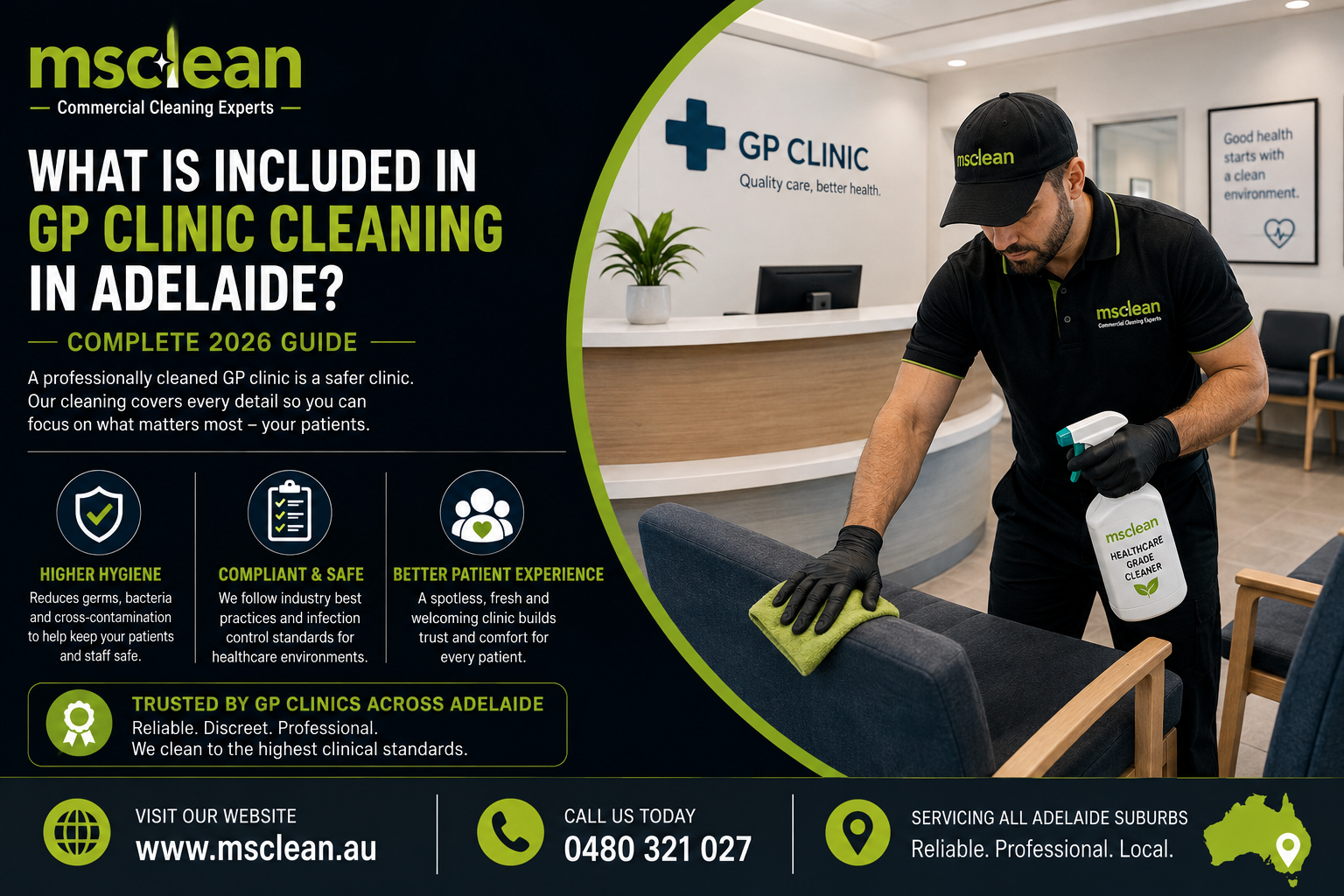
A professional GP clinic cleaning service in Adelaide includes routine cleaning, high-touch surface disinfection, clinical area cleaning, floor care, bathroom sanitation, waste management, staff kitchen cleaning, and periodic deep cleaning all delivered using TGA-listed hospital-grade disinfectants, a colour-coded zone equipment system, and a clean-to-dirty sequencing protocol that prevents cros s-contamination. The exact scope depends on the clinic layout, services provided, and infection-control requirements. GP clinic cleaning in Adelaide is structured around room-specific checklists aligned to RACGP Standards for General Practices and SA Health Cleaning Standards not a generic commercial cleaning checklist.
GP clinic cleaning services in Adelaide differ fundamentally from standard commercial office cleaning. Cleaning in these environments is an infection control measure, not just a presentation measure. Every element of a professional GP clinic clean the products used, the zone sequencing, the equipment colour coding, the dwell time compliance, and the documentation produced serves a clinical infection-control function. A properly scoped GP clinic cleaning service covers: reception and waiting area disinfection, consultation and treatment room cleaning, high-touch surface protocol, bathroom and amenity sanitisation, clinical waste management, staff kitchen cleaning, floor care, and periodic deep cleaning. Each area carries a different infection risk level and receives a protocol matched to that risk not a one-size approach applied to every room.
When a patient walks into your Adelaide GP clinic, they are not thinking about the cleaning protocol. They are thinking about whether they feel safe.
They look at the waiting room chairs. They notice whether the reception counter looks clean. They observe the state of the bathroom. And before you have said a single word about their health, they have already formed a view about the standard of care they are about to receive.
What they cannot see is the examination table that was disinfected with a TGA-listed product after the last patient. The colour-coded microfibre cloths that ensure the cloth used on the bathroom never touches the consultation room sink. The dwell time compliance that means the disinfectant your cleaner applied actually achieves the claimed pathogen kill rate rather than being wiped off 15 seconds after application.
This guide tells you exactly what a professional GP clinic cleaning service in Adelaide includes room by room, protocol by protocol and why each element exists as an infection-control measure rather than a cosmetic one. If you are evaluating a current provider, reviewing a contract, or trying to understand what your clinic should be getting, this is the most specific, clinically grounded answer you will find.
Why GP Clinic Cleaning Is Not Regular Office Cleaning
The patients who attend these facilities are often already unwell, immunocompromised, or in treatment for conditions that make them more susceptible to healthcare-associated infection.
Understanding why GP clinic cleaning differs from office cleaning helps practice managers evaluate whether the service they currently receive actually meets the standard their patients and their accreditation obligations require.
The Four Critical Differences
1. Products — TGA-listed hospital-grade disinfectants, not all-purpose detergent.
A standard commercial cleaner uses general-purpose surface spray and multipurpose detergent. These products clean visible soiling. They do not achieve documented kill rates against blood-borne viruses, airborne respiratory pathogens, or the organisms that create genuine infection risk in a clinical environment. A GP clinic cleaning service uses TGA-listed disinfectants with a confirmed kill spectrum — products registered on the Australian Register of Therapeutic Goods (ARTG) for use in clinical settings.
2. Protocols — infection control sequencing, not random room order.
Standard commercial cleaning moves through a building in whatever order is convenient. Medical cleaning follows a clean-to-dirty sequence — starting from the lowest-risk areas (consultation rooms, administrative spaces) and moving to the highest-risk areas (bathrooms, sluice areas, clinical waste zones) last. This prevents pathogens from being transported from contaminated areas to clean areas via the cleaning equipment or the cleaner themselves.
3. Equipment — colour-coded zone systems, not shared cloths.
A general cleaner uses the same cloth on the consultation room bench and the bathroom basin. A professional medical cleaner uses a colour-coded zone system — specific cloth and mop colours for each zone type — that physically prevents cross-contamination between clinical and bathroom areas. Different coloured cloths and mops for bathrooms, treatment rooms, and general areas prevents spreading germs from toilets to consulting rooms.
4. Documentation — audit-ready records, not just an invoice.
Adelaide GP clinics and specialist practices consistently maintain strong accreditation records and expect cleaning contractors to match the quality of the facilities they serve. Professional GP clinic cleaning produces daily checklists signed off by the cleaning team, inspection reports, GPS clock-in records for accountability, and documentation formatted for RACGP / AGPAL accreditation audit review.
The 4-Step Smart Cleaning Sequence Every GP Clinic Clean Follows
A properly trained medical cleaning team follows two sequencing rules on every visit:
- High to low: Start cleaning from the highest surfaces (shelves, tops of cabinets, light fittings) and work down to floor level. This prevents dust and debris dislodged from upper surfaces from falling onto surfaces already cleaned below.
- Clean to dirty: Move through the clinic from the cleanest areas (consultation rooms, administrative areas) to the dirtiest areas (bathrooms, clinical waste zones). This prevents cross-contamination from moving in the wrong direction.
Reception and Waiting Room Cleaning
The reception and waiting room carries the highest traffic density in any GP clinic. Forty to a hundred patients per day pass through this space, each bringing their own pathogen load from whatever brought them to the clinic. Every surface in the waiting area functions as a potential indirect transmission pathway to the next patient who touches it.
What Gets Cleaned in Reception and Waiting Areas
Reception desk and counter — full disinfection every visit
The reception desk carries constant hand contact from staff and patients throughout the day. The full desk surface — including the patient-facing side, the clerk’s side, the telephone handsets, monitor surfaces, keyboard edges, and mouse — receives a wipe-down with TGA-listed disinfectant on every service visit. The patient-facing side receives particular attention as a direct touchpoint for every person who checks in.
EFTPOS terminals and digital check-in screens
Payment terminals and touchscreen check-in systems carry a concentrated contact load — every patient touches these surfaces in sequence. Disinfection of EFTPOS terminals, touch screens, and stylus holders uses electronic-safe, TGA-listed disinfectant applied to a cloth — not sprayed directly onto electronic surfaces.
Door handles, push plates, and light switches
These represent some of the highest-frequency contact surfaces in the clinic. Every patient who enters and exits touches the door handle. Every staff member operates the light switches. All door handles, push plates, and light switches in the reception and waiting area receive disinfection on every visit — not as part of a general wipe-down, but as a specific high-touch surface protocol.
Waiting room chairs — armrests and contact surfaces
Chair armrests are gripped by every seated patient throughout the session. Chair surfaces, armrests, and leg bases receive disinfection using a product matched to the upholstery material. Hard plastic or vinyl chairs receive full disinfection. Fabric chairs receive appropriate sanitising treatment. The clinical rationale is straightforward: an immunocompromised patient sitting in a chair immediately after a patient with an infectious condition touches the same armrest without intermediate disinfection.
Glass partitions and internal windows
Reception glass panels that patients lean against or touch during check-in receive streak-free cleaning with an appropriate glass cleaner. Internal windows and glass partitions throughout the reception area are cleaned for both hygiene and presentation.
Floor care — vacuum and mop
Waiting room floors — whether carpeted, vinyl, or tiled — receive a thorough vacuum or sweep, followed by mopping with appropriate floor sanitiser. Carpet areas receive HEPA-filter vacuuming to capture fine allergens and biological particulate without redistributing it into the air. Periodic carpet steam cleaning is included in most Adelaide GP clinic cleaning contracts as a scheduled add-on service.
Pamphlets, hand sanitiser stations, and consumables
Brochure and magazine displays are tidied and repositioned. Hand sanitiser stations are checked and restocked where included in the scope. This is not a cosmetic task — a depleted hand sanitiser station in the waiting room of a GP clinic represents a gap in the infection-control chain.
Consultation and Treatment Room Cleaning
Consultation and treatment rooms carry the highest clinical infection risk in any GP clinic. These are the spaces where patient contact occurs, where examination occurs, and where the potential for surface contamination from biological material is highest.
What Gets Cleaned in Consultation Rooms
Examination beds and couches — end-of-session disinfection
Doctors and nurses wipe down examination beds immediately after each patient use — this is a clinical responsibility, not a cleaning contractor responsibility. However, the end-of-day or post-session professional clean includes full disinfection of the examination bed or couch surface, the frame, the pillow support, and any adjustable components using TGA-listed disinfectant. Medical-grade paper roll replacement is managed in coordination with clinical staff.
Medical equipment surface wipe-down
Non-invasive medical equipment surfaces, blood pressure monitor housings, otoscope holders, thermometer stations, pulse oximeter surfaces, and stethoscope hooks receive surface disinfection using medical-grade, non-corrosive disinfectants appropriate for electronic and clinical equipment. The cleaning contractor never operates, adjusts, or interacts with clinical instruments; only the external surface of housings and casings is cleaned.
Computer keyboards, mice, and monitors in consultation rooms
Keyboards are one of the most-touched and least-cleaned surfaces in a clinical environment. Consultation room keyboards and mouse surfaces receive disinfection with an appropriate electronic-safe product on every service visit. Monitor frames and screens receive appropriate care never sprayed directly.
Clinical sinks and taps
Consultation room sinks used for clinical handwashing carry a specific biofilm risk if not regularly deep cleaned. Sinks, taps, and tap handles receive deep cleaning and disinfection to prevent biofilm accumulation at drain interfaces and around fittings.
All bench surfaces and cabinet exteriors
Benchtops, supply cabinet exteriors, drawer handle surfaces, and specimen tray surfaces all receive disinfection. Special attention is given to the bench area immediately surrounding the sink and to surfaces adjacent to the examination bed these areas carry the highest indirect contamination load during clinical consultations.
Door handles, light switches, and all high-touch points within the room
Consultation room door handles inside and outside light switches, window latches, and any other high-contact surfaces receive disinfection on every visit as a specific protocol step rather than an incidental wipe.
Floors — vacuum and mop
Consultation room floors receive a thorough vacuum to remove loose debris before mopping with a TGA listed floor sanitiser. The clean to dirty zone system ensures consultation room floor cleaning happens before bathroom floor cleaning never after.
What Gets Cleaned in Treatment and Procedure Rooms
Treatment and procedure rooms carry additional cleaning requirements beyond a standard consultation room, depending on the procedures the clinic performs.
Clinical surface cleaning and full disinfection
All horizontal surfaces in treatment and procedure rooms receive full clinical-grade disinfection, not just a wipe down. This includes procedure trolley surfaces, instrument trays, IV stand components, and any other surface that may have had proximity to a clinical procedure.
Treatment bed and non-porous surface disinfection
Treatment beds with non porous surfaces receive full disinfection after each session. Porous or fabric treatment surfaces receive appropriate sanitising treatment. Any surface that a patient contacted directly during a procedure receives disinfection before the next patient.
Waste bin management — including clinical waste awareness
Waste bins in treatment rooms receive emptying and relining. Clinical waste has specific disposal requirements under the Environment Protection Act 1993 (SA) and SA Environment Protection Authority guidelines. Cleaning staff should never reach into bins that may contain clinical waste. Yellow biohazard bags should never be included in general waste. Professional GP clinic cleaning staff recognise and appropriately manage clinical waste containers they do not empty sharps containers (a clinical responsibility) but they do wipe exteriors and alert practice management when containers are approaching capacity.
High-Touch Surface Disinfection — The Most Important Protocol in Any GP Clinic
High-touch surface disinfection is particularly important in GP clinics and represents the infection-control core of every professional clinic cleaning service.
Every shift, the cleaning team targets these specific hotspot surfaces:
- Doorknobs and door handles — every door, every room, every visit
- Reception counter surfaces
- EFTPOS terminals and card readers
- Keyboards, mice, and phone handsets
- Handrails in corridors and stairwells
- Chair armrests in waiting and consultation areas
- Waiting room side tables and magazine holders
- Shared pens and clipboard holders
- Light switches and dimmer controls
- Lift call buttons in multi-level clinics
Why Dwell Time Compliance Matters on Every High-Touch Surface
The product matters. But the dwell time is what determines whether disinfection actually works. Applying a TGA-listed disinfectant and wiping it off immediately achieves a fraction of the claimed kill rate. The same product left wet on the surface for the manufacturer-specified contact time — typically 30 seconds to 10 minutes depending on the product and the targeted organism — achieves the 99.9%+ pathogen reduction the TGA registration claims.
A professional Adelaide GP clinic cleaning service documents dwell time compliance. This is not a detail — it is the difference between a clinic that has a cleaning contract and a clinic that has an infection-control cleaning programme.
Bathroom and Patient Amenity Cleaning
Patient bathrooms in a GP clinic carry a uniquely elevated infection risk. Patients who visit GP clinics are by definition more likely to be unwell — and the bathroom is one of the most-used spaces in the facility for every demographic of patient, including the most vulnerable.
What Gets Cleaned in Clinic Bathrooms
Toilet — full clinical sanitisation
Toilet bowl, seat, lid, handle or push-button flush mechanism, the exterior base, and the floor area around the base receive clinical-grade disinfection on every visit. The cleaning sequence starts with the toilet bowl and works outward to surfaces touched by clean hands basin, taps, mirror in a defined order that prevents recontamination.
Basin, taps, and tap handles
Basin surfaces, tap fittings, and tap handles receive thorough cleaning and disinfection. Tap handles in a GP clinic bathroom are touched by every patient before and after handwashing — they carry concentrated pathogen load and require specific attention on every service visit.
Mirror
Bathroom mirrors receive streak-free cleaning on every visit.
Floor — mop with hospital-grade floor sanitiser
Bathroom floors receive a full mop using TGA-listed floor disinfectant. Floor drains receive hot water flush where accessible. The bathroom floor mop head is colour coded red it never enters the consultation room or reception area.
Consumable restocking
Medical grade hand soap, paper towels, and toilet paper are restocked on every visit where included in the contract scope. A depleted hand soap dispenser in the clinical bathroom is a direct infection control failure.
Bin emptying and bin sanitisation
Waste bins receive emptying, relining, and exterior disinfection on every visit. Clinical waste bins are identified and left for the clinic’s clinical waste contractor never included in general waste.
Clinical Waste and Sharps Management
Clinical waste management in GP clinic cleaning requires specific awareness and defined protocols. This area is commonly misunderstood in service contracts.
What Cleaning Staff Do With Clinical Waste
What the cleaning contractor manages:
- Emptying and relining general waste bins throughout the clinic
- Identifying and leaving clinical waste (yellow biohazard bags) for the clinic’s registered clinical waste contractor
- Wiping the exterior surfaces of sharps containers and clinical waste bins
- Alerting practice management when sharps containers approach capacity
What the cleaning contractor does not do:
- Handle, lift, open, or dispose of sharps containers — this is a clinical responsibility
- Include yellow biohazard bags in general waste — this is an Environment Protection Act 1993 (SA) compliance requirement
- Reach into any bin that may contain clinical waste
Cleaning staff are not typically responsible for sharps management — that is a clinical responsibility. Any GP clinic cleaning contract that explicitly includes sharps handling by cleaning staff creates compliance and safety risk. Clarify this delineation in every service agreement.
Staff Kitchen and Breakroom Cleaning
The staff kitchen and breakroom is the clinical team’s reset space. A clean, hygienic kitchen supports staff health and prevents food-borne illness risk in a team that is already managing high pathogen exposure throughout the clinical day.
What Gets Cleaned in the Staff Kitchen
Benchtops — full wipe and sanitise
All bench surfaces, including the area around appliances, receive cleaning and sanitisation on every visit. Joins and edges where food debris accumulates receive specific attention.
Sink and tapware
Sink interior, sink exterior, and tap handles receive cleaning and disinfection. Food residue and biofilm around drain interfaces is removed on every visit.
Appliance exteriors
Microwave interior and exterior, toaster exterior, kettle exterior, and coffee machine exterior receive cleaning on every visit. Fridge exterior including handles receives a wipe-down. Fridge interior cleaning is typically included on a weekly or fortnightly schedule.
Dishwasher
Loading or unloading the dishwasher, or hand washing any remaining mugs and cutlery left in the sink, is typically included where specified in the contract scope.
Table and chairs
Table surfaces and chair backs and seats receive a wipe-down on every visit.
Floor — sweep and mop
Kitchen floors receive a sweep to remove food debris followed by a mop with appropriate sanitiser.
Rubbish removal
Kitchen bins are emptied, relined, and exterior-wiped on every visit.
Floor Care Throughout the Clinic
Floors represent the largest surface area in any GP clinic and carry the most varied soiling profile. A professional Adelaide GP clinic cleaning service manages floor care with method matched to surface type and zone risk level.
| Floor Area | Surface Type | Method | Frequency |
| Waiting room | Carpet | HEPA vacuum, spot treatment | Daily |
| Waiting room | Vinyl or tile | Sweep, mop with sanitiser | Daily |
| Reception | Vinyl or tile | Sweep, mop with sanitiser | Daily |
| Consultation rooms | Vinyl or tile | Sweep, mop with TGA-listed floor sanitiser | Daily |
| Corridors | Vinyl or tile | Sweep, mop with sanitiser | Daily |
| Bathrooms | Tile | Mop with hospital-grade floor disinfectant (red mop) | Daily |
| Staff kitchen | Vinyl or tile | Sweep, mop with food-safe sanitiser | Daily |
| All carpeted areas | Carpet | HEPA vacuum | Daily |
| All carpeted areas | Carpet | Steam extraction | Scheduled — quarterly |
| Hard floors (all types) | Various | Machine scrub | Scheduled — quarterly to annual |
The colour-coded mop system prevents cross contamination between zones. The bathroom floor mop never enters a consultation room. The kitchen floor mop never enters the bathroom. This is enforced operationally not just stated in policy.
Specialised Protocols That Separate Professional GP Clinic Cleaning From General Commercial Cleaning
TGA Registered Hospital Grade Disinfectants
All disinfectants used in a professional Adelaide GP clinic clean carry TGA listing — an ARTG (Australian Register of Therapeutic Goods) number that confirms the product has been assessed for safety and efficacy against the pathogens it claims to kill.
The kill spectrum matters. Disinfectants used in GP clinic settings should demonstrate efficacy against:
- Blood-borne viruses — Hepatitis B, Hepatitis C, HIV
- Respiratory pathogens — Influenza, COVID-19, RSV
- Multi-drug resistant organisms — MRSA, VRE
- Common gram-positive and gram-negative bacteria
- Fungal organisms where applicable
Ask any cleaning provider for the ARTG number of every disinfectant they use in your clinic.
The Colour-Coded Cleaning System
To prevent cross-contamination, cleaners use specific coloured microfibre cloths and mops for different areas.
| Colour | Zone | Equipment Type |
| Red | Bathrooms and toilets | Cloths, mop heads, spray bottles |
| Yellow | Clinical sinks and treatment areas | Cloths, mop heads — clinical zones only |
| Blue | General areas — waiting rooms, corridors, admin | Cloths, mop heads for non-clinical surfaces |
| Green | Kitchens and food preparation areas | Cloths, mop heads for food-adjacent surfaces |
This system makes cross-contamination prevention physically enforceable — not dependent on staff memory or intent.
AS/NZS 4146 Compliance for Linen
Where a GP clinic manages on-site linen — gowns, towels, or reusable covers — cleaning procedures must align with AS/NZS 4146:2010 standards for laundry practices in healthcare settings. Most clinics use external linen services, in which case this standard applies to the linen service rather than the cleaning contractor.
Staff Screening — Vaccinations and Police Clearances
All cleaners working in Adelaide GP clinics should hold:
- Current police clearance (National Police Check)
- Relevant vaccinations: influenza (annually), COVID-19 (current), and ideally Hepatitis B (particularly for clinical zone staff)
- NDIS Worker Screening Check for facilities serving NDIS participants
Compliance, Documentation, and Audit Readiness
This is the element that most Adelaide GP clinic cleaning services either do poorly or do not mention at all and it is the element that practice managers need most during an accreditation audit.
What Documentation a Professional GP Clinic Cleaning Service Produces
Daily cleaning checklists — signed off by the cleaning team
Every service visit generates a room by room completion checklist. The cleaning team member signs off each zone as completed. This checklist is available for practice management review and forms part of the audit evidence trail.
Supervisor inspection reports
A senior cleaner or supervisor periodically inspects the completed clean against the scope of work and produces a written inspection report. This report documents any areas that required additional attention and any observations relevant to the facility’s infection-control programme.
GPS clock-in and clock-out records
GPS-based clock-in technology confirms that the cleaning team was physically present at the clinic for the duration of the scheduled service. This creates accountability for attendance a common pain point with cleaning contractors who are paid for time they do not spend on site.
Product records — SDS (Safety Data Sheets) on site
Safety Data Sheets for every product used in the clinic are maintained on site and available on request. This is a WHS requirement under Australian legislation and a specific requirement in healthcare facility cleaning compliance.
Photo evidence — available in premium service contracts
Some Adelaide GP clinic cleaning providers offer photo documentation of completed cleaning zones time stamped images confirming the state of the clinic on departure. This level of documentation provides the strongest possible audit evidence trail.
RACGP Standards Alignment
The RACGP Standards for General Practices (5th Edition) specifically Standard GP4.1 includes requirements for infection prevention processes, environmental cleaning, and maintenance of a clean clinical environment. A GP clinic cleaning service aligned to RACGP GP4.1 produces documentation suitable for direct use in RACGP accreditation review.
A failed cleaning inspection can put your practice accreditation at risk. Most GPs only find out the hard way.
The gap between a cleaning contract and a compliant cleaning programme is not the cleaning itself it is the evidence. Your accreditation reviewer does not just walk through the clinic. They ask for the documentation. A cleaning provider who cannot produce daily checklists, supervisor inspection records, and product documentation cannot support your accreditation obligation regardless of how good the actual cleaning is.
Scheduling Options for Adelaide GP Clinic Cleaning
After-Hours Cleaning — The Standard Model
Most Adelaide GP clinics schedule professional cleaning after operating hours typically 6 pm to 9 pm on weeknights or before 7 am on early morning starts. After-hours cleaning ensures no disruption to patient appointments and no cleaning equipment visible in reception during consultations.
After hours cleaning is the standard for Adelaide GP clinic contracts. It is not a premium service it is the default expectation.
During-Hours Touchpoint Resets
High-volume GP clinics with more than 60 patients per day benefit from daytime touchpoint resets a targeted 20 to 30 minute clean during lunchtime or a session changeover that specifically covers high touch surfaces: door handles, EFTPOS terminals, bathroom fixtures, and waiting room chair armrests. This is offered as an add-on to the standard after-hours service for high traffic Adelaide practices.
Ad-Hoc Deep Cleans for Outbreak Situations
When an infectious illness event occurs in a GP clinic confirmed COVID 19 case in the waiting room, norovirus outbreak, or any other infectious exposure the standard cleaning schedule is insufficient for remediation. Professional Adelaide GP clinic cleaning providers offer emergency deep clean response with a heightened protocol: enhanced disinfectant concentration, extended dwell times, full surface coverage including soft furnishings, and a documented clearance report for practice management, insurers, and health authorities.
GP Clinic Cleaning Across Adelaide — Areas Ms Clean Services
Ms Clean provides professional GP clinic cleaning services across Adelaide metro and surrounding areas, including:
Adelaide CBD and inner suburbs: Adelaide CBD, North Adelaide, Parkside, Kent Town, Mile End medical precincts serving high patient volumes in compact multi-tenancy buildings; after hours access coordination standard.
Eastern suburbs: Norwood, Burnside, Kensington, Campbelltown, Hectorville professional services precinct with high GP density; presentation standards consistently elevated.
Northern suburbs: Prospect, Mawson Lakes, Salisbury, Elizabeth, Modbury, Tea Tree Gully community health and GP super-clinic concentration; high patient volumes requiring daily service.
Southern suburbs: Glenelg, Marion, Morphett Vale, Noarlunga, Hallett Cove coastal and suburban GP practices; flexible after-hours scheduling.
Western and inner-west suburbs: Henley Beach, Woodville, Seaton, Flinders Park accessible metro locations; standard after hours scheduling.
Why MS Clean?
Ms Clean has delivered professional GP clinic and medical facility cleaning services to Adelaide practices since 2015. We clean GP clinics, dental practices, allied health centres, pathology facilities, aged care properties, and NDIS facilities across Adelaide CBD and all metro suburbs. Every protocol described in this guide reflects the operational standard Ms Clean applies on every GP clinic service visit not aspirational standards or generic advice. Our cleaning documentation is formatted for RACGP and AGPAL accreditation audit review. We offer a free site assessment for any Adelaide GP practice that wants to understand whether their current cleaning programme meets the standard their accreditation obligations require.
Actionable Takeaways for Adelaide GP Practice Managers
1. Audit your current provider against the 4 critical differences.
Ask your current cleaning provider whether they use TGA-listed disinfectants (ask for ARTG numbers), a colour-coded zone system, a clean-to-dirty sequencing protocol, and daily documentation. If they cannot confirm all four, your cleaning programme has clinical gaps.
2. Request a room-by-room scope of work — not a general service description.
Your cleaning contract should specify every area, every task, and every frequency. If it says “clean the clinic” without room-specific detail, it does not protect you in a contract dispute or an accreditation audit.
3. Check whether your documentation is audit-ready.
Ask your provider what documentation they produce after each service visit. You need daily checklists signed by the cleaning team, inspection reports, and product records. An invoice is not documentation for an accreditation audit.
4. Confirm dwell time compliance.
Ask your cleaning provider what the required dwell time is for the specific TGA-listed disinfectant they use in your consultation rooms. If they cannot answer, the product is likely being applied without the required contact time.
5. Clarify clinical waste delineation in your contract.
Confirm explicitly that clinical waste and sharps management is delineated between the cleaning contractor (general waste only, identify and leave clinical waste) and the clinic’s clinical waste contractor. This delineation should appear in writing in the service agreement.
FAQs — GP Clinic Cleaning Services Adelaide
What is included in GP clinic cleaning services in Adelaide?
A professional GP clinic cleaning service in Adelaide includes reception and waiting area disinfection, consultation and treatment room cleaning, high-touch surface protocol, bathroom and patient amenity sanitisation, clinical waste awareness and management, staff kitchen cleaning, floor care across all areas, and periodic deep cleaning. All tasks are performed using TGA-listed hospital-grade disinfectants, a colour-coded zone equipment system, and a clean-to-dirty sequencing protocol. Documentation includes daily checklists, inspection reports, and product records for accreditation audit use.
What makes GP clinic cleaning different from normal office cleaning?
Cleaning in these environments is an infection control measure, not just a presentation measure. GP clinic cleaning uses TGA-listed hospital-grade disinfectants rather than general-purpose detergent, follows infection-control zone sequencing rather than a convenient room order, uses a colour-coded equipment system to prevent cross-contamination, documents every service for accreditation audit compliance, and trains staff in biohazard awareness and clinical waste protocols. Standard commercial cleaning achieves none of these things.
What is the colour-coded cleaning system used in GP clinics?
The colour-coded system assigns specific colours to specific zones — red for bathrooms and toilets, yellow for clinical sinks and treatment areas, blue for general waiting and reception areas, and green for kitchen and food preparation areas. Equipment stays within its assigned zone. This physically prevents bacteria from being transported from contaminated areas to clean areas via the cleaning cloth or mop.
How often should a GP clinic be professionally cleaned in Adelaide?
Most Adelaide GP clinics require daily professional cleaning on every operating day — covering all patient-contact areas, consultation rooms, bathrooms, and high-touch surfaces. High-traffic practices with 60+ patients per day benefit from a daytime touchpoint reset in addition to the main after-hours service. Periodic deep cleaning — carpet extraction, hard floor scrubbing, high dusting — is typically scheduled quarterly.
Do GP clinic cleaners handle sharps and clinical waste in Adelaide?
No. Cleaning staff are not typically responsible for sharps management — that is a clinical responsibility. Yellow biohazard bags should never be included in general waste. GP clinic cleaners manage general waste, identify and leave clinical waste in place for the registered clinical waste contractor, and wipe sharps container exteriors without opening or moving them. This delineation should be explicit in every service contract.
What documentation should a GP clinic cleaning service provide in Adelaide?
A professional Adelaide GP clinic cleaning service should provide: daily room-by-room completion checklists signed by the cleaning team, periodic supervisor inspection reports, GPS clock-in and clock-out records, Safety Data Sheets for every product used on site, and photo evidence where included in the service contract. This documentation supports RACGP, AGPAL, and SA Health compliance review during accreditation audits.
Can GP clinic cleaning be scheduled after hours in Adelaide?
Yes. After-hours cleaning is the standard scheduling model for Adelaide GP clinic cleaning contracts. Most practices schedule cleaning after the last patient appointment — typically arriving at 6 pm and completing before 9 pm. Early morning starts before 7 am are available for practices with early session times. Weekend and public holiday cleaning is also available with appropriate notice.
What TGA-listed disinfectants should a GP clinic cleaning service use?
Any disinfectant used in a clinical setting should carry TGA listing — an ARTG registration number confirming it has been assessed for safety and efficacy against the relevant organisms. In a GP clinic, disinfectants should demonstrate kill efficacy against blood-borne viruses (Hepatitis B, C, HIV), respiratory pathogens (influenza, COVID-19), and common healthcare-associated bacteria (MRSA, Staph, E. coli). Ask any provider for the ARTG number of every product they plan to use in your clinic.
Conclusion
Your Adelaide GP clinic’s cleaning programme is either supporting your infection-control obligations or creating gaps in them. There is no middle ground in a clinical environment.
Ms Clean provides GP clinic cleaning services across Adelaide aligned to RACGP Standards for General Practices, SA Health Cleaning Standards, and NHMRC infection control guidelines with TGA-listed disinfectants, colour-coded zone systems, daily documentation, and a free compliance walkthrough for any Adelaide practice that wants to know whether their current cleaning programme meets the standard it should.
Call Now
Ms clean Au
Address: 71 Alexandra Street, Prospect, SA-5082
M : 0480 321 027
E-Mail: contact@msclean.au