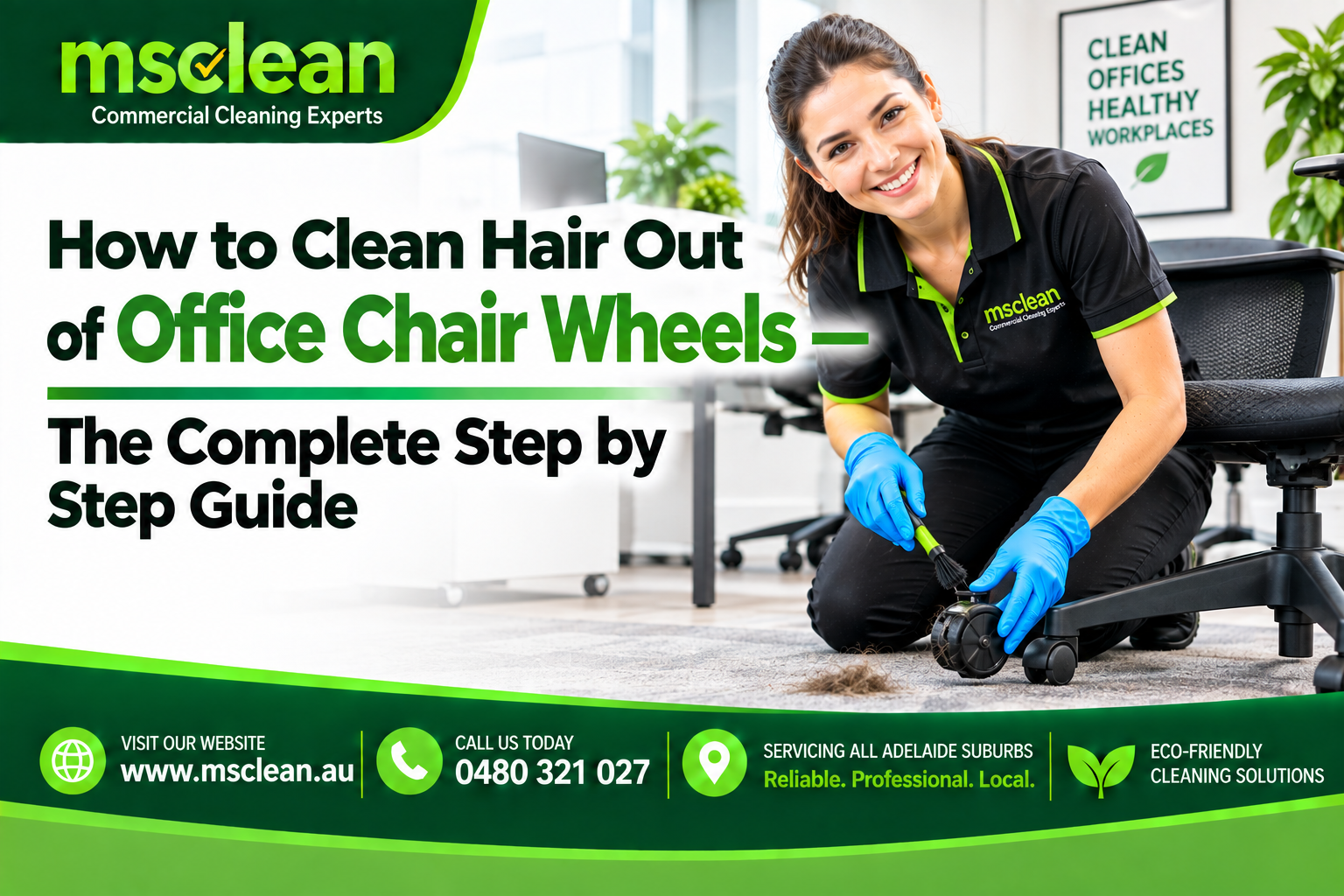
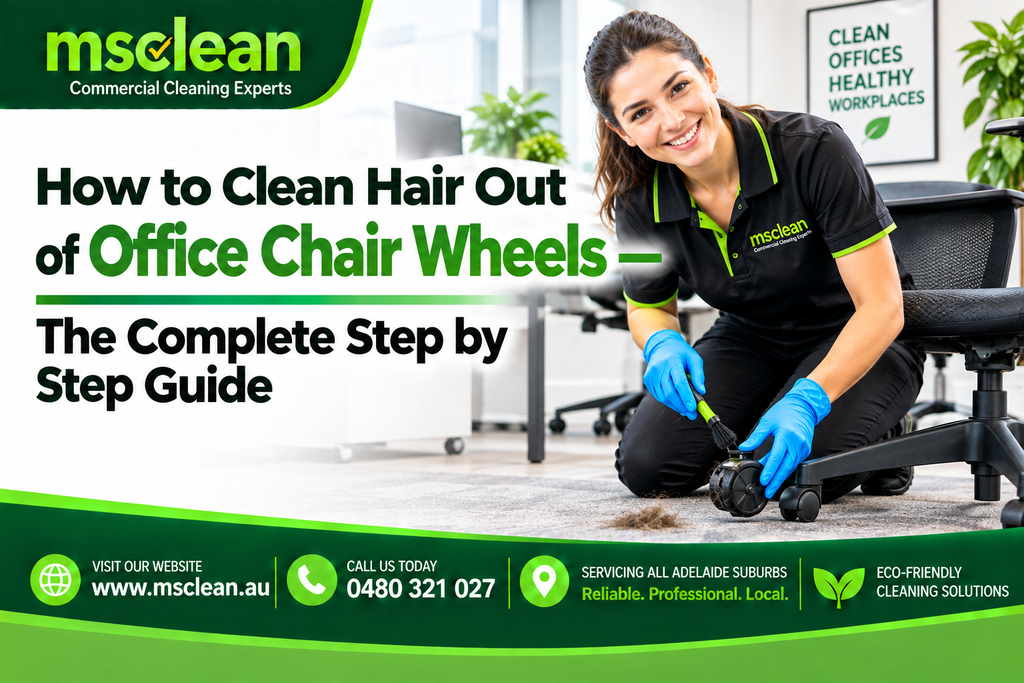
To remove hair from office chair wheels, flip the chair upside down on a stable surface so all wheels are accessible. Slide a pair of small scissors, a seam ripper or a razor blade underneath the wrapped hair around each axle and carefully cut through the tangled strands. Use tweezers or needle nose pliers to pull out the loosened clumps of hair and debris. If the hair is packed deep inside the caster, remove the wheels from the chair base most casters pull straight out with firm pressure, or use a flathead screwdriver to gently pry twin wheel casters apart. Wipe all parts with a damp cloth or soapy water, allow to dry completely and snap the wheels back into place.
How do you clean hair out of office chair wheels?
Step by step cleaning guide for hair in office chair wheels confirmed across multiple sources:
Prep the chair: flip the office chair upside down on a stable surface like the floor or a desk so all wheels are clearly visible and accessible.
Cut the hair: slide a pair of small scissors, a seam ripper or a razor blade underneath the wrapped hair. Carefully slice through the tangled strands around the axle and wheel crevices.
Pull out debris: use tweezers or needle nose pliers to grab and pull out the loosened clumps of hair and dirt.
Remove the wheels (optional): if hair is packed deep inside, pull or pop the caster wheels off the chair base. Use a flathead screwdriver to gently pry twin wheel casters apart if needed.
Clean and reassemble: wipe the parts clean with a damp cloth or soapy water, let them dry completely, and snap the wheels back into place.
The Opening
The chair moves fine when it is new. Six months later, it drags. A year in, it barely rolls at all.
The culprit is almost always the same thing: hair wrapped around the axle of every caster wheel. Not just a strand or two — a dense, compressed cylinder of hair, dust, carpet fibres and debris that builds up gradually until the wheel cannot rotate freely.
In a single office chair this is an inconvenience. In a commercial office with 40 chairs, 80 chairs or 200 chairs, it is a facilities management problem that affects how every staff member moves around their workstation throughout the day and how long the chair fleet lasts before replacement.
This guide covers the exact process for cleaning hair out of office chair wheels — individual chairs at home or at your desk, and commercial scale approaches for Adelaide businesses maintaining a chair fleet.
Why Hair Gets Stuck in Office Chair Wheels and Why It Matters
Office chair casters are twin wheel rolling mechanisms mounted on a swivel stem. The axle connecting the two wheels in each caster sits very close to the floor and sweeps across carpet and hard floors constantly throughout the day.
Hair that falls to the floor from any person’s head, from any pet in a home office ends up directly in the path of these axles. The wheel’s rolling motion pulls the hair strand around the axle rather than rolling over it. Each rotation wraps the strand tighter. Over weeks and months, hundreds of strands accumulate in this cylinder until the hair packed around the axle effectively locks the wheel.
Why it matters more than most people address:
A chair with locked casters forces the user to lift and reposition the chair rather than rolling it. This creates repetitive strain on the lower back from thousands of small repositioning movements throughout the day. It wears carpet backing at the fixed contact point rather than rolling across it, creating wear patterns that accelerate carpet deterioration. In a commercial fleet, this becomes a maintenance cost that accumulates quietly until the chair is replaced earlier than its actual structural lifespan would require.
Cleaning the casters is the single cheapest maintenance task for an office chair. Clean casters can add two to four years to a chair that would otherwise be written off because it no longer rolls.
What You Need Before You Start
You do not need specialist equipment. The tools that work best for cleaning hair out of office chair wheels are items found in every commercial cleaning kit or personal desk drawer.
The essential three:
Small scissors or a seam ripper: for cutting through the compressed hair cylinder around each axle. A seam ripper is actually more effective than scissors for this task because its hooked blade slides under the hair wrap and cuts in a single pull.
Tweezers or needle nose pliers: for pulling the cut segments of hair out of the axle crevice and the gap between the twin wheels. Tweezers work well for thin, fine hair. Needle nose pliers grip thick compressed wads better.
A damp cloth and soapy water: to wipe the caster housing, axle, and wheel surfaces clean once the hair is removed.
Optional but useful:
A flathead screwdriver: for prying apart twin wheel casters that are stuck together when the hair has compressed into the gap between them.
A stiff nylon brush (an old toothbrush works): for scrubbing debris from the axle groove after the hair has been removed.
Isopropyl alcohol or multipurpose cleaner: for cleaning the axle and caster housing to remove the sticky residue that compressed hair and debris leave behind.
A silicone lubricant spray (not WD40): for lubricating the axle after cleaning. WD40 attracts debris and should not be used on caster axles.
Step by Step: How to Clean Hair Out of Office Chair Wheels
Step 1 — Flip the chair upside down
Flip the chair upside down on a stable surface ,the floor is the most common choice. A desk or table works if it gives you a more comfortable working height. The goal is to have all five caster wheels clearly visible and accessible without straining to see underneath the chair base.
Work in a well-lit area. Hair wrapped around the axle is often dark and tightly compacted against a dark axle poor lighting makes it harder to see exactly where to cut.
For a commercial fleet, flip chairs on a dedicated hard floor area. Process them in batches of five to ten at a time on a regular maintenance schedule rather than one at a time reactively when someone complains the chair will not roll.
Step 2 — Cut through the wrapped hair
Take your small scissors or seam ripper and slide the blade underneath the compressed hair cylinder on each axle. The hair forms a tube around the axle you want to cut through this tube from one side so the cut segments can then be lifted away.
For scissors: position the tip underneath the hair wrap and cut in short snipping motions from one end of the axle to the other. You are cutting lengthwise along the axle, not across individual strands.
For a seam ripper: slide the pointed tip under the hair wrap and pull the curved blade through the wrap in a single motion. The seam ripper handles heavily compressed hair more effectively than scissors because it requires less repositioning.
For a razor blade: hold the blade flat against the axle and slide it through the hair wrap from the outer edge inward. Use careful short strokes. A razor blade cuts through the most tightly packed hair but requires the most care around your fingers.
Repeat this on every caster. A standard five caster office chair requires cutting on all five axles.
Step 3 — Pull out the loosened debris
Once the hair wrap is cut, use tweezers or needle nose pliers to grab the cut segments and pull them out of the axle crevice and the gap between the twin wheels.
Work systematically around each caster the outer edge of each wheel, the axle groove, and the centre gap between the twin wheels where debris packs most densely. Grip firmly and pull steadily rather than yanking yanking can leave strands behind at the base of the axle groove.
For heavily packed hair, multiple passes with the tweezers are more effective than one heavy pull. Each pass removes another layer until the axle is clear.
Step 4 — Remove the casters if needed (optional but recommended for heavy build up)
If the hair is packed deeply into the interior of the caster housing beyond what the scissors and tweezers can reach from the outside, removing the caster from the chair base allows full access.
How to remove standard pull out casters:
Grip the caster wheel housing firmly and pull straight downward away from the chair base stem. Most standard office chair casters are friction fit on a cylindrical socket firm downward pressure releases them. For stuck casters, place a flathead screwdriver between the caster stem and the chair base socket and lever gently while pulling.
How to pry apart twin wheel casters:
Some twin wheel casters accumulate so much compressed hair in the gap between the two wheels that the wheels have effectively fused into a single unit. Insert a flathead screwdriver into the gap between the wheels and twist gently to create separation. Once separated, the hair in the gap can be pulled out fully.
After removal, clean the caster fully including the internal housing before reinserting.
Step 5 — Clean and reassemble
Wipe all caster surfaces with a damp cloth or soapy water the wheel surfaces, the axle, the housing interior and the stem. This removes the sticky film of compressed hair residue, skin oil and floor debris that accumulates along with the hair.
Allow the casters to dry fully before reinserting any moisture on the stem or socket can cause the stem to stick or create surface rust on metal components.
Optional: apply a small amount of silicone spray to the clean axle before reinserting the caster. Silicone lubricant reduces friction and slows the rate at which the next round of hair accumulates around the axle. Do not use WD40 it is petroleum based and attracts dust and debris onto the axle, accelerating the build up problem.
Snap the clean casters back into the chair base push the stem straight up into the socket until it clicks into place.
Flip the chair right side up and test the rolling action on the floor. A freshly cleaned set of casters rolls noticeably more freely than one with even moderate hair build up.
Section 4 — Commercial Chair Fleet Maintenance in Adelaide Offices
The individual approach above works fine for one chair. For an Adelaide office with a chair fleet of 30, 60 or 200 chairs, the approach changes.
Why commercial chair caster maintenance is a scheduled task, not a reactive one
In an office with 60 staff, the combined rate of hair shedding and floor debris accumulation across all chairs means that a significant proportion of the fleet will have compromised caster rolling within six months of a new chair installation, and most chairs will have at least partially locked casters within 12 to 18 months.
Waiting until staff complain that chairs will not roll means the problem has already reached the point of maximum build up harder to clean, more wear on the carpet contact point, and a staff experience issue.
A scheduled caster maintenance programme cleaning the caster wheels on all chairs in the fleet on a six monthly or annual basis keeps rolling performance consistent and extends the service life of the chair fleet significantly.
Batch processing for commercial chair fleets
For a commercial chair fleet clean, batch processing is the efficient approach.
Set up a hard floor area large enough to flip and process 10 to 20 chairs at a time. Flip all chairs in the batch. Work through each step cut, pull, clean across all chairs in the batch before moving to the next step. This is faster than completing the full process on one chair before moving to the next because the tool setup, the cutting motion and the pulling motion are more efficient when repeated across multiple chairs in sequence.
For a fleet of 60 chairs, batch processing of 10 at a time across six batches typically requires two to three hours for a trained technician with the right tools and a systematic approach. For a fleet of 200 chairs, this is a half day job for two technicians.
Scheduling around the Adelaide office calendar
The most practical scheduling window for commercial chair caster maintenance in Adelaide offices is during a weekend cleaning session or during quiet periods such as Christmas and New Year, the Australia Day long weekend or EOFY leave periods when office occupancy is lowest.
Ms Clean can include chair caster maintenance as a scheduled addition to any commercial cleaning contract, or as a standalone periodic service for Adelaide offices wanting to address the chair fleet without disrupting operations.
When to replace casters rather than clean them
Commercial office casters have a finite service life regardless of cleaning. Signs that casters need replacement rather than cleaning:
The plastic housing is cracked or the wheel is chipped a structural failure that cleaning cannot address.
The caster rolls unevenly or wobbles after cleaning indicates worn bearings or a bent axle.
The caster stem is deformed or corroded common in older chairs where moisture has reached the metal stem components.
The chair has been repaired multiple times and the caster socket is worn loose the caster no longer sits firmly in the socket after reinsertion.
Standard office chair casters are widely available as universal replacements in Adelaide office supply stores and online. Replacing all five casters on a chair that is otherwise structurally sound is significantly cheaper than replacing the chair entirely.
Preventing Hair Build Up in Office Chair Wheels
Prevention reduces cleaning frequency and extends the interval between caster replacements.
Hard floor mat under wheeled chairs
An office chair mat on hard floors reduces the amount of floor debris that reaches the casters. Hair on a smooth mat sits on the surface and does not wrap around the axle as readily as hair embedded in carpet pile. For carpet, an office chair mat lifts the caster away from the carpet surface slightly and reduces the carpet fibre that ends up in the caster alongside hair.
Regular floor vacuuming with HEPA filtration
The primary source of hair in office chair casters is the floor surface directly under and around the chair. A commercial HEPA filtered vacuum run over the office floor on a daily cleaning schedule significantly reduces the volume of hair available for the casters to pick up. Vacuum in multiple directions to capture hair lying flat that a single direction pass misses.
Caster style selection for new chair purchases
When replacing chairs or purchasing new ones, rollerblade style casters (a single large wheel with a smooth edge) accumulate far less hair than standard twin wheel casters because the contact surface is smaller and the gap between dual wheels where hair packs densest does not exist. If repeated caster hair build up is a significant maintenance issue in your Adelaide office, specifying rollerblade casters on future chair purchases is a practical prevention step.
Chair floor protectors
Chair glides — fixed plastic or felt floor protectors that replace rolling casters entirely eliminate hair accumulation for chairs that do not need to roll. For meeting room chairs that are pushed in and out of the table but don’t require constant rolling repositioning, chair glides are a practical alternative to rolling casters.
Chair Wheel Cleaning as Part of Commercial Office Cleaning in Adelaide
Most commercial office cleaning contracts in Adelaide cover floor cleaning, surface wiping and bin emptying. Chair caster maintenance falls outside the standard scope of most cleaning contracts and is addressed as a periodic additional service.
Ms Clean includes chair caster maintenance as an optional addition to commercial cleaning contracts for Adelaide businesses. The service covers all chairs in the office fleet, cleaned using the five-step process described in this guide, with replacement caster sourcing available for chairs where casters require replacement rather than cleaning.
How this fits into a commercial cleaning program:
Annual or biannual scheduled caster maintenance for office chair fleets of any size. Included as a periodic scope item in the annual commercial cleaning contract alongside carpet steam cleaning, window cleaning and high dusting. Available as a standalone one off service for Adelaide offices wanting to address a backlog of neglected chair maintenance.
Actionable Takeaways
For an individual chair right now:
Flip upside down. Seam ripper or scissors along each axle. Tweezers to pull. Damp cloth to wipe. Silicone spray on the axle. Flip back. Done in under 15 minutes per chair.
For an Adelaide office with a chair fleet:
Book a time when the office is unoccupied. Set up a batch processing area. Process in groups of 10. Add the task to the annual facilities calendar so it happens before complaints arrive, not after.
For preventing the problem from recurring faster than it should:
HEPA filtered daily vacuuming of the floor area under and around chairs. Chair mats on carpet. Consider rollerblade casters for any future chair purchases.
FAQs — How to Clean Hair Out of Office Chair Wheels
Q1. How do you clean hair out of office chair wheels?
Flip the chair upside down. Slide small scissors, a seam ripper or a razor blade under the compressed hair around each caster axle and cut through the wrap lengthwise. Use tweezers or needle nose pliers to pull out the cut segments. For deep build up, remove the casters by pulling them straight off the chair base. Wipe all surfaces with a damp cloth, dry completely, apply silicone lubricant to the axle and reinsert the casters.
Q2. What is the best tool to remove hair from office chair wheels?
A seam ripper is the most effective single tool because it slides under the hair wrap and cuts through it in a single pull. Small scissors work well for lighter buildup. Needle nose pliers are better than tweezers for gripping thick compressed wads of hair. For the deep cleaning step after cutting, a stiff nylon brush (an old toothbrush) clears the remaining debris from the axle groove.
Q3. Do you need to remove the casters to clean the hair out?
Not always. For moderate hair buildup, cutting and pulling while the casters are still on the chair is sufficient. For heavy build-up where the hair is packed deep into the interior of the caster housing and the gap between the twin wheels, removing the casters gives full access and produces a more thorough clean. Most standard office chair casters pull straight off with firm downward pressure on the caster housing.
Q4. How often should office chair wheels be cleaned?
For individual chairs in a home office or low traffic environment: every three to six months. For commercial office chairs in a busy open plan environment: every four to six months. In offices with carpeted floors (where carpet fibres add to the hair accumulation), every three to four months. On hard floor surfaces where vacuuming is more effective, the interval can extend to six months. In a commercial fleet, scheduling biannual caster cleaning for all chairs prevents the problem from reaching the point where chairs stop rolling before maintenance occurs.
Q5. Why do office chair wheels stop rolling?
The most common cause is hair and debris accumulating around the caster axle until the wheel cannot rotate. Other causes include: the caster stem loosening from the socket (the chair wobbles rather than not rolling), bearing failure in older casters (the wheel spins unevenly), carpet pile long enough to catch the caster edge on each rotation, and cracked or damaged caster housing. If the chair still does not roll properly after thorough caster cleaning, the casters themselves may need replacement.
Q6. Can you clean office chair wheels with water?
Yes, with a damp cloth or light soapy water after removing the hair. Do not soak the casters or use a high-pressure wash; water in the bearing mechanism can cause rust and shorten the caster life. Wipe with a damp cloth, rinse with a clean damp cloth and allow to air dry fully before reinserting. The stem and socket should be dry before reinsertion to prevent corrosion or sticking.
Q7. Does Ms Clean provide office chair wheel cleaning for commercial fleets in Adelaide?
Yes. Ms Clean provides chair caster maintenance as a scheduled periodic service for commercial offices in Adelaide. This covers the full five step process for all chairs in the fleet, with batch processing for efficiency and optional caster replacement sourcing for chairs requiring new wheels. Contact Ms Clean to add chair caster maintenance to your commercial cleaning contract or book it as a standalone service for your Adelaide office.
Call Now
Ms clean Au
Address: 71 Alexandra Street, Prospect, SA-5082
M : 0480 321 027
E-Mail: contact@msclean.au