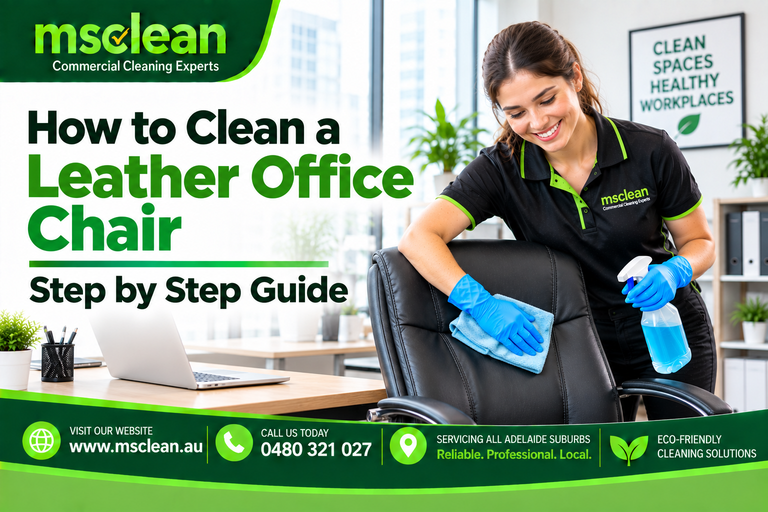

Clean a leather office chair by first vacuuming the surface to remove loose debris, then wiping it down with a damp cloth and a small amount of mild soap or pH-balanced leather cleaner, working gently with the leather grain. You never use hot water, alcohol, bleach, or household cleaning sprays on leather. After cleaning, you dry the leather completely with a clean, dry cloth, then apply a leather conditioner to restore moisture and protect the surface from cracking. For commercial environments with multiple executive chairs or reception lounge seating, the process is the same, but the scale and documentation requirements differ from a single residential chair.
How do you clean a leather office chair?
Leather office chairs need regular maintenance to stay professional-looking and last longer. Cleaning a leather office chair involves several steps. First, remove surface debris by vacuuming the chair with a soft brush attachment. Second, wipe down the chair with a damp cloth and a small amount of mild soap or leather-specific cleaner, taking care not to oversaturate the leather. Third, dry the leather thoroughly with a clean, dry cloth immediately after cleaning. The fourth step is to apply a leather conditioner to restore natural oils and prevent cracking, using a circular motion to work the conditioner into the leather surface. Common mistakes that damage leather office chairs include using household cleaning sprays, baby wipes, excessive water, and harsh chemicals, including bleach and ammonia based products. Regular cleaning every four to six weeks and conditioning every three to four months keeps executive leather office seating in professional condition.

Leather office chair cleaning process
Walk into any Adelaide CBD law firm, financial advisory practice, or senior management office, and you will find leather office chairs in one of two states: either very well maintained or quietly deteriorating.
The difference between the two is rarely the chair’s quality when it was purchased. A $600 executive chair cleaned and conditioned every few months will look better at five years than a $2,000 chair that has never been properly treated.
Leather is not forgiving of neglect. It dries. It cracks. The oils that give it that boardroom look deplete slowly every time the chair is used, sat in, sweated on, and exposed to Adelaide’s dry summer heat and air conditioning cycles.
The good news is that leather office chair maintenance is not complicated. The methods are straightforward, the products are inexpensive, and the time investment is small compared to replacing executive seating that could have lasted a decade with proper care.
This guide covers the full process for residential and commercial leather office chair cleaning, the right products for each situation, stain-specific methods that work, and the signs that the chair needs professional attention rather than another DIY pass.
Before You Clean: Understand What Type of Leather You Have
Not all leather responds the same way to cleaning products. Using the wrong approach on the wrong leather type causes permanent damage. Two minutes of identification before you begin prevents irreversible mistakes.
The Main Leather Types in Office Chairs
Full grain leather. The highest quality natural leather. Retains the hide’s original surface, including natural markings. Responds well to leather-specific cleaners and conditioners. Sensitive to water saturation and harsh chemicals. Most premium executive office chairs use full grain leather.
Top grain leather. The most common leather in commercial office seating. Slightly sanded and treated to remove surface imperfections. More consistent appearance than full grain. Responds well to standard leather cleaning products. More tolerant of moisture than full grain.
Bonded or reconstituted leather. Not genuine leather in the traditional sense. Made from leather scraps and fibers bonded with polyurethane or other binders. Very common in mid range commercial office chairs. Looks like leather but degrades differently, particularly in Adelaide’s dry heat. Bonded leather often peels and flakes rather than cracking. Standard leather cleaners are appropriate, but conditioning has limited benefit on bonded surfaces.
Faux leather (PU or vinyl). Not leather at all. Very common in lower cost commercial seating and in environments where hygiene is prioritized over aesthetics, including some medical and food service office environments. You can clean it with a damp cloth and mild soap. Does not require conditioning. Often mislabelled as leather in product descriptions.
How to tell which type you have: Genuine leather has an irregular grain pattern and a characteristic smell. Bonded leather often feels slightly stiffer and begins to peel at seams and high-stress points after a few years. Faux leather has a perfectly uniform pattern and a slight plastic quality. Check the care label on the underside of the seat if one is present.
What You Need Before You Start
Gathering everything before you begin speeds up the process and prevents you from leaving a damp leather surface while you search for the next product.
For all genuine leather office chairs:
A soft brush vacuum attachment for removing loose debris from the surface and seam areas. Two or three clean, soft cloths: microfibre cloths are ideal because they are lint-free and gentle on leather surfaces. A pH balanced leather cleaner or a very small amount of mild dish soap diluted in distilled water. A leather conditioner appropriate for the leather type. Distilled water rather than tap water where possible, as Adelaide tap water has moderate mineral content that can leave deposits on leather surfaces.
For stain treatment:
Isopropyl alcohol on a cotton swab for ink stains on genuine leather. Use a clean, dry cloth to blot any liquid spill immediately. A small amount of petroleum jelly or leather specific grease stain remover for oil and grease stains.
What you must not use on genuine leather office chairs:
Baby wipes. Despite being commonly suggested online, baby wipes contain alcohol and other chemicals that dry out leather and cause premature cracking. Household surface sprays. These contain chemicals such as bleach, ammonia, and strong surfactants that permanently strip the natural oils from leather. Washing up liquid in more than a very small diluted amount. Undiluted soap leaves a residue that attracts soiling. Excessive water. Leather is not waterproof. Saturating leather causes swelling, staining, and long term cracking as it dries.
How to Clean a Leather Office Chair — Step by Step
Step 1: Vacuum the Chair Thoroughly
Cleaning a leather office chair requires removing surface debris before applying any liquid. Use a soft brush attachment on your vacuum cleaner to remove loose dirt, crumbs, hair, and dust from the seat surface, backrest, armrests, and especially the seams and crevices where debris accumulates but isn’t visible until you look directly at it.
Pay specific attention to the seam lines running along the seat edges and backrest. These areas collect fine debris that can scratch the leather surface if you run a cloth across them before vacuuming them clear.
Run the vacuum attachment gently across every surface. Do not press hard. The goal is to lift loose material away from the leather, not to scrub.
Step 2: Prepare Your Cleaning Solution
For general cleaning of a genuine leather office chair, the safest starting point is a small amount of mild soap diluted in distilled water. A few drops of mild dish soap in a cup of water are sufficient. The solution should be barely soapy, not foamy.
For commercial executive seating or premium leather chairs, a pH balanced leather cleaner is the better option. These products are formulated specifically for leather and will not strip natural oils or leave chemical residue in the way that household products can. You can find them at leather furniture retailers and online cleaning supply companies across Australia.
Step 3: Test on a Hidden Area First
Before cleaning any visible surface of the leather chair, apply a small amount of the cleaning solution to a hidden area, typically the underside of the seat or the back of a rear panel. Allow it to sit for two minutes, then blot dry. If the color changes, if the leather feels tacky, or if any transfer appears on the cloth, the product is not safe for this specific leather and should not be used.
This test takes two minutes and prevents irreversible damage to a surface that the chair occupant sees every day.
Step 4: Clean the Leather Surface
Dampen a clean microfibre cloth with the cleaning solution. The cloth should be damp, not wet. Wring it out until no excess moisture will transfer to the leather when you press the cloth against your palm.
Wipe the leather surface in gentle circular motions or along the leather grain. Work in sections rather than covering the entire chair in one pass. Keep each cleaned section small enough to dry before moving on.
The cleaning sequence that produces the best result: start at the top of the backrest and work down. Then address the seat surface. Then the armrests. Then the sides and lower sections. Gravity ensures that any material you dislodge from upper sections does not fall onto already cleaned lower sections.
Do not scrub. Leather does not respond to aggressive mechanical action the way fabric does. Firm, consistent pressure with a damp cloth is sufficient to remove everyday office soiling.
Step 5: Wipe With a Clean Damp Cloth
After the cleaning solution passes, wipe the cleaned sections with a second cloth dampened with clean distilled water only. This removes any soap residue from the leather surface. Residue left on leather after cleaning attracts dust and can cause the surface to feel slightly tacky.
Step 6: Dry Immediately and Thoroughly
Use a dry clean cloth to wipe each section immediately after the water rinse. Do not allow water to sit on the leather surface for any extended period.
Dry in the same direction as the leather grain. The goal is to remove all surface moisture before moving to conditioning.
Do not use a hair dryer, a heater, or any heat source to speed drying. Heat causes leather to dry unevenly and can cause cracking or surface damage, particularly on full grain and top grain leather.
Allow the chair to air dry in a well ventilated area away from direct sunlight for at least thirty minutes after the surface appears dry. Leather holds moisture beneath the surface for longer than it appears dry on top.
Step 7: Apply Leather Conditioner
Applying a leather conditioner to restore natural oils and prevent cracking is the step that most people skip and the most important step for long term leather health.
Leather is a natural material that contains oils which give it its characteristic suppleness and appearance. These oils deplete over time through regular use, cleaning, and exposure to air conditioning and heat. Conditioning replenishes them.
Apply a small amount of leather conditioner to a clean, soft cloth. Work the conditioner into the leather surface using circular motions, covering one section at a time. Use enough product to leave a thin, even film on the leather surface, not a thick coating.
Allow the conditioner to absorb for ten to fifteen minutes. Buff off any excess with a clean, dry cloth, using the same circular motion. The leather should feel supple and have a gentle sheen, not a greasy or wet appearance.
Conditioner frequency: For office chairs used daily in commercial environments, conditioning every three to four months is appropriate. In Adelaide’s dry summer conditions, where air conditioning runs heavily, the higher end of this range is the better choice.
How to Remove Specific Stains From a Leather Office Chair
Ink Stains on Leather Office Chairs
Ink is one of the most common and most feared stains on leather office seating. It responds to isopropyl alcohol if treated quickly.
Dip a cotton swab in isopropyl alcohol and gently dab the ink stain from the outside edge inward. Do not rub. The alcohol dissolves the ink and transfers it to the swab. Rotate to a clean section of the swab between each dab. Continue until no more ink transfers to the swab.
Rinse the treated area with a clean, damp cloth immediately after treatment, as isopropyl alcohol is drying on leather. Apply leather conditioner to the treated area after cleaning to restore moisture.
Old ink stains on leather that have been there for more than a day are much harder to remove. Professional upholstery cleaning is the best option for old or large ink stains.
Grease and Oil Stains on Leather Office Chairs
Food oil, hand lotion, and body oil stains on leather office chairs respond well to a targeted absorption approach.
Apply a very small amount of cornstarch or baking soda directly to the fresh grease stain. Leave it for a few hours to absorb the oil. Gently brush off with a soft cloth. The grease will partially transfer into the powder as it absorbs.
Follow with the standard leather cleaning process using a pH balanced leather cleaner. The cleaner’s degreasing action removes any remaining oil residue. Condition after cleaning.
Dye Transfer Stains on Leather Office Chairs
Dark denim and colored fabric clothing can transfer dye onto light-colored leather office seating over time. This is a common issue in open plan commercial offices where staff sit in pale coloured executive chairs while wearing dark jeans or coloured trousers.
Dye transfer on leather responds to a leather specific ink and dye remover product. Apply a small amount to a cloth and work gently over the dye-stained area. Multiple applications are often needed for significant transfer staining. This type of stain is best treated professionally if the transfer covers a significant area or has been present for more than a week.
Water Stains on Leather Office Chairs
Water stains on leather appear when moisture sits on the surface long enough to leave a tide mark as it evaporates. They are common on armrests in humid environments and on seat cushions after a spill that didn’t fully dry.
Dampen the entire stained section of the leather uniformly with a clean, damp cloth, rather than spot-treating the water mark alone. Allow the section to dry evenly. This even wetting and drying process prevents the tide mark from reforming because the entire section dries at the same rate. Condition after the section is dry.
Commercial Leather Office Chair Cleaning in Adelaide
Commercial cleaning differs from cleaning a single chair at home in three ways: seating volume, scheduling requirements, and documentation standards that apply in some facility types.
Volume and Efficiency in Commercial Environments
A law firm in the Adelaide CBD with twenty executive offices, a reception lounge with six leather chairs, and a boardroom with twelve leather executive chairs has nearly forty leather seating pieces to maintain. The cleaning process described above applies to each piece, but at commercial scale it must be structured efficiently and scheduled to minimize disruption to the working environment.
Professional commercial upholstery cleaning services, including leather chair cleaning, are scheduled outside operating hours. Most Adelaide commercial offices allow cleaning access before 7 am or after 6 pm. The cleaning process for commercial leather seating is compressed into a structured workflow that covers multiple pieces in a single visit without rushing the critical steps.
Documentation for Regulated Environments
Medical practices, aged care facilities, and NDIS properties with leather or faux leather seating in waiting rooms or consultation spaces need cleaning documentation for compliance. A leather office chair in a medical center waiting room that is cleaned and conditioned requires the same completion record as any other surface cleaned in that facility.
Ms Clean provides completion records formatted for regulatory compliance use after every commercial upholstery cleaning service in Adelaide medical and aged care environments.
Leather Chair Maintenance Scheduling for Adelaide Commercial Clients
The appropriate cleaning frequency for commercial leather office seating in Adelaide depends on usage intensity and the facility environment.
Executive seating in individual offices with light personal use benefits from professional cleaning and conditioning every four to six months. Waiting room and reception lounge seating with high daily contact from multiple different users benefits from professional cleaning every three to four months. Boardroom leather seating receives professional attention before major events and on the same three- to four-month schedule as reception seating.
Adelaide’s climate adds a specific consideration. The dry summer heat and heavy air conditioning use from December through March accelerate leather oil depletion faster than in more humid cities. Adelaide commercial leather seating should be conditioned more frequently than the standard range.
How Often Should Leather Office Chairs Be Cleaned?
The right cleaning frequency depends on usage intensity, the specific leather type, and the chair’s environment.
| Usage Situation | Cleaning Frequency | Conditioning Frequency |
| Home office, light daily use | Every 2 to 3 months | Every 4 to 6 months |
| Single occupant executive office | Every 2 to 3 months | Every 3 to 4 months |
| Reception or waiting room, multiple users daily | Every 6 to 8 weeks | Every 3 months |
| Boardroom seating | Every 3 months | Every 4 months |
| High volume commercial seating, Adelaide summer heat | Every 6 weeks | Every 3 months |
| Medical or aged care facility leather seating | Every 4 to 6 weeks | Every 3 months |
Regular cleaning every four to six weeks and conditioning every three to four months keeps executive leather office seating in professional condition for commercial environments.
Signs That Leather Office Chairs Need Professional Cleaning
These are situations where DIY cleaning isn’t the right first move and professional upholstery cleaning delivers a much better result.
Cracking or flaking leather. Leather that has already cracked or begun to flake has lost significant oil content and has surface-level structural damage. DIY cleaning and conditioning will not reverse existing cracking. A professional leather restorer can clean, fill, and re-color cracked leather in some cases, but prevention through regular conditioning is significantly more effective than restoration after the fact.
Significant dye transfer staining. Dark denim and colored fabric dye transfer that has been present for more than a week requires professional leather dye remover treatment, not the DIY methods appropriate for fresh staining.
Old ink stains that have set. Ink older than 24 hours has bonded with the leather at a chemical level that isopropyl alcohol on a swab may not fully address. Professional cleaning with specialist leather ink remover products produces better outcomes for old or large ink stains.
Odor embedded in the leather. Tobacco smell, persistent body odor, or any biological odor embedded in the leather of a commercial chair requires professional enzyme treatment, not surface cleaning. The odor compounds sit in the leather itself, not on the surface, and surface cleaning does not reach them.
Commercial-scale cleaning requires after-hours scheduling and documentation. When the volume of leather seating in a commercial environment makes systematic professional cleaning the practical choice, and when regulated facilities need completion records, professional commercial upholstery cleaning is the right approach.
Ms Clean provides professional leather office chair and commercial upholstery cleaning across Adelaide with fixed pricing confirmed before we start.
Why choose MS Clean?
MS Clean has provided professional office chair cleaning, commercial upholstery cleaning, and leather furniture care services to Adelaide businesses since 2015. We clean leather executive seating in law firms, financial advisory practices, medical centers, corporate offices, and aged care facilities across Adelaide CBD, Norwood, Glenelg, Prospect, Mawson Lakes, Salisbury, Marion, and all surrounding suburbs. The guidance in this article reflects direct operational experience with leather office seating across every major leather type found in Adelaide commercial environments, including the specific effects of Adelaide’s dry summer heat and heavy air conditioning use on leather oil depletion rates.
FAQs — How to Clean a Leather Office Chair
What is the best way to clean a leather office chair?
Vacuum the chair thoroughly with a soft brush attachment, then wipe it down with a damp microfibre cloth and a small amount of pH-balanced leather cleaner or very diluted mild soap. Work gently in circular motions, dry immediately with a clean cloth, and apply a leather conditioner after cleaning to restore natural oils. Never use household spray cleaners, baby wipes, bleach, or excessive water on leather.
How often should a leather office chair be cleaned in a commercial environment?
Commercial leather office seating in Adelaide benefits from professional cleaning every six to eight weeks for high-contact pieces like waiting room and reception chairs, and every two to three months for individual executive office seating. Conditioning should happen every three months in Adelaide’s dry climate. The dry summer heat and heavy air-conditioning use in Adelaide accelerate leather oil depletion compared to more humid Australian cities.
Can you use baby wipes to clean a leather office chair?
No. Baby wipes contain alcohol and other chemicals that dry out leather and cause premature cracking over time. Although they’re commonly recommended online, baby wipes aren’t appropriate for leather office chairs. Use a clean microfibre cloth dampened with distilled water and a pH balanced leather cleaner instead.
How do you remove ink from a leather office chair?
Dip a cotton swab in isopropyl alcohol and dab the ink stain from the outside edge, working inward. Rotate to a clean section of the swab between each dab, and continue until no more ink transfers. Rinse with a clean, damp cloth immediately after, then apply leather conditioner to the treated area. Old ink stains more than 24 hours old are significantly harder to remove and benefit from professional leather treatment rather than DIY methods.
What products should you not use on a leather office chair?
Never use bleach, ammonia based cleaners, household surface sprays, baby wipes, saddle soap in large amounts, strong alcohol solutions, or excessive water on leather office chairs. These products strip the natural oils from leather and can cause surface cracking, color fading, and permanent texture damage. Use only products specifically formulated for leather or a very mild diluted soap solution.
How do you stop a leather office chair from cracking?
Regular conditioning every three to four months is the most effective way to prevent leather cracking. Conditioning replenishes the natural oils that deplete through regular use and exposure to air conditioning and heat. In Adelaide’s dry summer climate, conditioning more frequently is appropriate. Keep leather office chairs away from direct sunlight and heating vents, which accelerate oil depletion from the leather surface.
Is it worth professionally cleaning leather office chairs in Adelaide?
Yes, for commercial environments with multiple leather chairs, executive seating, or any leather furniture in a client-facing environment. Professional cleaning addresses embedded soiling, staining, and odor that DIY methods cannot fully reach, and professional conditioning is applied at the correct level for the leather type. For Adelaide commercial offices, medical centers, and reception areas with leather seating, professional upholstery cleaning every three to four months extends the life of the seating and maintains the professional presentation standard.
How do you clean bonded leather office chairs?
Clean bonded leather the same way as genuine leather, using mild soap and water on a damp cloth. Still, conditioning has limited benefit on bonded surfaces because the bonding agent does not absorb conditioning products the way natural leather does. Bonded leather is more prone to peeling and flaking than genuine leather, and once peeling begins, it typically indicates the end of the chair’s useful life rather than a cleaning problem.
Actionable Takeaways
1. Vacuum before you ever apply any liquid to leather. Fine debris in leather seams and surface texture can scratch the leather if you drag a cloth across it before vacuuming. This one step prevents surface scratches that look like cleaning damage.
2. Always test any product on a hidden area before cleaning a visible surface. Two minutes of testing prevents permanent damage. The underside of the seat is the right test location.
3. Condition after every clean, not just periodically. Every cleaning process removes some surface oil from leather. Conditioning after every clean replaces what the cleaning process removes, rather than waiting for the leather to visibly dry out before treating it.
4. In Adelaide’s dry summer climate, increase conditioning frequency. The combination of extreme summer heat and constant air conditioning cycling in Adelaide CBD offices dries leather significantly faster than the same chair in a more humid environment. Every three months rather than every six months is the right Adelaide conditioning schedule for regularly used commercial leather seating.
5. Book professional leather chair cleaning for commercial environments on a scheduled cycle, not when the chairs look obviously dirty. Leather that looks fine often has significant oil depletion and accumulated embedded soiling that a professional clean addresses before visible deterioration occurs. A scheduled professional clean every three to four months is less expensive than replacing executive seating prematurely.
6. Do not use baby wipes or household spray products on leather. This is the most common source of preventable leather chair damage in Adelaide commercial offices. Keep a proper leather cleaner in the office cleaning supplies and brief any cleaning staff on the correct products.
Conclusion
Your leather office chairs are a significant investment in your Adelaide workplace’s professional environment. The right care routine keeps them in boardroom condition for years. The wrong products age them in months.
Ms Clean provides professional leather office chair cleaning and commercial upholstery cleaning across all Adelaide metro suburbs executive offices, reception lounges, boardrooms, waiting rooms, and any commercial leather seating environment. Fixed price confirmed before we start. After-hours scheduling as standard.
Call Now
Ms clean Au
Address: 71 Alexandra Street, Prospect, SA-5082
M : 0480 321 027
E-Mail: contact@msclean.au