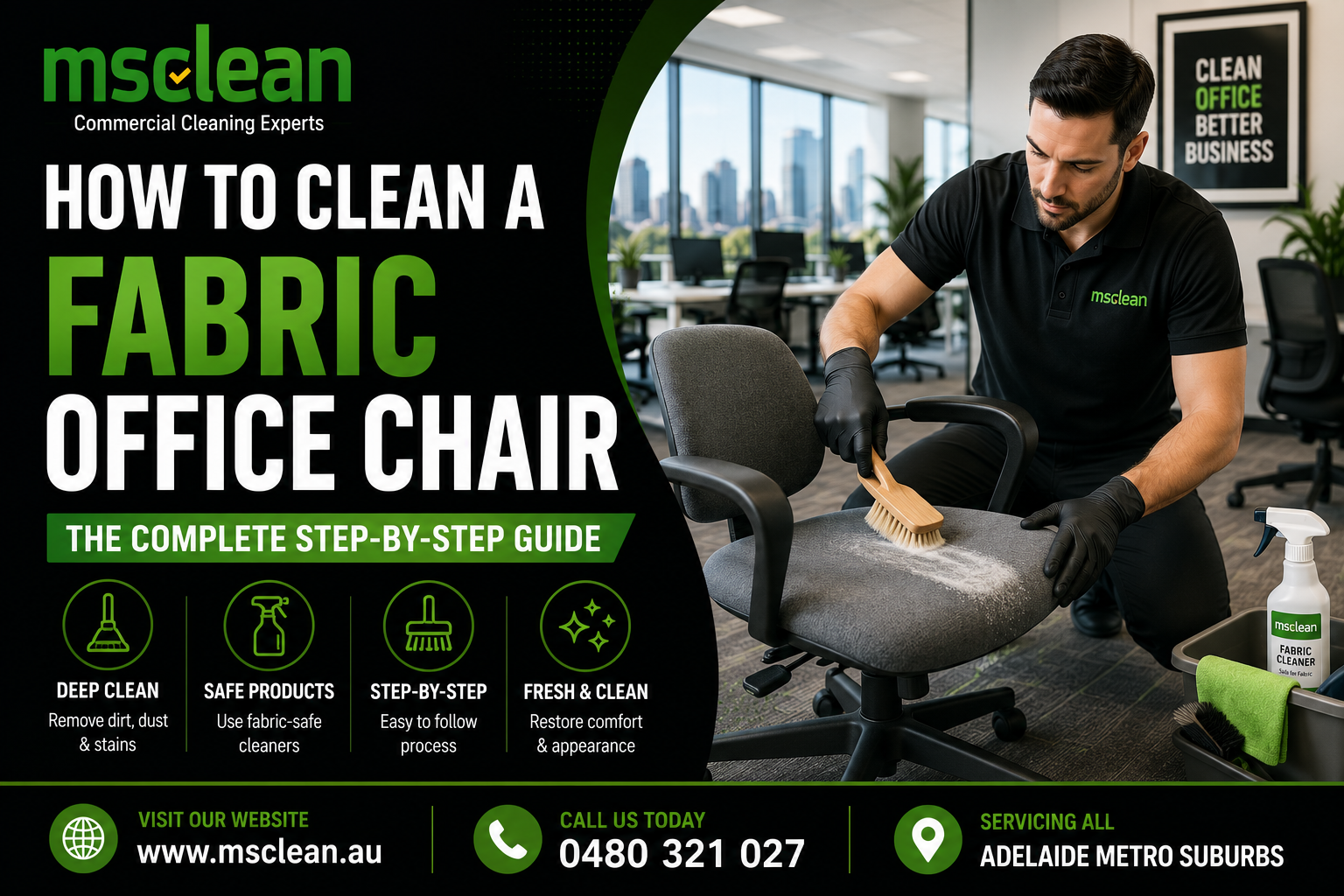
A fabric office chair is cleaned by first vacuuming loose debris from every surface, then spot-treating any stains with the appropriate cleaning solution matched to the fabric code on the chair’s tag. A mild soap-and-water solution is applied to the fabric using a microfibre cloth, blotted (never rubbed), and the chair is allowed to air-dry completely before being sat on again. Baking soda can be sprinkled on the seat beforehand and vacuumed off to remove odors. The entire process takes 20 to 40 minutes for a standard chair, not including drying time.
Most office chairs have a tag under the seat that outlines care instructions. The material code on that tag will be W, S, S/W, or X, and it determines which cleaning method to use. W means water based cleaning products are safe to use. S means solvent-based cleaners only. S/W means both can be used. X means the fabric can only be vacuumed; no liquid cleaning of any kind. Good upholstery care comes down to three habits: act fast on spills, use the right cleaning method for your fabric type, and test any product on an inconspicuous area first. Using the wrong product on the wrong fabric type can permanently damage the upholstery, set a stain, or strip a protective coating, which is why checking the tag before cleaning is the most important step most people skip.
Your office chair is one of the most-used pieces of furniture in your entire workplace. It is sat on for six, seven, or eight hours a day. Lunch is eaten at it. Coffee is spilled on it. Skin cells, sweat, dust, and the rigors of daily life work their way into the fabric over months of continuous use.
And yet most office chairs are never cleaned, not even once, until the stain is so noticeable that it becomes embarrassing, or the smell becomes something other people comment on.
Here is the thing. A fabric office chair is not hard to clean. It does not require expensive equipment or professional products. What it does require is the right method for your specific fabric, a bit of patience, and the knowledge of which mistakes will make the problem worse instead of better.
This guide covers everything. How to read your chair’s fabric code, what cleaning solutions work on which stains, a step-by-step process that is easy to follow, and the mistakes that set stains permanently instead of lifting them. By the end of it, your fabric office chair will look and smell significantly better than it did before you started.
Before You Clean Anything: Check the Fabric Code
Most office chairs have a tag under the seat that outlines care tips. Look there first before beginning any cleaning.
The tag on your chair carries a fabric code that indicates exactly which cleaning method is safe for your upholstery. Using the wrong method of applying water to a solvent-only fabric, for example, can cause shrinkage, color bleeding, water rings, or permanent damage to the fibers.
Here is what each code means.
| Code | What It Means | Safe to Use |
| W | Water-based cleaning only | Mild soap and water, upholstery cleaner, water-based stain remover |
| S | Solvent-based cleaning only | Dry cleaning solvent, alcohol based cleaner, no water |
| S/W | Either method is safe | Water-based or solvent products are both appropriate |
| X | Vacuum only | No liquid of any kind, dry cleaning methods only |
W is the most common code and is ideal; it is durable and can be cleaned with standard upholstery cleaning products. Most modern office chair fabrics carry the W or S/W code. If your chair has an S code, do not apply water; use a dry-cleaning solvent instead. X is very uncommon; it means the fabric cannot be cleaned with any liquid and should only be vacuumed.
If no tag is found on the chair, check the manufacturer’s website for the specific model before applying any cleaning product.
What You Need Before You Start
The right tools make the process faster and reduce the risk of damaging the fabric. Here is everything that should be gathered before starting.
For W or S/W coded fabric chairs:
- Vacuum cleaner with upholstery or brush attachment
- Two clean microfibre cloths: one for applying solution, one for blotting
- Mild dish soap or a dedicated upholstery cleaner
- Warm water in a bowl or spray bottle
- Baking soda (for odor removal)
- A soft-bristled brush, an old toothbrush, works for seams and crevices
- A dry towel for absorbing excess moisture
For S S-codedabric chairs:
- Vacuum cleaner with upholstery attachment
- Alcohol-based cleaning solvent or dry-cleaning fluid
- Clean white cloths for application white avoids color transfer
- A well-ventilated space solvent products should not be used in enclosed areas
For all chair types:
- A well-lit space so stains and soiling are clearly visible
- Patience — the process should not be rushed, particularly during blotting and drying
How to Clean a Fabric Office Chair — Step by Step
Step 1 — Move the Chair to a Good Cleaning Spot
The chair should be moved to a space where it can be cleaned comfortably from every angle — all the way around and underneath. A spot near a window or door is ideal, since good airflow significantly aids the drying process after cleaning.
For S-coded chairs cleaned with solvent products, a well-ventilated area is not optional. Solvent fumes can accumulate quickly in an enclosed space and should not be breathed in during cleaning.
Step 2 — Remove Loose Debris First
Light, frequent cleaning works better than occasional deep cleaning — and every deep clean should start with vacuuming before any liquid is applied.
The vacuum is used with the upholstery or brush attachment to remove all loose debris from every surface of the chair — the seat cushion, backrest, armrests, the sides of the seat, the base of the backrest, and the crevices where the seat meets the back. Compressed air or a soft duster can be used for hard-to-reach joints and seams.
Baking soda can be sprinkled on the seat at this point to begin removing odors. It is left for 15 minutes, then vacuumed off before any wet cleaning begins.
Skipping the vacuuming step and applying cleaning solution to a chair with debris on it pushes the particles deeper into the fabric during the wet cleaning phase. The vacuuming step should not be skipped.
Step 3 — Test the Cleaning Solution on a Hidden Area
Even with only a mild soap, it is never certain how a particular substance will react with a specific chair’s fabric. Testing a hidden spot first ensures no important part of the furniture is damaged.
A small amount of the chosen cleaning solution is applied to a hidden area, the underside of the seat, the back of the backrest, or an inner surface that will not be visible. The area is left for two to three minutes, then blotted with a clean cloth.
If any color transfers onto the cloth, the cleaning solution is causing the dye to bleed and should not be used on the visible fabric. A gentler solution, plain water first, then a more diluted soap solution, should be tried instead.
Step 4 — Apply the Cleaning Solution
For W or S/W coded chairs:
A few drops of mild dish soap are mixed into warm water until a light s, sudsy solution is formed. The solution is applied to the fabric using a clean microfibre cloth, dampened, not soaking. The cloth should not drip when squeezed.
The fabric is dampened and blotted gently. The chair should not be soaked. Excess moisture leads to odor and slow drying, and can cause mould or mildew to develop in the padding beneath the fabric.
For S-coded hairs:
For dry clean only fabrics, a small amount of alcohol-based cleaning solvent is used to dab at only stained areas. The solvent is applied to a clean white cloth first, never sprayed directly onto the fabric, and dabbed onto the stained area.
Step 5 — Work the Cleaning Solution in Gently
A soft-bristled brush or a microfibre cloth is used to work the cleaning solution into the fabric using gentle circular motions. The process starts at the outer edge of a stained or soiled area and moves inward; working from the outside in prevents the stain from spreading to the clean fabric around the edges.
Spills should be blotted, not rubbed. Rubbing can make things worse, especially on fabric chairs, by spreading the stain and pushing it deeper into the fiber.
For heavily soiled areas, armrests, the front edge of the seat cushion, and the lumbar area of the backrest, the brush is used gently along the grain of the fabric. Excessive scrubbing can damage the fabric surface and create a permanent, worn-looking area.
Step 6 — Blot, Do Not Rub
After the cleaning solution has been worked in, a clean, dry microfibre cloth is used to blot the area firmly. The cloth is pressed onto the fabric and lifted, not wiped across the surface.
Blotting lifts dissolved soiling from the fabric. Rubbing pushes it sideways and deeper. The cloth is rotated to a clean section as it picks up soiling, so clean fabric is always used to lift from the chair, not a cloth already loaded with what was just removed.
This step is repeated until no more soiling transfers to the cloth.
Step 7 — Rinse the Area with Clean Water
A clean cloth dampened with plain water, with no soap, is used to blot the cleaned areas and remove any soap residue from the fabric. Soap residue left in the fabric after cleaning attracts dust and re-soils faster than untreated fabric.
The rinsing step is blotted, not wiped, using the same inward-working technique as the cleaning step.
Step 8 — Dry the Chair Completely
After cleaning, the chair should be allowed to dry naturally in a shaded area. Direct sunlight can cause fading or damage to certain materials. If drying needs to be sped up, a blow dryer on a cool setting can be used, kept several inches from the fabric to prevent heat damage.
The chair should not be sat on until it is completely dry — including the padding beneath the fabric. A chair that feels dry on the surface may still hold moisture in the padding, and sitting on it before it is fully dry can cause the padding to develop a musty smell that is harder to remove than the original stain.
Drying time depends on the amount of moisture applied, the ventilation in the space, and the temperature. In Adelaide’s dry summer conditions, most fabric office chairs dry within two to four hours with good airflow. In winter or in enclosed offices, allow four to six hours.
How to Remove Specific Stains from a Fabric Office Chair
Different stains require different approaches. The general cleaning method in Section 3 works for general soiling and light marks. Specific stains require specific treatment applied before the main cleaning cycle, not after.
Coffee and Tea Stains
Coffee and tea stains are tannin-based and respond well to immediate cold-water treatment. Hot water should not be used on coffee stains; heat sets the tannins into the fabric.
A clean cloth is blotted onto the spill immediately to absorb as much liquid as possible. Cold water is applied to the area, and it is blotted again. A mild dish soap solution is then applied and worked in gently, followed by the standard blotting and rinsing process.
For older, set coffee stains, a small amount of white vinegar diluted in water can be applied before the soap solution. The mild acid helps break down the tannins before the soap lifts them.
Red Wine
Red wine is treated with cold water, and salt is applied immediately after the spill occurs. The salt draws the liquid out of the fabric before it sets. The area is then blotted, never rubbed, with a clean cloth.
A mixture of dish soap and a small amount of hydrogen peroxide can be applied to older red wine stains on W-coded fabric, after testing on a hidden area. Hydrogen peroxide is a mild bleaching agent and should be used with caution on coloured fabric.
Ink Stains
For dry clean only fabrics, a little bit of an alcohol-based cleaning solvent is dabbed at stained areas only. Isopropyl alcohol applied to a clean white cloth and dabbed, not rubbed, onto an ink stain is effective on most W and S/W coded fabrics as well. The alcohol dissolves the ink before it is blotted away.
Multiple passes are often needed. The cloth is moved to a clean section between each pass so dissolved ink is not redistributed onto the fabric.
Food and Grease Stains
A small amount of baking soda or cornstarch is sprinkled onto a fresh grease stain and left for 15 to 20 minutes to absorb the oil before any liquid is applied. The powder is then vacuumed off, and a dish soap solution, which is effective at cutting grease, is applied and worked in gently.
Pet Hair and Dander
A rubber glove dragged across the fabric surface, or a lint roller collects pet hair efficiently before vacuuming. The vacuum is then used with the brush attachment to remove remaining hair and dander from the fabric.
Sweat and Body Odor
Baking soda is sprinkled over the seat and left for 15 minutes, then vacuumed off to remove odors. For persistent odor, leave the baking soda for up to 30 minutes. After vacuuming, the chair is cleaned with a mild soap solution and allowed to air dry completely.
White vinegar diluted in water (one part vinegar to two parts water) can be lightly misted onto the fabric after cleaning and allowed to dry. The vinegar smell dissipates as it dries, taking the odor compounds with it.
Mould and Mildew
Mould on fabric office chair upholstery is treated by first taking the chair outside or to a well-ventilated area. Dry mould is brushed off gently with a stiff brush before any liquid is applied brushing wet mould spreads it further into the fabric.
A solution of one cup of warm water and one tablespoon of white vinegar, or a diluted fabric-safe antimicrobial solution, is applied to the affected area and left to dwell for five minutes. The area is then scrubbed gently with a soft brush, blotted, and allowed to dry fully in direct sunlight where possible UV light kills mould spores.
If mould has penetrated into the padding beneath the fabric, professional cleaning or chair replacement should be considered.
How to Clean Different Parts of a Fabric Office Chair
Different parts of the chair accumulate different types of soiling and benefit from specific attention.
Seat Cushion
The seat cushion receives the most soiling — body contact, food and drink spills, and dust accumulation. The full step-by-step process in Section 3 is applied to the seat cushion. Particular attention is paid to the front edge where the fabric folds under the seat frame, and the edges where the seat meets the backrest.
Backrest
The backrest collects body oils, sweat, and hair product residue in the lumbar and upper back areas. These are protein-based soils that respond to mild enzymatic cleaners or dish soap solutions. The backrest is cleaned from top to bottom, with extra attention paid to high-contact areas.
Armrests
Fabric chairs trap dust and crumbs deep within fibers. Armrests on fabric office chairs accumulate skin oils, hand lotion, and surface contact soiling faster than any other part of the chair. A slightly more concentrated soap solution can be used on armrests, and the bristled brush can be used to work it gently into the fabric before blotting.
Chair Base and Casters
The base and casters are not upholstered but accumulate dust, hair, and floor debris that gets redistributed when the chair is rolled. A damp cloth is wiped around the base frame. Casters are cleaned with a cloth or old toothbrush, and any hair or thread wound around the caster axles is removed to keep the chair rolling smoothly.
How Often Should a Fabric Office Chair Be Cleaned?
Regular cleaning extends upholstery life and maintains professional appearance. The right cleaning frequency depends on how heavily the chair is used and the environment it is in.
| Usage Level | Recommended Cleaning Frequency |
| Light use — home office, occasional use | Full clean every 6 to 12 months |
| Moderate use — daily office use, one person | Full clean every 3 to 6 months |
| Heavy use — shared chair, hot-desking | Full clean every 1 to 3 months |
| After a spill or visible staining | Spot treat immediately — full clean at next scheduled cycle |
| After illness of the regular user | Full clean with disinfection treatment immediately |
Light, frequent cleaning works better than occasional deep cleaning. A quick vacuum of the seat and backrest once a week — taking less than two minutes — prevents the build-up that makes a quarterly deep clean so much harder than it needs to be.
Mistakes That Make Fabric Office Chair Cleaning Worse
These are the most common mistakes that damage fabric or set stains permanently rather than remove them.
Rubbing Instead of Blotting
Rubbing a spill or stain spreads it across a wider area and pushes it deeper into the fabric fiber. Blotting lifts it out. Every cleaning action on fabric upholstery should be a press-and-lift motion, not a wipe.
Skipping the Fabric Code Check
Disinfectant spray or wipes should not be used directly on fabric unless the disinfectant is approved for that fabric type; otherwise, it may have undesirable effects on the fabric. A water-based cleaner used on an S-coded fabric can cause permanent water rings, shrinkage, or color bleeding. The tag is checked before anything is applied.
Using Too Much Water
Excess moisture leads to odor and slow drying. A fabric office chair that has been over-wetted during cleaning takes many hours to dry, and if it is sat on before the padding is fully dry, a musty odor develops inside the chair that is very difficult to remove afterward
Using Hot Water on Stains
Hot water sets protein-based stains (blood, coffee, food) permanently into fabric. Cold water should always be used on fresh stains before applying any cleaning solution.
Not Testing Before Applying
Testing a hidden spot first ensures no important part of the furniture is damaged. Skipping the test on an inconspicuous area is the most common reason a fabric chair ends up with a discolored patch from a cleaning attempt that seemed reasonable. Two minutes of testing can prevent irreversible damage.
To the chair: Applying Heat to Speed Drying
A blow dryer on a hot setting or placing the chair in direct sunlight to speed drying can cause fabric shrinkage, color fading, and color damage. If drying needs to be accelerated, a blow dryer on a cool setting, held several inches from the fabric surface, is the safest option.
How to Keep a Fabric Office Chair Cleaner for Longer
These habits reduce the frequency of deep cleaning needed and extend the life of the fabric.
Deal with spills immediately. Taking the time to properly clean spills as they happen is an investment in both your health and your workspace. A fresh spill blotted within the first minute is dramatically easier to remove than one that has soaked into the fiber and dried.
Vacuum weekly. A two-minute pass with the upholstery attachment once a week removes the loose debris that compacts into soiling if left for weeks or months.
Apply a fabric protector after cleaning. After cleaning, a fabric protector can be applied to help prevent stains from setting in. These sprays create a protective barrier that makes it easier to clean up spills and dirt before they sink into the fabric.
Avoid eating directly over the chair. Food crumbs that fall into the crevices of fabric chairs attract bacteria and accelerate soiling. A simple habit change significantly reduces the cleaning burden.
Wash hands before sitting. Hand creams, oils, and food residue transferred to armrests and upholstery from unwashed hands are among the primary sources of armrest soiling in office environments.
When Professional Cleaning Should Be Considered
Some fabric office chair cleaning situations are beyond what a DIY cleaning can effectively address.
When the stain has been set by a previous incorrect cleaning attempt. A stain that has been rubbed, treated with the wrong product, or heat-dried can be permanently bonded to the fabric. A professional cleaner may be able to reduce its appearance, but full removal is often not possible.
When mould has penetrated into the chair padding. Surface mould can be treated at home. Mould that has grown into the foam or fiber padding beneath the fabric requires professional treatment or chair replacement; the padding cannot be effectively treated with surface cleaning methods.
When the chair has a persistent odor that does not respond to cleaning. An odor that returns after cleaning usually indicates the source is in the padding, not on the fabric surface. Professional extraction equipment can reach the padding in a way that a cloth and spray bottle cannot.
When the chair is used in a regulated environment. Office chairs in healthcare, childcare, aged care, or food service environments may be subject to specific hygiene standards that require documented professional cleaning using TGA-approved products, rather than a DIY soap-and-water approach.
Ms Clean provides professional cleaning of office chairs and furniture across Adelaide as part of our commercial office cleaning services. If the chairs in your workplace need more than a DIY clean can deliver or if your facility requires documented cleaning records, contact Ms Clean for a free assessment.
Why do you hire MS Clean?
Ms Clean has delivered professional office cleaning adelaide services to businesses across Adelaide since 2015. We clean offices, medical centers, law firms, recruitment agencies, gyms, and more throughout Adelaide CBD and all metro suburbs. Fabric office chair cleaning is a regular component of our scheduled office cleaning contracts, and the approach described in this guide reflects the same methods our team applies in professional environments every week. The guidance here is practical, method-specific, and based on real experience with commercial upholstery, not generic advice copied from a product label.
FAQs — How to Clean a Fabric Office Chair
Q1. How is a fabric office chair cleaned without leaving water marks?
Water marks on fabric after cleaning are caused by using too much water, which leaves a ring as it dries. They are prevented by using a lightly dampened cloth, not a wet one, and working in small sections that are blotted dry immediately after cleaning. The entire cleaned area is then blotted with a dry towel to absorb as much moisture as possible before air drying begins.
Q2. What is the best cleaning solution for a fabric office chair?
A few drops of mild dish soap mixed with warm water, or a dedicated upholstery cleaner, works well for workW and S/W-coded fabric office chairs. The solution should be mild, not concentrated, and tested on a hidden area before being applied to visible fabric. For S-coded fabric, a dry-cleaning solvent is used instead of any water-based product.
Q3. How long does a fabric office chair take to dry after cleaning?
In Adelaide’s dry summer conditions with good ventilation, most fabric office chairs are dry within two to four hours after a standard cleaning. In cooler or more humid conditions, allow four to six hours. The chair should not be sat on until the fabric and padding feel completely dry. Sitting on a damp padded chair causes the padding to develop an odor.
Q4. Can baking soda be used to clean a fabric office chair?
Baking soda is sprinkled on the seat, left for 15 minutes, and vacuumed off to remove odors. It is effective for deodourising but does not clean or remove stains on its own. It is used as a first step before the main cleaning process, not as a substitute for it.
Q5. How is coffee removed from a fabric office chair?
Cold water is blotted onto the stain immediately to dilute it. The area is then blotted, not rubbed, with a clean cloth to absorb as much of the liquid as possible. A mild dish soap solution is applied, worked in gently with a soft cloth, blotted thoroughly, and rinsed with clean water. For older coffee stains, applying a small amount of diluted white vinegar before the soap solution helps break down the tannins.
Q6. How is a fabric office chair cleaned without a vacuum?
A stiff-bristled brush or a lint roller is used to remove loose debris from the fabric surface before any wet cleaning begins. The brush strokes in one direction to collect hair, crumbs, and dust toward an edge where they can be collected and removed. The rest of the cleaning process follows as normal. Vacuuming is the most efficient method for debris removal, but it is not the only one.
Q7. How often should a fabric office chair be professionally cleaned?
Office chairs in regular daily use in a commercial environment benefit from professional cleaning every three to six months, depending on usage intensity. Chairs used in healthcare, aged care, childcare, or food service environments should be professionally cleaned more frequently and with documented products that meet the relevant hygiene standards.
Q8. Can professional office cleaning services in Adelaide clean fabric office chairs?
Yes. Ms Clean provides professional office cleaning services across Adelaide, including fabric furniture and office chair cleaning as part of scheduled commercial cleaning contracts. For offices where documented cleaning records are required, medical centers, aged care facilities, and childcare centers, Ms Clean provides the appropriate cleaning protocols and completion records. Contact Ms Clean for a free site assessment.
Conclusion
A clean fabric office chair is not just about its appearance. It is about the hours spent sitting in it every day and whether the environment it is part of reflects the standard your workplace is actually trying to maintain.
If your office chairs need professional attention or if your Adelaide business is ready for a commercial cleaning service that covers the furniture as well as the floors Ms Clean is ready to help.
Call Now
Ms clean Au
Address: 71 Alexandra Street, Prospect, SA-5082
M : 0480 321 027
E-Mail: contact@msclean.au