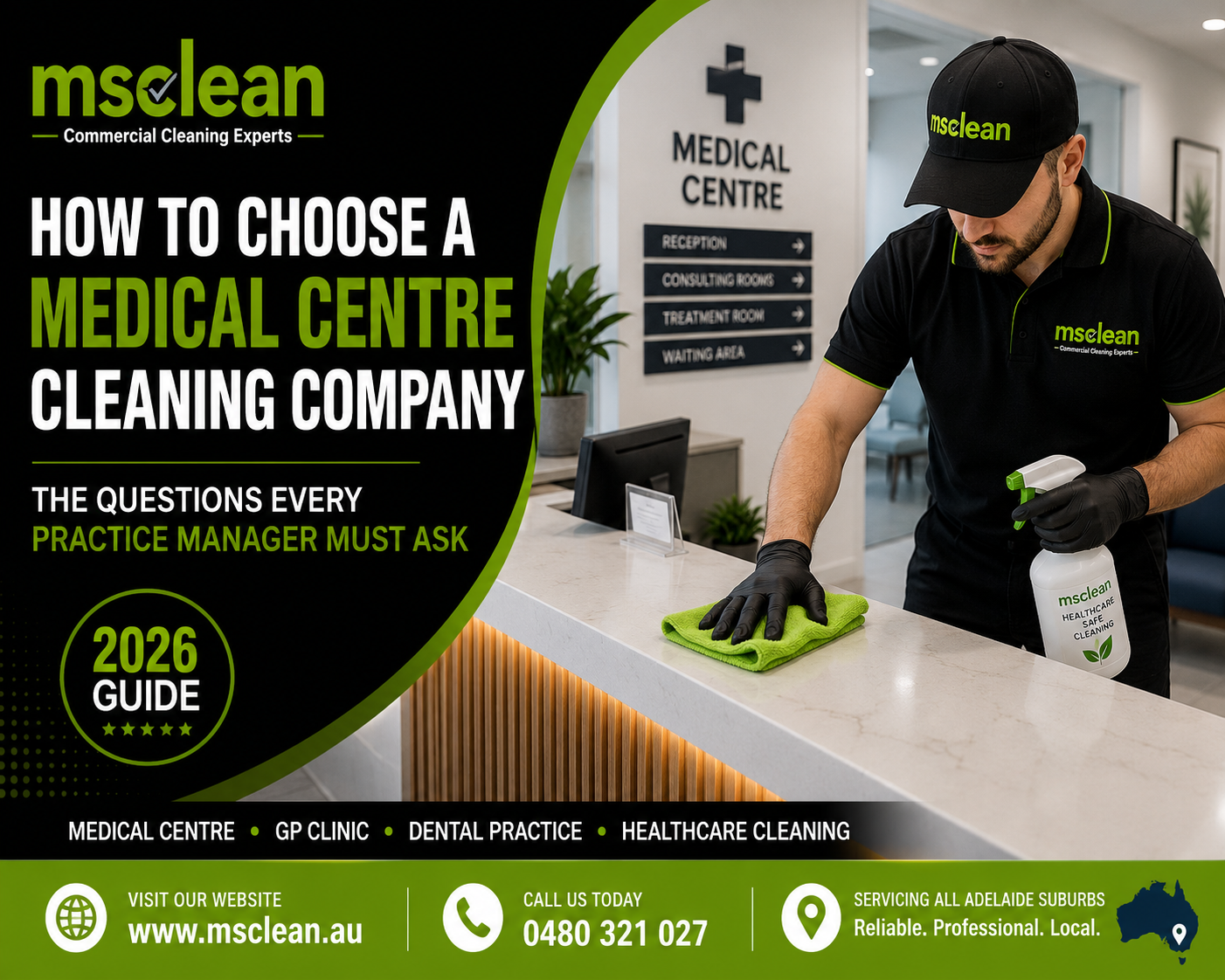
You choose the right medical centre cleaning company by verifying five non-negotiable things before you sign anything: proof of infection-control training, TGA-listed hospital-grade disinfectants with documented dwell times, a colour-coded zone equipment system, current public liability insurance, and a cleaning plan built specifically around your facility type — not a generic office cleaning checklist relabelled as medical. The company that ticks all five and answers your questions directly and without hesitation is worth talking to further. The one that struggles with any of them is telling you something important.
To choose the right medical centre cleaning company, you need to look for proven compliance with Australian health standards, specialised training in infection control and cross-contamination prevention, proper insurance, and customised cleaning protocols tailored to your specific facility type. Key criteria to evaluate include regulatory compliance — verify that they use TGA-listed, hospital-grade disinfectants and follow strict infection control and biohazard waste disposal protocols aligned with Australian Commission on Safety and Quality in Health Care (ACSQHC) guidelines. Check staff training and certification — ensure their team holds or trains under recognised standards and understands the specific infection-control obligations of your clinical environment. Confirm they use appropriate tools including microfibre colour-coded systems, HEPA-filter vacuums, and high-touch disinfection protocols with documented dwell times. Ask for proof of comprehensive general liability insurance and worker’s compensation coverage. Check that they can work around your clinic hours, whether you need overnight cleaning, early morning starts, or rapid response to infection events.
Here is what nobody tells you when you start searching for a medical centre cleaning company.
Every single one of them says the same things. Hospital-grade cleaning. Trained professionals. Infection control expertise. Trusted by healthcare facilities across Australia.
Type those phrases into any search engine in Adelaide, Sydney, Melbourne, or Brisbane. Within three minutes, you will have a shortlist of companies that are all, by their own account, exactly what you are looking for.
The problem is this: a general commercial cleaner who applies a TGA-listed disinfectant without following the correct dwell time delivers less infection control than someone mopping with soapy water at the right concentration. The product on the shelf means nothing if the person applying it does not know the contact time, the dilution ratio, and which surfaces in your specific facility require that product versus a different one.
Choosing the wrong medical cleaning company does not just mean you get a so-so clean. In a healthcare setting, it means patients face preventable infection risk. It means your facility can fail an ACSQHC accreditation audit. It means you carry the liability for a cleaning programme that looks compliant on paper and is not in practice.
This guide gives you the real criteria, the specific questions to ask before you sign anything, the red flags that tell you to walk away, and the standards that separate a genuinely capable medical cleaning provider from a commercial cleaning company that happens to clean healthcare spaces.

Why Medical Centre Cleaning Is Different From Every Other Type of Cleaning
Before you evaluate any provider, you need to understand what makes medical cleaning genuinely different — not because providers tell you it is, but because the consequences of getting it wrong are categorically different from a dirty office.
Healthcare-associated infections affect approximately 165,000 patients in Australian hospitals and medical facilities each year, according to the Australian Commission on Safety and Quality in Health Care. For medical centre managers, that statistic is not a policy document abstraction. It is a daily operational responsibility.
In a standard commercial office, a missed surface means a dusty corner. In a medical centre, a missed surface means a patient with a compromised immune system touching a door handle that carries the previous patient’s pathogen load.
The difference comes down to three specific realities.
Reality 1 — The stakes are clinical, not cosmetic. Medical centre cleaning is infection control delivered through cleaning processes. A visually clean consulting room that has not been disinfected with a TGA-listed product at the correct concentration and contact time is a compliance failure, not just an aesthetic one.
Reality 2 — Every zone in your facility carries a different risk level. High-risk areas — consulting rooms, treatment rooms, procedure areas, any space where patient contact occurs — need the most rigorous attention. Medium-risk areas — waiting rooms, reception, staff areas — require regular cleaning and sanitisation but at a different standard to clinical zones. A good cleaning programme reflects that. Not every area carries the same infection risk and a good medical cleaning programme is built around the specific areas and risk levels within your facility.
Reality 3 — Your facility faces real compliance obligations. In Australia, medical centres operating under RACGP Standards for General Practices, AHPRA-registered practitioners, and any facility seeking NSQHS accreditation face documented cleaning obligations. A cleaning company that cannot produce evidence of compliance-aligned protocols, documented training, and service records for audit review does not meet the standard you are legally and professionally required to maintain.
The 10 Criteria That Actually Separate Good Medical Cleaning Companies from Everyone Else
Use this as your evaluation framework. Every company you speak to gets measured against these ten criteria. The ones that meet all ten are worth a site assessment. The ones that struggle with three or more are telling you to look elsewhere.
TGA-Listed Hospital-Grade Disinfectants with Documented Dwell Times
This is the single most important technical criterion. The product is not enough on its own. The dwell time — the contact time the product needs to remain wet on a surface to achieve its claimed kill rate — is what determines whether the disinfection actually works.
Ask any provider: what TGA-listed disinfectants do you use, and what is the required dwell time for each product in a clinical setting?
A company that can answer this precisely, naming the product, citing its TGA registration number, and explaining the dwell time protocol knows what they are doing. A company that says “we use hospital-grade products” without being able to specify them does not.
High-risk areas need TGA-listed disinfectants applied at correct concentrations with adequate dwell times. Correct dwell time is the difference between a surface that is disinfected and a surface that was sprayed and wiped, which achieves significantly less pathogen reduction.
Colour-Coded Zone Equipment System
Cross-contamination prevention is one of the core infection-control functions of a medical cleaning programme. The colour-coded equipment system is how professional medical cleaners enforce zone boundaries, preventing bacteria and pathogens from moving on the cleaning equipment from high-risk to low-risk areas.
The standard system assigns specific colours to specific zones. Red for bathroom and sluice areas. Yellow for clinical and isolation zones. Blue for general and waiting areas. Green for kitchen and food preparation areas.
Ask any provider: do you use a colour-coded cleaning system, and how do you enforce zone boundaries during a service?
A company that uses a colour-coded system and can describe how they enforce it operationally is a company that has genuinely built cross-contamination control into their processes. A company that says “our staff is careful” is describing intent, not a system.
HEPA-Filter Vacuums
Standard vacuum cleaners redistribute fine particulate, including allergens, mould spores, and biological debris back into the air through their exhaust. In a standard office, this is an inconvenience. In a medical waiting room where immunocompromised patients sit, it is a clinical risk.
HEPA (High-Efficiency Particulate Air) filter vacuum systems capture particles down to 0.3 microns — including the fine biological debris that standard vacuums blow back into the air. Ask any provider whether they use HEPA-filter vacuums on all medical facility sites.
Infection Control Training — Documented and Current
Every person who enters your medical facility with a cleaning product is either reducing or adding to the infection risk of that space. The difference between a trained medical cleaner and an untrained one is not enthusiasm — it is knowledge of cross-contamination pathways, correct product application, and zone-specific protocol compliance.
Ask for documented training records. A reputable provider can show you that their staff complete infection-control training before their first shift in a healthcare environment, and that training is refreshed on a regular schedule.
Ask about the training and certification of the professional medical cleaning staff. Reputable providers invest in continuous training to keep their employees up-to-date with the latest cleaning techniques and technologies.
In Australia, relevant training frameworks include ACSQHC infection-control guidelines, RACGP infection prevention standards for general practice, and state health department protocols. Ask specifically which of these the provider’s training is aligned to.
Facility-Specific Cleaning Plan — Not a Generic Checklist
A small physiotherapy clinic has very different needs from a busy medical centre. A dental practice requires different cleaning procedures than an aged care facility.
A generic office cleaning checklist applied to a medical centre is not a medical cleaning programme. It is a visual maintenance schedule that misses the clinical obligations of the space.
A genuinely capable medical cleaning company produces a cleaning plan that:
- Maps your facility into risk zones and assigns protocols per zone
- Specifies the products, concentrations, and dwell times for each zone
- Sets cleaning frequency based on patient volume and zone risk level, not just a standard daily/weekly schedule
- Identifies high-touch surfaces specific to your facility type
- Documents the cleaning schedule in a format that supports accreditation audit review
Ask any provider: can you please show me an example cleaning plan for a facility similar to ours? If they show you a generic office cleaning checklist with “medical” added to the header, that is your answer.
Comprehensive Insurance and Bonding
Ensure that the cleaning service provider has appropriate insurance and liability coverage. This safeguards your facility from any unforeseen accidents or damages that may occur during the cleaning process.
You need to see a current certificate of currency for:
- Public liability insurance — $20 million minimum for a medical facility
- Workers’ compensation — covering all staff who enter your premises
- Professional indemnity — covering claims arising from the cleaning service itself
Ask for the certificate of currency before any work begins. A provider who cannot produce it within 24 hours either does not have adequate coverage or cannot locate their own documents — neither inspires confidence.
Background Checks and Security Screening
Medical centres process patient health information. Staff rooms often contain prescription pads, medication supplies, and clinical records. The cleaning company you hire will have after-hours access to all of these spaces.
Every staff member entering your facility should hold a current police clearance and have completed a site-specific security induction. Ask for documented confirmation of these checks for every person assigned to your practice — not a general statement that checks are performed.
Consistent Staff Assignment
A rotating roster of different cleaners in a medical facility creates two specific risks: inconsistent protocol compliance from people who are unfamiliar with your specific facility layout and zone requirements, and an ever-changing pool of individuals with after-hours access to your premises.
The same dedicated cleaning team assigned to your facility builds familiarity with your zone map, your high-risk areas, and the specific protocols your facility requires. Ask any provider: will we have a consistent, dedicated cleaning team, or does the staff rotate?
Flexible Scheduling Around Clinical Operations
Your cleaning programme needs to work around patient appointments, not the other way around. Most medical centre cleaning happens outside clinic hours — before the first patient arrives, after the last patient leaves, or in carefully managed windows during extended lunch breaks.
Ask specifically about:
- After-hours and early morning availability
- Emergency or same-day response for biohazard events, spillages, or infection incidents
- Weekend and public holiday coverage during your operating hours
- Notification process if scheduled cleaning needs to change
Service Records and Compliance Documentation
Every service visit should produce a documented record — a completion log that confirms what was cleaned, by whom, with which products, at what time. This documentation is not bureaucracy. It is the evidence you produce if your facility faces an accreditation audit, a patient complaint, or an infection-control review.
Ask any provider: what documentation do you produce after each service visit, and in what format is it available for our compliance records?
A provider who produces nothing beyond an invoice after each visit cannot support your accreditation obligations. A provider who produces a detailed service log with zone-by-zone confirmation, product records, and supervisor sign-off has built documentation into their operating model.
Red Flags to Walk Away From Immediately
These are the signs that a provider — regardless of how professional their website looks or how confident their sales rep sounds — does not operate at the standard a medical centre requires.
They cannot name the TGA registration number of a single product they use.
If a company tells you they use “hospital-grade disinfectants” but cannot cite a specific TGA-listed product or its registration number, they are using marketing language rather than clinical knowledge.
Their cleaning plan is a generic checklist with no zone risk classification.
A cleaning plan that does not differentiate between your consulting rooms and your waiting room is not a medical cleaning plan. It is an office cleaning plan applied to a healthcare space.
They do not use a colour-coded equipment system.
Cross-contamination prevention requires a system. “Our staff are careful” is not a system.
They cannot produce staff training documentation.
Claiming that staff are “trained in infection control” without documentary evidence means nothing. The training is only as real as the records that prove it happened.
Their quote is noticeably cheaper than every other provider.
In medical cleaning, a significantly cheaper quote almost always means something is being skipped — training, documentation, correct products, adequate dwell times, or insurance. Get it wrong and you face not just complaints, but potential liability, failed audits, and real harm to vulnerable people.
They have not asked to visit your facility before quoting.
A genuine medical cleaning provider cannot write you a compliant cleaning plan without understanding your facility’s specific zones, layout, patient volume, and risk profile. A provider who quotes from a phone call or website form is quoting a generic clean, not a medical cleaning programme.
How to Evaluate Different Medical Facility Types
Different healthcare facilities need different things from a cleaning provider. Here is what to look for based on your facility type.
| Facility Type | Key Cleaning Focus | Specific Questions to Ask |
| GP Medical Centre | Consulting room disinfection after each session, waiting room high-touch reset, bathroom sanitisation | Can you service between patient sessions during the day for high-touch resets? |
| Dental Clinic | AS/NZS 4187 infection control alignment, treatment chair area protocol, spittoon area (clinical staff only), instrument decontamination zones | Are your protocols aligned to AS/NZS 4187 sterilisation and infection prevention standards? |
| Physiotherapy and Allied Health | Treatment table surfaces, gym equipment cleaning, reception and waiting room | Do you understand the different risk levels between a treatment room and a reception area? |
| Pathology Collection Centre | Blood draw area biohazard awareness, bench sanitisation, biological waste protocol | Do your staff hold biohazard awareness training? |
| Day Surgery and Procedure Facility | Terminal cleaning after each procedure, theatre-adjacent area protocol, NSQHS compliance | Can you produce documentation formatted for NSQHS accreditation audit review? |
| Aged Care Facility | Resident-safe chemical protocols, Aged Care Quality Standards alignment, infection outbreak response | Are your products and protocols aligned to Aged Care Quality and Safety Commission standards? |
| NDIS Facility | Participant-safe chemicals, NDIS Practice Standards documentation, regular schedule evidence | Can you provide documentation formatted for NDIS Commission compliance review? |
| Medical Imaging and Radiology | High patient throughput, contrast media spill response, equipment surface protocol | How do you handle contrast media or chemical spills in imaging areas? |
The Questions You Must Ask Before You Sign Any Medical Cleaning Contract
These questions cut through marketing language and get to the operational reality of how a provider actually works. Use them in every conversation with every provider you evaluate.
Regulatory and Compliance Questions
Do you use TGA-listed, hospital-grade disinfectants?
You need the specific product names and TGA registration numbers — not a general yes.
Are your cleaners trained in infection-control protocols aligned to ACSQHC and RACGP standards?
Ask for documented training records — dates, content covered, and trainer credentials.
How does your team maintain patient privacy during after-hours cleaning?
Staff should have specific protocols for handling visible patient information — file management, screen conduct, and information-handling behaviour.
Can you provide proof of General Liability Insurance of at least $20 million?
Ask for a current certificate of currency before the first service.
Are you compliant with Safe Work Australia guidelines for chemical handling in healthcare settings?
They should be able to confirm their SWMS (Safe Work Method Statement) documentation for all clinical cleaning tasks.
Training and Staffing Questions
What specific infection-control training does your company provide to staff working in medical facilities?
Ask for the curriculum, the frequency of refresher training, and how compliance is documented.
How do you conduct background checks and security screening for staff entering medical facilities?
Ask for police clearance confirmation — not a general statement that checks are performed.
Will our facility have a dedicated cleaning crew, or will staff rotate?
Consistent staff means consistent protocol compliance. Rotating staff means inconsistent familiarity with your specific facility.
How do you train staff to prevent cross-contamination between rooms and zones?
They should describe a colour-coded zone system — not general awareness of the concept.
Quality and Operational Questions
Do you use a colour-coded microfibre system for different zones in the facility?
Ask specifically which colours map to which zones and how zone compliance is supervised.
What is your process for auditing and verifying cleaning quality?
They should describe supervisor inspections, completion logs, and a client communication process for reported issues.
How do you handle emergency spill cleanups or urgent requests?
Ask about response time commitments, the protocol for a Category 3 biohazard event, and who to call.
Can you provide three references from medical facilities similar to ours that we can contact directly?
References from GP clinics if you run a GP clinic. Dental if you run a dental practice. A company that only references commercial clients has not genuinely built a healthcare cleaning programme.
Australian Compliance Standards Your Medical Cleaning Provider Must Understand
A medical cleaning provider in Australia needs to demonstrate working knowledge of these specific frameworks. Ask about each one directly.
| Standard / Framework | What It Covers | Why It Matters for Cleaning |
| ACSQHC National Safety and Quality Health Service (NSQHS) Standards | Environmental cleaning as part of infection-control obligations | Your accreditation depends on demonstrable compliance |
| RACGP Standards for General Practices (5th Edition) | Infection prevention in general practice including environmental cleaning | GP clinics must demonstrate cleaning programme compliance |
| AS/NZS 4187:2014 | Infection prevention and control in health care — decontamination standards | Applies directly to dental and procedure environments |
| Therapeutic Goods Administration (TGA) product registration | Registration of disinfectants used in clinical environments | Disinfectants must carry TGA listing for use in healthcare settings |
| Safe Work Australia / SafeWork SA | Chemical handling, biological hazard response, SWMS requirements | PCBU duty to eliminate or minimise risk in the workplace |
| Aged Care Quality and Safety Commission Standards | Infection control in residential and community aged care | Aged care facilities must demonstrate compliant cleaning to the Commission |
| NDIS Practice Standards | Safe, clean environment for NDIS participants with documented evidence | NDIS providers need documented cleaning schedules for compliance review |
| WHS Act 2012 (SA) | PCBU duty to ensure a safe workplace — including cleaning contractor risk | Practice managers carry WHS duty for cleaning contractor behaviour on site |
A cleaning company that has never heard of the NSQHS Standards or cannot explain what AS/NZS 4187 covers does not hold the expertise their marketing claims.
How to Compare Quotes from Medical Cleaning Providers
When you receive multiple quotes, comparing them on price alone is a mistake. The cheapest quote may skip the elements that make the service genuinely compliant. Here is how to compare quotes accurately.
| Comparison Point | What to Check | Red Flag |
| TGA-listed disinfectants | Named in the quote or cleaning plan | Generic “hospital-grade products” with no specifics |
| Dwell time documentation | Referenced in the cleaning plan | No mention of contact time or dwell time |
| Colour-coded zone system | Specified in the plan | Not mentioned |
| Staff training evidence | Available on request | “Our staff are trained” with no documentation |
| Cleaning plan specificity | Zone-by-zone protocol | Generic checklist or room list |
| Insurance coverage | Certificate of currency available | Verbal confirmation only |
| Completion documentation | Included in service scope | Invoice only after each visit |
| References from medical facilities | Offered proactively | References from offices or retail only |
| Flexible scheduling around clinic hours | Confirmed in writing | “We can arrange that” without specifics |
Why choose ms Clean?
Ms Clean has delivered professional cleaning services to Adelaide medical centres, GP clinics, dental practices, allied health facilities, aged care providers, and NDIS facilities since 2015. We understand that medical cleaning is not a premium version of office cleaning — it is a distinct discipline with specific product requirements, zone protocols, documentation obligations, and staff training standards. The guidance in this article reflects direct experience cleaning regulated healthcare environments across Adelaide metro — not general advice adapted from generic commercial cleaning content.
What a Good Medical Cleaning Contract Should Include
You have found a provider that meets your criteria. Before you sign anything, check that the contract includes these elements.
Written scope of work — zone by zone. Not “the medical centre will be cleaned.” Every zone, every task, every frequency, and every product type listed explicitly.
TGA-listed disinfectant specification. The contract or attached cleaning plan names the specific disinfectants to be used and references their TGA registration.
Cleaning frequency schedule. High-risk clinical areas versus medium-risk waiting areas should carry different cleaning frequencies — both documented.
Staff assignment statement. Named or dedicated crew assigned to your facility, with a defined process for notifying you of any change.
Documentation and reporting. Every service visit produces a completion log available in a format you can use for compliance records.
Insurance confirmation. Public liability and workers’ compensation certificates attached to the contract.
SLA escalation pathway. Defined response times for reported issues — not “we will fix it as soon as possible.”
Termination clause. Notice period and conditions — including a performance-trigger clause
Red Flags in a Medical Cleaning Quote or Contract
Read every document carefully before signing. These specific inclusions or omissions carry real risk.
A quote given in under 60 seconds over the phone. A genuine medical cleaning provider cannot quote your facility without understanding its layout, zone configuration, patient volume, and specific compliance obligations. A rapid phone quote is a commercial cleaning price, not a medical cleaning programme.
No mention of dwell times. If the cleaning plan does not reference contact time for disinfectants, the plan does not reflect clinical understanding.
Lock-in contracts longer than 12 months without performance reviews. A provider that insists on a 24-month lock-in without built-in quality reviews is betting on your inertia once the honeymoon period ends.
No dedicated staff. A rotating cleaning roster in a medical facility creates consistent compliance and security risks. This is not a minor operational detail.
Documentation produced only on request. In a medical facility, completion records should be automatic after every service — not generated only when you ask for them before an audit.
FAQs — How to Choose a Medical Centre Cleaning Company
Regulatory and Compliance Questions
Do you use TGA-listed, hospital-grade disinfectants?
You need a specific yes backed by product names and TGA registration numbers — not a general claim. A genuine medical cleaning provider names the products they use, can cite the TGA registration, and explains the dwell time protocol for each one. If the answer is “yes, we use hospital-grade products” without specifics, ask again.
Are your cleaners trained in OSHA Bloodborne Pathogens standards and Australian infection-control equivalents?
In Australia, the relevant frameworks are ACSQHC guidelines, RACGP infection-prevention standards, and state health department protocols. Ask for documented training records including dates and curriculum content. Training that cannot be documented is training that may not have happened.
How does your team maintain patient privacy during cleaning?
Staff should have specific behavioural protocols for handling visible patient information during after-hours cleaning, including not touching files, screens, or clinical records. Ask for the written protocol, not a verbal assurance.
Can you provide proof of General Liability Insurance at a minimum of $20 million?
Ask for a current certificate of currency. A legitimate provider produces this within 24 hours of being asked. A provider who cannot find their own insurance documentation raises a serious question about the quality of their operational management.
Training and Staffing Questions
What specific medical cleaning certifications does your company hold?
In Australia, relevant credentialing includes alignment with ACSQHC frameworks and, for ISO-certified companies, ISO 9001 (quality), ISO 14001 (environmental), and ISO 45001 (WHS). Some providers hold ISO 9001, ISO 14001, and ISO 45001 certification covering quality, environmental management, and workplace safety. Ask for certification documentation with current expiry dates.
How do you conduct background checks and security screening for staff?
Every person entering your medical facility after hours should hold a current police clearance. Ask for confirmation of this for every individual assigned to your practice, not a general policy statement.
Will our facility have a dedicated cleaning crew, or will staff rotate?
A dedicated crew that knows your facility produces more consistent protocol compliance than a rotating roster. This matters more in a medical centre than anywhere else — because protocol familiarity in a clinical zone directly affects infection-control outcomes.
How do you train staff to prevent cross-contamination between rooms and zones?
The answer should describe a colour-coded equipment system — specific colours for specific zones, enforced through supervision and documented in service records. An answer that describes awareness without a structured system is not sufficient for a clinical environment.
Quality and Operational Questions
Do you use colour-coded microfiber cloths for different zones?
Yes is the minimum answer. The complete answer names which colours apply to which zones, how supervisors enforce zone boundaries, and how cross-zone compliance appears in the service documentation.
What is your process for auditing and checking cleaning quality?
Look for: supervisor inspections on a defined schedule, unannounced spot checks, completion logs reviewed against the scope of work, and a defined client escalation process. “We check our work” is not a quality assurance system.
How do you handle emergency spill cleanups or urgent requests?
A medical cleaning provider should have a documented emergency response protocol — response time commitment, biohazard event procedure, and a direct contact number for out-of-hours urgent requests. Ask for the response time commitment in writing.
Can you provide three references from local medical facilities that we can contact directly?
References from GP clinics if you run a GP clinic. Dental references if you run a dental practice. A company whose references are all commercial offices or retail premises has not built genuine experience in healthcare cleaning.
Actionable Takeaways
Print this checklist. Use it before you talk to any medical cleaning provider.
Count the criteria, not the claims. Every provider claims medical expertise. You need documented evidence against the 10 criteria in this guide, not marketing language.
Ask for TGA product names and registration numbers. This single question separates genuine medical cleaning providers from commercial cleaners who add “medical” to their service list.
Request a site visit before you accept a quote. No provider can write a compliant medical cleaning plan without seeing your facility. A quote produced without a site visit is a commercial cleaning price.
Ask for three references from similar medical facilities. Contact them directly. Ask specifically about protocol consistency, documentation, and how the provider responded when something went wrong.
Check the insurance certificate before signing. Current, adequate, and confirmed — not “yes we’re insured.”
Read the contract for zone-specific cleaning frequencies. If consulting rooms and waiting rooms carry the same cleaning specification in the contract, the provider does not understand medical facility risk zoning.
Build an exit clause into the contract. A performance-trigger early exit clause protects you if the cleaning standard slips after the first month.
Final CTA
Choosing a medical centre cleaning company is one of the most consequential facility management decisions you make. The wrong choice creates real infection risk for your patients, compliance exposure for your facility, and liability for you as the PCBU responsible for the safety of that environment.
If your Adelaide medical centre, GP clinic, dental practice, allied health facility, or aged care service needs a professional cleaning company that can answer every question in this guide directly and with documentation — Ms Clean is ready for the conversation.
Call Now
Ms clean Au
Address: 71 Alexandra Street, Prospect, SA-5082
M : 0480 321 027
E-Mail: contact@msclean.au
