
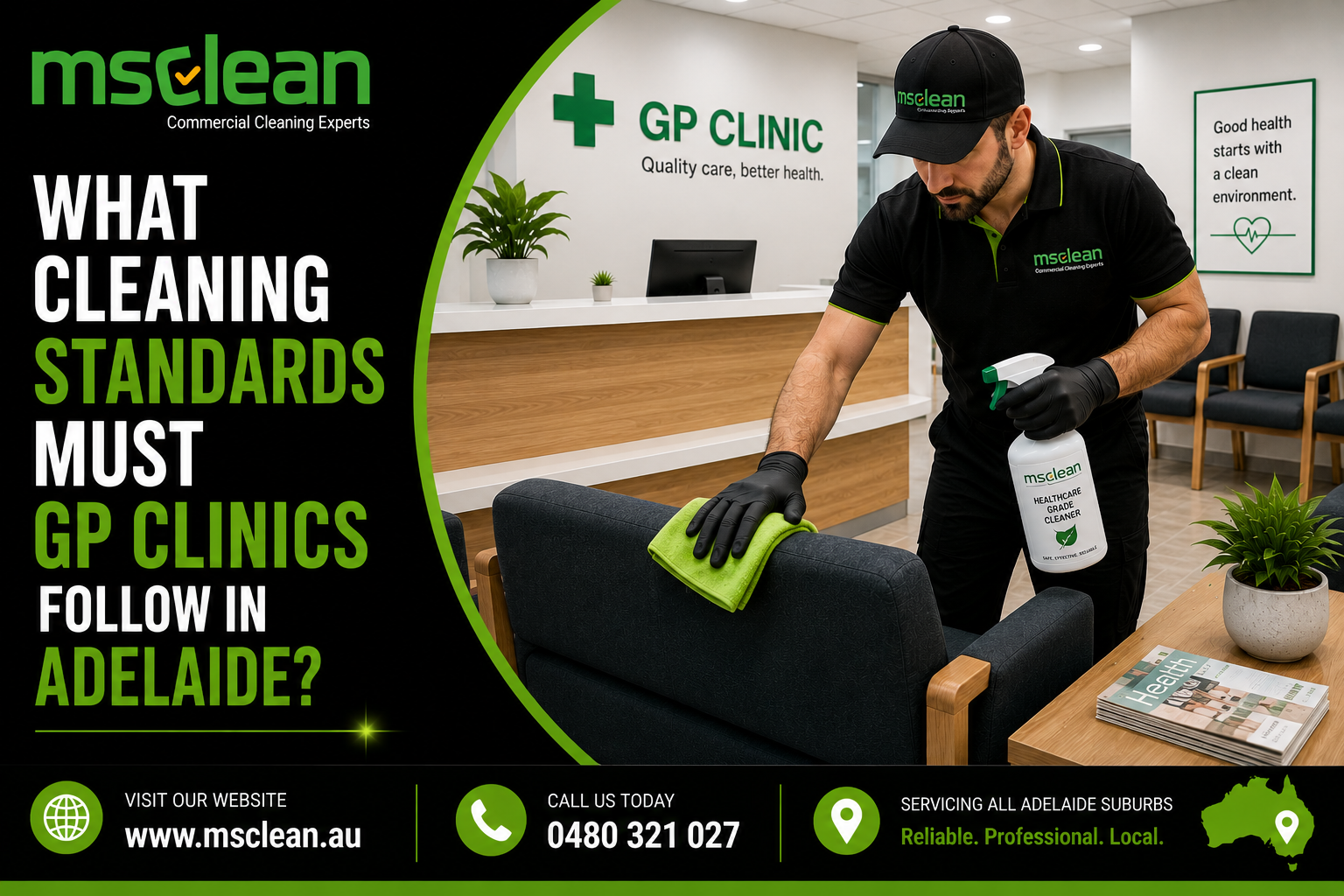
GP clinics must comply with RACGP accreditation standards, NHMRC infection control guidelines, and state health authority directives. Cleaning staff must be trained in infection prevention principles, PPE usage, and clinical waste handling. All cleaning activities must be documented to provide audit evidence during accreditation assessments. In South Australia, this compliance framework draws from the RACGP Standards for General Practices, the NHMRC Australian Guidelines for the Prevention and Control of Infection in Healthcare (2019), SA Health Cleaning Standards, TGA requirements for hospital-grade disinfectant products, and the Work Health and Safety Act 2012 (SA). Meeting these standards is not optional — it is a condition of accreditation, a WHS obligation, and a patient safety requirement.
General Practice clinics in Adelaide must follow strict national infection prevention guidelines and RACGP standards. These rules require documented cleaning policies, the use of TGA-listed hospital-grade disinfectants on clinical contact surfaces, and proper segregation of clinical and general waste. The core regulatory frameworks are: RACGP Standards, which require explicit, documented infection prevention and control procedures encompassing routine cleaning schedules, staff training, and waste management; National Guidelines, alignment with infection control principles set by Australian health authorities to minimise healthcare-associated infections; and SA Health Cleaning Standards, which detail every frequency and method for each area of a healthcare facility. Key cleaning protocols include mandatory application of TGA-registered hospital-grade disinfectants on all examination tables, benches, and clinical touchpoints; use of colour coded microfibre cloths and mops mapped to specific risk zones; documented and trained spill management protocols; and correct segregation of clinical waste from general waste.
Here’s what surprises most Adelaide GP practice managers when they first take it seriously.
When compliance walkthroughs are run in Adelaide practices, the same findings come up again and again: almost never that the practice is unclean, almost always a system gap. No records at all. The practice is cleaned nightly and has nothing to show for it. To a surveyor, undocumented cleaning is indistinguishable from no cleaning. One mop for the whole practice. Supermarket products in clinical rooms.
This is the gap between cleaning and compliance. A GP clinic can be visually clean and still fail an accreditation audit because compliance is about documented systems, trained staff, correct products, and evidence of all three. The surveyor does not just walk through the clinic and decide whether it looks clean enough. They ask for records.
This guide explains exactly what cleaning standards Adelaide GP clinics must follow, what each standard actually requires, and what practice managers and cleaning providers need to do to meet them. It covers every relevant framework : RACGP, NHMRC, SA Health, TGA, WHS — and gives you the compliance actions that make the difference between a clinic that passes an audit and one that does not.
Why GP Clinic Cleaning Standards Exist — The Clinical and Legal Context
Cleaning in healthcare environments is an infection control measure, not just a presentation measure. The patients who attend these facilities are often already unwell, immunocompromised, or in treatment for conditions that make them more susceptible to healthcare-associated infection.
Healthcare-associated infections (HAIs) affect approximately 165,000 patients in Australian hospitals and medical facilities annually, according to the Australian Commission on Safety and Quality in Health Care. GP clinics and general practice settings are not immune from this risk . They host vulnerable patient populations in shared spaces throughout every operating day.
The cleaning standards Adelaide GP clinics must follow exist because:
Patient safety requires it. A surface in a consulting room that is not properly disinfected between patient contacts is a direct transmission pathway for pathogens including influenza, MRSA, norovirus, and COVID-19. Standards ensure cleaning achieves infection control outcomes, not just a tidy appearance.
The law requires it. GP clinics in Adelaide operate under multiple legislative obligations, including cleaning and hygiene requirements. The Work Health and Safety Act 2012 (SA) imposes a duty on the PCBU in a GP clinic, that is the practice to eliminate or minimise risk so far as reasonably practicable. An inadequately cleaned clinical environment creates WHS risk for both staff and patients.
Accreditation requires it. The RACGP does not just recommend cleaning it mandates it as part of practice accreditation. A GP practice that cannot demonstrate a compliant, documented cleaning programme risks non-conformity findings in its RACGP accreditation assessment which affects its ability to operate, its billing arrangements, and its standing with AHPRA-registered practitioners.
Whether a clinic is in suburban Modbury or downtown Adelaide, it is following the same playbook as a major hospital.
The Full Compliance Framework: Every Standard Adelaide GP Clinic Must Meet
GP clinics, physiotherapy practices, dental clinics, psychology offices, chiropractic practices, and pathology collection centres operate under hygiene requirements that are fundamentally different from standard commercial cleaning.
Here are the specific standards and frameworks that apply to every GP clinic in Adelaide, explained plainly.
RACGP Standards for General Practices (5th Edition)
The Royal Australian College of General Practitioners publishes the Standards for General Practices the primary accreditation framework for Australian GP clinics. These standards cover hand hygiene, personal protective equipment, environmental cleaning, sterilisation, outbreak management, and staff immunisation.
The specific standard that governs cleaning is GP4.1 — Infection Prevention and Control. Under GP4.1, a GP clinic must demonstrate:
- A documented cleaning schedule that specifies cleaning frequency, procedures, and responsibilities across all areas of the facility
- Use of TGA-listed disinfectants on clinical contact surfaces
- A colour-coded equipment system that prevents cross-contamination between zones
- Staff training in infection-control cleaning procedures
- Documented records of cleaning activities available for accreditation review
- A documented clinical waste management procedure
- Spill management protocols covering blood and body fluid incidents
Under RACGP standards, practices must have a documented cleaning schedule that systematically ensures the entire facility is cleaned appropriately. This schedule describes recommended cleaning frequencies, procedures, and the roles and responsibilities of staff who perform cleaning. Cleaning when something looks dirty is not enough the standard requires scheduled, evidence-based cleaning across the entire facility.
What a RACGP surveyor looks for in an accreditation visit:
- The written cleaning schedule — is it current, detailed, and accessible?
- Completed cleaning checklists — do they cover the review period?
- Product records — are TGA-listed disinfectants used and documented?
- Colour-coded equipment evidence — is the system physically in place?
- Staff training records — can cleaning staff demonstrate infection-control knowledge?
NHMRC Australian Guidelines for the Prevention and Control of Infection in Healthcare (2019)
The National Health and Medical Research Council publishes the primary national reference for infection prevention in Australian healthcare settings. Chapter 3 covers environmental cleaning specifically and is essential reading for any cleaning provider or clinic manager responsible for facility hygiene.
The NHMRC Guidelines establish:
- The evidence base for risk-based cleaning frequency in healthcare environments
- The requirement for a clean-first, then disinfect approach — organic matter deactivates disinfectants, so the cleaning step must precede the disinfection step
- Principles for product selection — disinfectants must be appropriate for the surface type, the target organism, and the clinical risk level of the zone
- Zone risk classification — different areas of a clinic carry different infection risk and require protocols matched to that risk level
- Staff training requirements for all personnel performing environmental cleaning in clinical settings
These principles focus on risk-based cleaning, correct disinfectant use, and staff training. General practices are also assessed against the RACGP Standards for general practices, which require clinics to maintain clean and safe environments and demonstrate systems that reduce infection risk.
SA Health Cleaning Standards for Healthcare Facilities
South Australia’s state health authority publishes cleaning standards that apply to healthcare facilities across the state. The SA Health Cleaning Standards document details every frequency and method for each area, from operating theatres to offices. The Cleaning Standard aims to make healthcare spaces free from foreign matter such as dust, dirt, and biological material.
SA Health Cleaning Standards define:
- Zone risk classifications and associated cleaning frequencies — from the highest-risk clinical procedure areas to lower-risk administrative zones
- Required cleaning method for each zone type — the specific approach, not just a generic instruction to clean
- Product compliance requirements — which types of products are required at each risk level
- Documentation obligations for audit readiness
- Staff competency requirements for personnel assigned to clinical cleaning zones
The SA Health Cleaning Standards supplement the national NHMRC framework with state-specific implementation guidance. Adelaide GP clinics must align their cleaning programmes to both.
TGA Requirements for Disinfectant Products
The Therapeutic Goods Administration registers disinfectants used in clinical settings in Australia. A TGA-listed disinfectant carries an ARTG (Australian Register of Therapeutic Goods) number confirming it has been assessed for safety and efficacy against the organisms it claims to kill.
All cleaning activities must use TGA-listed hospital-grade disinfectants on clinical contact surfaces. General-purpose spray is not a TGA-listed disinfectant, no matter how strong it smells.
Every GP clinic in Adelaide must:
- Use only TGA-listed disinfectants on clinical contact surfaces — examination tables, benches, door handles, clinical equipment exteriors
- Maintain Safety Data Sheets (SDS) on site for every product used
- Know the dwell time for every product — the contact time the disinfectant must remain wet on the surface to achieve its claimed kill rate
- Match the product to the surface type and the risk level of the zone being cleaned
How to verify a disinfectant is TGA-listed: Ask the supplier for the ARTG number. This number confirms the product appears on the Australian Register of Therapeutic Goods. A product can market itself as “hospital-grade” without TGA listing — marketing language does not equal regulatory compliance.
Work Health and Safety Act 2012 (SA) and Cleaning Services Award
Cleaning staff in healthcare environments may be exposed to blood and body fluids, contaminated sharps risks, and infectious pathogens. The WHS Act 2012 (SA) imposes a duty on the PCBU to eliminate or minimise risk so far as reasonably practicable.
For a GP clinic, this WHS duty covers both the cleaning contractor and the practice. If you engage a cleaning company to clean your clinic, you have a duty of care for the working conditions of those cleaning staff. This means:
- Cleaning staff must receive appropriate infection-control training before working in clinical areas
- PPE must be supplied and worn — gloves, apron, eye protection where relevant
- SWMS (Safe Work Method Statements) must be in place for high-risk cleaning tasks including blood and body fluid spill management
- Cleaning products must be handled according to SDS instructions
- The clinic must not instruct cleaning staff to perform tasks — such as handling clinical waste or sharps — outside their trained scope
AS/NZS 4187:2014 — Infection Prevention and Control in Healthcare
AS/NZS 4187:2014 covers infection prevention and control in health care settings with particular relevance to the decontamination of reusable equipment. For GP clinic cleaning, the most relevant provisions relate to:
- Colour-coded laundry and cleaning procedures
- Environmental surface cleaning and disinfection standards
- Handling of linen in clinical settings — including the prohibition on clinical linen being laundered in domestic environments
AS/NZS 4187 — reprocessing of reusable medical devices — applies in the environmental context of GP clinic cleaning.
AS 4031 — Non-Reusable Containers for Collection of Sharp Items
AS 4031 governs the containers used for sharps disposal in clinical settings. For GP clinic cleaning, the relevant provisions are:
- Sharps containers must meet the AS 4031 standard
- Cleaning staff must not open, handle, or empty sharps containers — this is a clinical responsibility
- Cleaning staff must identify sharps containers approaching capacity and alert clinic management
- Sharps containers must never be included in general waste
What RACGP GP4.1 Specifically Requires: A Detailed Breakdown
What RACGP GP4.1 requires of your practice cleaning, laid out as a checklist you can use today.
This is the standard most Adelaide GP practice managers need to understand most specifically because it is the standard that RACGP surveyors apply during accreditation visits.
GP4.1 Requirement 1 — A Documented Cleaning Schedule
The cleaning schedule is not an invoice. It is not a verbal arrangement with a cleaning company. It is a written document that specifies:
- Every area of the facility that gets cleaned
- The frequency of cleaning for each area (daily, weekly, monthly, periodic)
- The specific tasks performed in each area at each frequency
- The products to be used in each zone
- The staff or cleaning contractor responsible for each task
The schedule must be current — reviewed and updated when the clinic layout changes, when products change, or when patient volume changes significantly.
GP4.1 Requirement 2 — TGA-Listed Products for Clinical Surfaces
RACGP GP4.1 requires TGA-registered, hospital-grade disinfectants on all clinical contact surfaces. This includes:
- Examination tables and clinical couches
- Clinical benchtops
- Medical equipment housings and casings
- Door handles in clinical rooms
- Any surface in clinical zones that patients or practitioners contact during consultation or treatment
The clinic must be able to name the TGA-listed products used, cite their ARTG numbers, and produce the SDS documentation on request during an accreditation review.
GP4.1 Requirement 3 — Colour-Coded Equipment System
RACGP accreditation assessors look for physical evidence of a colour-coded zone equipment system. The system must be:
- In place and operational — not just documented in a policy
- Understood by every person who performs cleaning in the clinic
- Enforced — with supervisor oversight confirming zone boundaries are maintained
The standard system:
| Colour | Zone |
| Red | Bathrooms and toilet areas |
| Yellow | Clinical and treatment zones |
| Blue | General waiting and reception areas |
| Green | Kitchen and food preparation areas |
GP4.1 Requirement 4 — Documented Staff Training
Every person performing cleaning in a clinical setting must receive training in:
- Infection-control principles relevant to a GP clinic environment
- Correct use of TGA-listed disinfectants — dilution, application, dwell time
- Colour-coded zone system operation
- PPE selection and donning/doffing procedure
- Clinical waste identification and handling limitations
- Blood and body fluid spill management
- The clean-to-dirty sequencing protocol
Document training dates, topics covered, and the name of the person who received training. An undocumented training session is indistinguishable from no training in an accreditation review.
GP4.1 Requirement 5 — Completion Records for Every Clean
Every cleaning visit must generate a completion record — a room-by-room checklist signed off by the cleaning team member, confirming what was cleaned, when, and with which products. This documentation:
- Forms part of the practice’s infection-prevention evidence file
- Is reviewed during RACGP accreditation visits
- Provides the practice with a documented defence in the event of a patient complaint about hygiene
- Demonstrates to SafeWork SA that the PCBU is actively managing infection-control risk
GP4.1 Requirement 6 — Clinical Waste Management
RACGP GP4.1 and the Environment Protection Act 1993 (SA) together require:
- Clinical waste (yellow biohazard bags) to be segregated from general waste at the point of generation
- Clinical waste to be collected by a registered clinical waste contractor — never included in general council waste
- Sharps containers to meet AS 4031 and to be disposed of through a licensed sharps disposal service
- Cleaning staff to be trained in clinical waste identification and the limits of their handling scope
GP4.1 Requirement 7 — Blood and Body Fluid Spill Management Protocol
Every GP clinic must have a documented, trained spill management protocol. RACGP and the NHMRC guidelines require:
- A written procedure covering the step-by-step response to a blood or body fluid spill
- PPE requirements for spill response — minimum gloves and apron, eye protection where splash risk exists
- Use of appropriate disinfectant — typically hypochlorite-based (bleach) solution at the correct concentration for body fluid spills, applied after initial clean-up of the bulk material
- Documentation of spill events in the clinic’s incident log
The Two-Step Cleaning and Disinfection Protocol — The Foundation of All Standards
Two-step cleaning processes — clean first, then disinfect — are standard in any accredited medical facility.
Every major cleaning standard applicable to Adelaide GP clinics — RACGP, NHMRC, SA Health, TGA — is built on the same foundational technical principle. Cleaning and disinfection are two separate steps that must happen in sequence.
Step 1 — Clean.
Remove visible organic matter — dust, debris, bodily fluid residue, and any material that would deactivate or dilute the disinfectant applied in step 2. Use detergent and water, mechanical action (wiping, scrubbing), and appropriate cloths. After this step, the surface is visually clean but not necessarily free of pathogens.
Step 2 — Disinfect.
Apply TGA-listed hospital-grade disinfectant to the pre-cleaned surface. Observe the manufacturer-specified dwell time — the contact time required for the product to achieve its claimed kill rate. Only after the full dwell time can you wipe the surface dry.
Why this sequence matters:
Organic matter — blood, body fluids, mucus — deactivates disinfectants. A disinfectant applied to an unclean surface is partially neutralised by the organic material before it can reach the pathogens on the surface. Cleaning first removes the organic barrier and allows the disinfectant to work as registered.
A cleaning provider who sprays disinfectant on a visibly soiled surface and wipes it immediately is doing neither step correctly. They have not cleaned first, and they have not observed dwell time. The surface may look clean. It is not disinfected.
Zone Risk Classification — The Cleaning Frequency Standard for Each Area
NHMRC infection prevention guidelines focus on risk-based cleaning — different zones require different frequencies and protocols matched to their clinical risk level.
Adelaide GP clinics must classify every area of the facility by infection risk and assign cleaning frequency accordingly. Here is the standard zone classification with the compliance-appropriate cleaning schedule for each.
Zone Classification and Cleaning Frequency Standards
| Zone | Area Examples | Risk Level | Minimum Cleaning Frequency | Required Products |
| Clinical Zone — High Risk | Consultation rooms, examination areas, procedure rooms, clinical sinks | Highest | Full clean and disinfection every session or daily minimum — TGA-listed disinfectant with dwell time | TGA-listed hospital-grade disinfectant |
| Transition Zone | Clinical corridors, hallways adjacent to clinical rooms | High | Daily — high-touch surfaces multiple times | TGA-listed disinfectant on touch points |
| Medium-Risk Zone | Waiting rooms, reception, patient bathrooms | Medium-High | Daily full clean — high-touch surfaces every 2 hours minimum during patient hours | TGA-listed disinfectant |
| Low-Risk Zone | Administrative offices, storage, staff rooms | Lower | Daily standard clean | Appropriate cleaning product matched to risk level |
| Wet Areas | All bathrooms — staff and patient | Medium-High | Minimum twice daily during operating hours, full clean end of session | TGA-listed disinfectant, colour-coded red equipment |
A typical daily checklist for a GP practice includes treatment room cleaning and disinfection between each patient (documented per appointment), waiting room touch-point cleaning multiple times daily, and bathroom cleaning and disinfection at minimum twice daily.
The Complete RACGP Compliance Checklist for Adelaide GP Clinics
Use this checklist to audit your clinic’s current cleaning programme against the standards that matter. This reflects the evidence an RACGP surveyor will look for.
Documentation and Systems
Written cleaning schedule covers every area of the clinic with specific tasks, frequency, products, and responsible parties
Cleaning schedule is current — reviewed in the last 12 months
Completed cleaning checklists are filed and accessible for the review period
Product records show TGA-listed disinfectants in use — ARTG numbers available
Safety Data Sheets for every cleaning product are on file and accessible at the clinic
Staff training records document infection-control cleaning training for every person performing cleaning
Spill management protocol is documented, accessible, and staff have been trained on it
Clinical waste management procedure is documented and aligned to Environment Protection Act 1993 (SA)
Operational Standards
Colour-coded equipment system is physically in place — separate coloured cloths and mops for each zone
The same cleaning equipment does not move between clinical zones and bathroom zones
TGA-listed disinfectants are used — not general-purpose supermarket products — on clinical surfaces
Dwell time is observed for every disinfectant application in clinical areas
Two-step clean-then-disinfect process is followed in all clinical zones
High-touch surfaces in waiting room and reception receive disinfection multiple times daily during patient hours
Clinical waste bins contain yellow biohazard bags — not standard bin liners
Sharps containers are not handled by cleaning staff
PPE (gloves, apron) is worn by cleaning staff in clinical areas
Audit Readiness
Completion checklists are signed, dated, and filed — not generic or retrospectively filled
A specific named contact exists for the cleaning provider or internal cleaning coordinator
The cleaning contract or service agreement specifies the scope aligned to RACGP requirements
Emergency response protocol exists for post-outbreak enhanced cleaning
The Most Common Compliance Failures in Adelaide GP Clinics
When compliance walkthroughs are run in Adelaide practices, the same findings come up again and again.
Understanding the most common failures helps practice managers address them before an accreditation visit — not during one.
Failure 1 — No Completion Records
The clinic is cleaned every night. There are no records. A surveyor cannot distinguish between a clinic cleaned every night with no records and a clinic never cleaned — because in both cases, the evidence trail is identical: nothing.
Fix: Implement a signed daily checklist from day one of any cleaning engagement. File it. Keep it accessible.
Failure 2 — Shared Equipment Across Zones
The same mop head moves between the bathroom and the consultation room. The same cloth wipes the examination table and the toilet. The colour-coded zone system exists in the cleaning policy but not in the cleaning cupboard.
Fix: Purchase and label a complete colour-coded set cloths, mop heads, and spray bottles for each zone colour. Conduct regular physical inspections of the cleaning cupboard to confirm the system is in operational use.
Failure 3 — Supermarket Products in Clinical Rooms
General-purpose surface spray, multipurpose wipes, and bleach-based domestic cleaners appear in the cleaning trolley. None carry a TGA registration number. None of them are appropriate for clinical contact surfaces.
Fix: Replace all clinical cleaning products with TGA-listed alternatives. Confirm ARTG numbers. Update the product records in the cleaning schedule.
Failure 4 — Zero Dwell Time Compliance
Staff spray the consultation room bench and wipe immediately. The disinfectant has been on the surface for under 5 seconds. The product requires a 2-minute dwell time to achieve its claimed kill rate.
Fix: Brief every cleaning team member on the dwell time for every product they use. Make it part of the written cleaning instructions — not assumed knowledge.
Failure 5 — No Staff Training Documentation
The cleaning contractor states that their staff are trained in infection control. There are no records. The surveyor asks for evidence. None is produced.
Fix: Request documented training records from any cleaning contractor before their first service. Maintain copies in the clinic’s compliance file.
Failure 6 — Clinical Waste Mismanagement
Yellow biohazard bags appear in general waste bins. Sharps containers are placed in standard rubbish. Cleaning staff handle clinical waste without the appropriate training or scope authorisation.
Fix: Brief all cleaning staff explicitly on clinical waste identification and the boundary of their handling scope. Confirm clinical waste collection is managed by a registered contractor.
What a Compliant GP Clinic Cleaning Contract Must Include
Your cleaning contract is part of your compliance evidence. A cleaning service agreement that does not reflect these standards does not support your accreditation obligation — regardless of how well the physical cleaning is performed.
A compliant Adelaide GP clinic cleaning contract must include:
Scope of work — zone by zone. Not “clean the clinic.” Every zone, every task, every frequency, and every product type listed explicitly.
TGA-listed product specification. The contract or attached cleaning plan names specific TGA-listed disinfectants or specifies that only TGA-listed products will be used in clinical zones.
Colour-coded zone equipment statement. Confirmation that colour-coded equipment is in operational use and which colours apply to which zones.
Staff training statement. Confirmation that every team member deployed to the clinic has received infection-control training before their first service — with training records available on request.
Completion documentation. Every service visit produces a signed completion checklist delivered to the practice within 24 hours.
Police clearance confirmation. Every team member entering the clinic has a current police clearance — documented and available on request.
Clinical waste delineation. Explicit statement that clinical waste and sharps management is delineated — cleaning staff manage general waste only, with clinical waste identified and left for the registered clinical waste contractor.
SLA escalation pathway. Defined response times for reported issues and a named direct contact for the clinic.
Why choose MS Clean?
Ms Clean has delivered professional GP clinic and medical facility cleaning to Adelaide practices since 2015. Clinical cleaning is an infection control measure, not just a presentation measure. Every protocol described in this guide reflects the operational standard Ms Clean applies on every GP clinic service visit, including TGA-listed product compliance, colour-coded zone equipment, dwell time adherence, daily completion documentation, and staff with documented infection-control training. Our documentation is formatted for RACGP and AGPAL accreditation audit review. We offer a free compliance walkthrough for any Adelaide GP practice that wants to assess whether its current cleaning programme meets the standards described in this guide.
Adelaide GP Clinic Cleaning Standards by Suburb
Whether a clinic is in suburban Modbury or downtown Adelaide, it follows the same playbook as a major hospital.
The cleaning standards that apply to a GP clinic in the Adelaide CBD on King William Street apply equally to a practice in Norwood, Salisbury, Glenelg, Mawson Lakes, Marion, or Elizabeth. SA Health Cleaning Standards and RACGP GP4.1 do not vary by postcode.
What does vary by suburb is the access and scheduling context for professional cleaning services:
Adelaide CBD: Standard after-hours lift and building access coordination. Security induction requirements. Loading dock protocol. CBD practices typically have higher patient volumes and need more frequent daytime touchpoint reset.
Norwood and inner eastern suburbs: Mix of heritage and modern commercial buildings. Higher patient volume in many practices. Monthly accreditation-aligned documentation standard across the professional services precinct.
Mawson Lakes and northern suburbs: Technology park and suburban medical centre mix. High patient volume in some community health hubs. NDIS-adjacent practices may have additional documentation requirements.
Glenelg and coastal suburbs: Salt air particulate adds to environmental cleaning load. Coastal practices cleaning windows and entry surfaces require slightly more frequent attention to maintain presentation standards alongside hygiene compliance.
Marion, Noarlunga, and southern suburbs: High concentration of community health and GP clinics. NDIS and aged care adjacent facilities may require compliance documentation aligned to both GP and aged care standards.
Ms Clean provides GP clinic cleaning services aligned to RACGP, NHMRC, and SA Health standards across all Adelaide metro suburbs.
FAQs — What Cleaning Standards Must GP Clinics Follow in Adelaide?
What is RACGP GP4.1 and what does it require for cleaning?
RACGP GP4.1 is the infection prevention and control standard within the RACGP Standards for General Practices (5th Edition) that governs environmental cleaning in GP clinics. Under RACGP standards, practices must have a documented cleaning schedule that systematically ensures the entire facility is cleaned appropriately, specifying frequencies, procedures, and staff responsibilities. Cleaning only when something looks dirty is not enough the standard requires scheduled, evidence-based cleaning across the entire facility. GP4.1 specifically requires TGA-listed disinfectants on clinical surfaces, colour-coded zone equipment, documented staff training, completion checklists, and a clinical waste management procedure.
What TGA-listed disinfectants must Adelaide GP clinics use?
Any disinfectant applied to clinical contact surfaces in a GP clinic must carry a TGA ARTG registration number confirming it has been assessed for safety and efficacy. General-purpose surface spray is not a TGA-listed disinfectant regardless of how it is marketed. TGA-listed disinfectants used in GP clinics must demonstrate kill efficacy against blood-borne viruses, respiratory pathogens, and common healthcare-associated bacteria. Ask any cleaning provider or product supplier for the ARTG number before using any product on clinical surfaces.
What does SA Health require for GP clinic cleaning in Adelaide?
The SA Health Cleaning Standards document details every frequency and method for each area of a healthcare facility. The Cleaning Standard aims to make healthcare spaces free from foreign matter such as dust, dirt, and biological material. SA Health Cleaning Standards supplement the national NHMRC framework with state-specific implementation guidance covering zone risk classifications, required cleaning methods, product compliance, documentation obligations, and staff competency requirements. Adelaide GP clinics must align their cleaning programmes to both the national NHMRC guidelines and the SA Health Cleaning Standards.
What documentation must a GP clinic produce for an accreditation audit?
All cleaning activities must be documented to provide audit evidence during accreditation assessments. For an RACGP accreditation review, a GP clinic should produce: the current written cleaning schedule, completed cleaning checklists covering the review period, product records confirming TGA-listed disinfectants are in use, evidence of the colour-coded equipment system, staff training records for infection-control cleaning, the spill management protocol, and the clinical waste management procedure.
What happens if a GP clinic does not meet RACGP cleaning standards?
Non-conformity findings in an RACGP accreditation assessment create formal compliance obligations — the clinic must address identified gaps and demonstrate remediation within specified timeframes. Serious or repeated non-conformities can affect the clinic’s accreditation status, which impacts billing arrangements with Medicare and private health insurers, AHPRA practitioner registration obligations, and the clinic’s ability to operate as a RACGP-accredited general practice. Beyond accreditation risk, a cleaning programme that falls short of RACGP standards creates ongoing infection-control risk for patients and staff.
Must cleaning staff at a GP clinic hold police clearances?
Yes. Every person who enters an Adelaide GP clinic to perform cleaning after hours should hold a current National Police Check clearance. This applies to both directly employed cleaning staff and contractor employees. For clinics treating NDIS participants or patients under the aged care system, additional screening requirements may apply — including an NDIS Worker Screening Check. Ask any cleaning contractor to confirm police clearance status for every individual they assign to your clinic before work begins.
What is the colour-coded cleaning system and why is it required?
The colour-coded cleaning system assigns specific equipment colours to specific zones — red for bathrooms, yellow for clinical areas, blue for general areas, green for kitchens — and physically enforces zone boundaries by making equipment non-transferable between zones. It is required because cross-contamination through cleaning equipment is a documented infection pathway: a cloth that cleans a toilet and is then used on a consultation bench transfers bathroom pathogens to a clinical surface. The most common physical compliance finding in Adelaide practice walkthroughs is one mop for the whole practice — the same equipment moving between toilets and treatment rooms.
Do RACGP cleaning standards apply to all suburban GP clinics in Adelaide?
Yes. Whether a clinic is in suburban Modbury or downtown Adelaide, it follows the same playbook as a major hospital. RACGP GP4.1, NHMRC guidelines, and SA Health Cleaning Standards apply to every GP clinic in South Australia regardless of location, size, or patient volume. A two-doctor practice in Marion has the same TGA product compliance obligation as a large multi-GP clinic in the Adelaide CBD.
Actionable Takeaways — What Adelaide GP Practice Managers Should Do This Week
1. Walk your clinic against the RACGP GP4.1 compliance checklist in Section 6.
Identify every gap between what the standard requires and what your current cleaning programme produces. Do this before your next accreditation review — not during it.
2. Ask your cleaning provider for the ARTG numbers of every product used in your clinic.
If they cannot produce them within 24 hours, the products may not be TGA-listed. Replace non-compliant products before your next accreditation visit.
3. Open your cleaning cupboard and look for the colour-coded equipment.
If it does not exist physically — if there is one set of cloths for the whole clinic — your cleaning programme has a cross-contamination gap that no cleaning policy document can fix on its own.
4. Request one month of completed cleaning checklists from your provider.
If they cannot produce signed, dated, room-by-room completion records, you have no audit evidence regardless of how well the cleaning is actually performed.
5. Confirm the dwell time for every disinfectant used in your consultation rooms.
Ask your cleaning team member. If they do not know the answer, the product is being applied without the required contact time — and your clinical surfaces are not being disinfected to their claimed standard.
6. Review your clinical waste management procedure against the Environment Protection Act 1993 (SA).
Confirm that yellow biohazard bags never appear in general waste bins, that sharps are managed by a licensed contractor, and that your cleaning staff understand the boundaries of their clinical waste handling scope.
Conclusion
Compliance with RACGP, NHMRC, SA Health, and TGA cleaning standards is not a checkbox your Adelaide GP clinic ticks before an accreditation visit. It is an ongoing operational obligation that protects your patients, staff, practitioners, and practice.
Ms Clean provides GP clinic cleaning services across Adelaide that meet every standard described in this guide — TGA-listed products, colour-coded zone equipment, dwell time compliance, daily documentation, police-cleared staff, and completion records formatted for RACGP accreditation audit review. Free compliance walkthrough available for any Adelaide practice that wants to verify its current cleaning programme against the standards that apply to it.
Call Now
Ms clean Au
Address: 71 Alexandra Street, Prospect, SA-5082
M : 0480 321 027
E-Mail: contact@msclean.au